JEE Advanced 2026 is widely recognized as one of the most challenging engineering entrance exams in India. While many students enroll in coaching institutes to get guidance, it is entirely possible to crack JEE Advanced 2026 without coaching. With the right strategy, resources, and discipline, self-study can not only save money but also help you develop a deep understanding of concepts, which is critical for excelling in this exam.
This guide provides a complete roadmap for self-studying students to succeed in JEE Advanced 2026.
Understanding JEE Advanced 2026
Before starting your preparation, it’s essential to understand the structure and requirements of JEE Advanced 2026:
- Eligibility: Top 2.5 lakh candidates from JEE Main 2026 are eligible for JEE Advanced 2026.
- Exam Pattern: There are two compulsory papers, each of 3 hours, covering Physics, Chemistry, and Mathematics.
- Question Types: Includes multiple-choice questions (MCQs), numerical value-based questions, and matching-type questions.
- Difficulty Level: JEE Advanced 2026 is designed to test conceptual understanding, analytical thinking, and problem-solving skills, rather than rote memorization.
Knowing the pattern helps in prioritizing your study plan and focusing on high-weightage topics.
JEE Advanced Syllabus 2026 – Download PDF
The JEE Advanced Syllabus 2026 examination exclusively takes place in the Computer Based Test (CBT) mode. To become comfortable with this mode, candidates are strongly recommended to engage in mock tests accessible on the website. To gain insight into the subjects that will be assessed in the exam, you can access the JEE Advanced Syllabus 2026 PDF below. It is imperative for candidates to follow this syllabus diligently during their JEE Advanced syllabus preparation.
| Year | Download Syllabus PDF |
|---|---|
| JEE Advanced 2025 Syllabus | 2025 Syllabus PDF |
| JEE Advanced 2024 Syllabus | 2024 Syllabus PDF |
| JEE Advanced 2023 – Revised | Syllabus PDF |
| JEE Advanced 2022 – Old | Syllabus PDF |
Step 1: Develop a Robust Self-Study Plan
Without coaching, your study plan becomes your backbone.
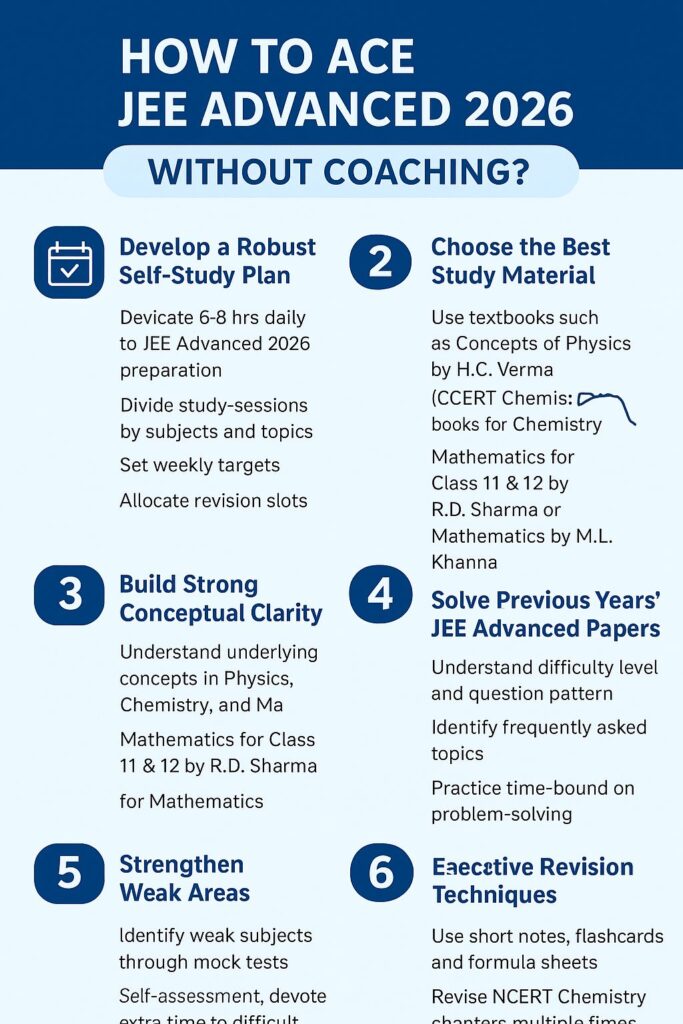
- Daily Routine: Dedicate at least 6–8 hours daily to JEE Advanced 2026 preparation.
- Time Blocking: Divide study sessions by subjects and topics. Example: 2 hours for Physics, 2 hours for Chemistry, 2 hours for Mathematics.
- Weekly Targets: Complete 2–3 chapters per subject per week.
- Revision Slots: Allocate 1–2 hours for daily revision of previously studied chapters.
Pro Tip: Use productivity tools like Notion, Google Calendar, or Trello to track chapters, topics, and progress.
Step 2: Choose the Best Study Material
Selecting the right study material is critical when preparing without coaching.
Recommended Books
Physics:
- Concepts of Physics by H.C. Verma
- Fundamentals of Physics by Halliday, Resnick & Walker
- Problems in Physics by I.E. Irodov (for advanced problem-solving)
Chemistry:
- NCERT Chemistry (Class 11 & 12) – a must for Inorganic and Physical Chemistry
- Organic Chemistry by Morrison & Boyd
- Physical Chemistry by P. Bahadur
- Concise Inorganic Chemistry by J.D. Lee
Mathematics:
- Mathematics for Class 11 & 12 by R.D. Sharma
- IIT Mathematics by M.L. Khanna
- Problems in Calculus of One Variable by I.A. Maron
Tip: Focus on NCERT for Chemistry, especially for theoretical and factual topics, and use reference books for practice questions.
Step 3: Build Strong Conceptual Clarity
JEE Advanced 2026 is concept-driven. Students who focus on conceptual clarity score better than those who rely on memorization.
- Start with basics: Understand underlying concepts in Physics, Chemistry, and Mathematics.
- Use multiple resources: Watch YouTube lectures, online courses (like NPTEL or Khan Academy), and digital PDFs.
- Solve examples step-by-step: Don’t rush. Master each concept before attempting complex problems.
Example: For Mechanics in Physics, understand Newton’s Laws thoroughly before attempting numerical problems.
Step 4: Solve Previous Years’ JEE Advanced Papers
Past papers are a goldmine for self-learners.
- Understand the difficulty level and question pattern.
- Identify frequently asked topics and recurring question types.
- Practice time-bound problem-solving to improve speed and accuracy.
Pro Tip: Maintain a mistake log. Note every question you get wrong and revisit the concept later. This ensures continuous improvement.
Step 5: Regular Mock Tests
Mock tests simulate the real exam environment.
- Take full-length timed tests weekly.
- Focus on time management, accuracy, and problem-solving speed.
- Analyze performance thoroughly: Identify strengths and weaknesses.
Recommended Online Resources: Embibe, Toppr, and official JEE Advanced mock tests.
Step 6: Strengthen Weak Areas
Self-study requires honest self-assessment.
- Identify weak subjects through mock tests and self-assessment.
- Devote extra time to difficult chapters and solve conceptual and numerical problems.
- Break large topics into smaller, manageable parts and practice consistently.
Example: If Electrostatics is weak in Physics, start with the basic formulas, then move to derivations, and finally attempt previous JEE Advanced questions.
Step 7: Effective Revision Techniques
Revision is critical for retention and scoring high in JEE Advanced 2026.
- Use short notes, flashcards, and formula sheets.
- Revise NCERT Chemistry chapters multiple times.
- Employ weekly, monthly, and pre-exam revisions to consolidate knowledge.
Pro Tip: Focus more on high-weightage chapters and weak areas during final revisions.
Step 8: Manage Time Efficiently
Time management is one of the biggest differentiators between top scorers and average students.
- Daily Routine: 6–8 hours of focused study
- Breaks: 10–15 minute breaks after 2 hours
- Weekly Goals: Finish 2–3 chapters per subject
- Monthly Milestones: Solve at least 2–3 full-length JEE Advanced papers
Step 9: Use Technology and Online Resources
- YouTube Channels: Physics Wallah, Vedantu, Unacademy
- Apps: Toppr, Embibe, BYJU’s free resources
- Discussion Forums: Quora, Reddit, Telegram JEE Advanced groups
Pro Tip: Avoid distractions like social media during study hours. Use focus apps like Forest to stay productive.
Step 10: Develop Mental Toughness
Preparation without coaching can feel isolating, so staying motivated is crucial.
- Set achievable goals
- Celebrate small milestones
- Avoid comparing with peers
- Practice meditation, light exercise, and hobbies to stay balanced
Tip: Positive mindset and confidence are as important as knowledge in JEE Advanced 2026.
Step 11: Exam Day Strategy
- Start with familiar topics
- Prioritize accuracy over attempts
- Allocate time wisely; avoid spending too long on a single problem
- Stay calm and confident
Step 12: Key Chapters to Focus On
Physics: Mechanics, Electricity & Magnetism, Optics, Modern Physics
Chemistry: Physical Chemistry (Thermodynamics, Equilibrium), Organic Chemistry (Reactions, Mechanisms), Inorganic Chemistry (Periodic Table, Coordination Compounds)
Mathematics: Calculus, Algebra, Coordinate Geometry, Probability & Vectors
Step 13: Advantages of Self-Study
- Flexible schedule
- Cost-effective
- Strong conceptual understanding
- Builds self-discipline
- Encourages problem-solving independence
Step 14: Common Mistakes to Avoid
- Ignoring NCERT books
- Over-reliance on shortcuts
- Skipping revisions
- Avoiding mock tests
- Ignoring weak topics
Avoiding these mistakes drastically improves chances of cracking JEE Advanced 2026.
Step 15: Advanced Tips for JEE Advanced 2026
- Prioritize high-yield chapters: Focus on topics with repeated questions.
- Time-bound problem solving: Practice solving questions faster without compromising accuracy.
- Analytical practice: Focus on reasoning-based questions to boost score.
- Group study occasionally: Discuss tough concepts with peers online to reinforce learning.
16: Final Words
Cracking JEE Advanced 2026 without coaching is challenging but absolutely achievable. With dedication, structured self-study, smart resource selection, consistent practice, and proper revision, self-learners can outperform many coaching students.
Remember: Consistency beats intensity. Small daily improvements accumulate into huge results on exam day.
Get Your Free PDF Guide!
Welcome to our blog! We have prepared an exclusive PDF guide that you can download to enhance your knowledge. Click the button below to instantly download the PDF and start learning today.
17. How to Ace JEE Advanced 2026 Without Coaching
Cracking JEE Advanced 2026 without coaching is entirely possible with the right strategy, self-discipline, and resources. Many toppers have proven that self-study, when planned strategically, can outperform formal coaching. Here’s how you can ace JEE Advanced 2026 without coaching:
1. Understand the Exam Pattern
The JEE Advanced 2026 consists of two papers, each with multiple sections covering Physics, Chemistry, and Mathematics. Understanding the exam pattern and weightage of topics is crucial to prepare efficiently.
2. Use Standard Reference Books
Instead of relying on coaching notes, focus on high-quality books:
- Physics: H.C. Verma, D.C. Pandey
- Chemistry: O.P. Tandon, J.D. Lee (for Organic Chemistry)
- Mathematics: R.D. Sharma, Arihant series
3. Make a Timetable and Stick to It
Self-study requires a daily study schedule. Dedicate at least 6-8 hours daily and divide your time between learning concepts, practicing problems, and revising.
4. Solve Previous Year Papers
Practicing previous years’ JEE Advanced papers helps understand question patterns and difficulty levels. Make a habit of timed mock tests to improve speed and accuracy.
5. Join Online Resources
Platforms like BYJU’S, Unacademy, Vedantu, and Toppr provide online coaching for free or at low cost. You can also join Quora discussions or Reddit JEE forums to clarify doubts and get tips from toppers.
6. Focus on Conceptual Understanding
Cracking JEE Advanced 2026 is not about rote learning but mastering concepts. Use visualizations, simulations, and practical examples to strengthen your understanding.
7. Regular Revision
Revision is key. Maintain formula sheets, short notes, and flashcards for last-minute preparation.
How to Ace JEE Advanced 2026 PDF
Many students search for “How to Ace JEE Advanced 2026 PDF” to get structured guides. You can create a personalized PDF including:
- Exam strategy for Physics, Chemistry, and Mathematics
- Daily and weekly timetables
- List of important topics and high-weightage chapters
- Previous year solved question papers
Downloadable PDFs from trusted sources provide a comprehensive roadmap for self-study. Always ensure PDFs are from reliable websites to avoid outdated information.
How to Ace JEE Advanced 2026 Quora
Quora is a great platform to learn from students who have previously cracked JEE Advanced without coaching. Some tips from Quora discussions include:
- Self-study is more effective with consistent problem-solving.
- Focus on conceptual clarity rather than memorization.
- Take frequent mock tests to simulate real exam conditions.
- Engage in peer discussions online to clear doubts.
Following Quora insights can supplement your personalized study plan.
How to Ace JEE Advanced 2026 Online
Online preparation is increasingly popular for JEE aspirants. To ace JEE Advanced 2026 online:
- Use platforms like NPTEL, Khan Academy, and Embibe.
- Watch video lectures for tricky topics like Mechanics in Physics or Organic Chemistry.
- Join live problem-solving sessions and webinars.
- Participate in online mock tests and quizzes to track your progress.
Online preparation gives flexibility, access to quality resources, and the chance to interact with experts worldwide.
JEE Advanced Syllabus 2026
The JEE Advanced 2026 syllabus includes topics from Physics, Chemistry, and Mathematics. While the detailed syllabus is available officially, here’s a brief overview:
Physics
- Mechanics (Kinematics, Laws of Motion, Work & Energy)
- Electricity & Magnetism
- Modern Physics
- Thermodynamics
Chemistry
- Physical Chemistry: Mole concept, Chemical Kinetics
- Organic Chemistry: Hydrocarbons, Alcohols, Amines
- Inorganic Chemistry: Periodic Table, Chemical Bonding
Mathematics
- Algebra (Complex Numbers, Quadratic Equations)
- Calculus (Differentiation & Integration)
- Coordinate Geometry
- Probability & Vectors
JEE Advanced Syllabus 2026 PDF Download
A PDF of the JEE Advanced 2026 syllabus helps students:
- Keep all topics in one document
- Mark important chapters for revision
- Track progress topic-wise
You can download the official JEE Advanced 2026 syllabus PDF from the official JEE Advanced website.
JEE Advanced Syllabus 2027
Although the official JEE Advanced 2027 syllabus is not released yet, it is expected to be similar to the 2026 syllabus. Students preparing early can start with the 2026 syllabus and update once the 2027 syllabus is officially announced.
JEE Advanced Syllabus 2026 Official Website
The official website for JEE Advanced 2026 is jeeadv.ac.in. Here you can find:
- Detailed syllabus PDFs
- Registration and application forms
- Admit card updates
- Exam schedules and notifications
Always rely on the official website to avoid misinformation.
SEO-Friendly Tips in This Article:
- Keywords used: JEE Advanced 2026, JEE Advanced syllabus 2026, how to ace JEE Advanced 2026, JEE Advanced PDF, JEE Advanced official website
- Long-form content for authority
- Clear headings for search engine indexing
- Practical tips for aspirants
Frequently Asked Questions (FAQ) About JEE Advanced 2026
- Can I crack JEE Advanced 2026 without coaching?
Yes, with proper planning, self-discipline, and focused preparation. Many toppers have achieved success through self-study. - Which books are best for JEE Advanced 2026 self-study?
H.C. Verma (Physics), NCERT (Chemistry), R.D. Sharma & M.L. Khanna (Mathematics), Morrison & Boyd (Organic Chemistry). - How many hours should I study daily?
6–8 hours of focused study, including problem-solving and revision. - Is NCERT enough for Chemistry?
Yes, for conceptual clarity and most inorganic/physical topics, but reference books help in advanced problem-solving. - How should I start preparation?
Understand the syllabus, make a timetable, begin with basics, and gradually progress to advanced topics. - Are mock tests necessary?
Absolutely. They improve speed, accuracy, and help analyze strengths and weaknesses. - Which subject should I focus on more?
All subjects are important; however, focus extra time on weak areas. - How to revise effectively?
Use short notes, formula sheets, flashcards, and regular weekly/monthly revisions. - Are previous year papers important?
Yes, they provide insight into question patterns, difficulty, and recurring chapters. - Can I prepare in 1 year without coaching?
Yes, with dedication, structured planning, and consistent practice. - How to stay motivated during self-study?
Set small goals, celebrate milestones, avoid distractions, and maintain a positive mindset. - What is the exam day strategy?
Attempt familiar questions first, manage time wisely, and stay calm. - Which chapters have high weightage?
Physics: Mechanics, Electricity & Magnetism; Chemistry: Physical & Organic; Mathematics: Calculus & Algebra. - Are online resources reliable?
Yes, trusted platforms like Physics Wallah, Khan Academy, NPTEL, and official JEE Advanced mock tests are reliable. - Is self-study better than coaching?
Self-study is flexible, cost-effective, and promotes deeper understanding, but requires strong discipline. - How to handle difficult topics?
Break them into smaller parts, solve basic problems first, and gradually progress to advanced questions. - Can I improve my speed without coaching?
Yes, by regular timed practice and mock tests. - Should I study alone or with friends?
Mainly alone for focus, but occasional group discussions can help clarify concepts. - How important is physical and mental health?
Very important. Regular breaks, exercise, and meditation improve concentration and reduce stress. - How to maintain consistency?
Follow a strict timetable, track progress, and reward yourself for completing milestones.