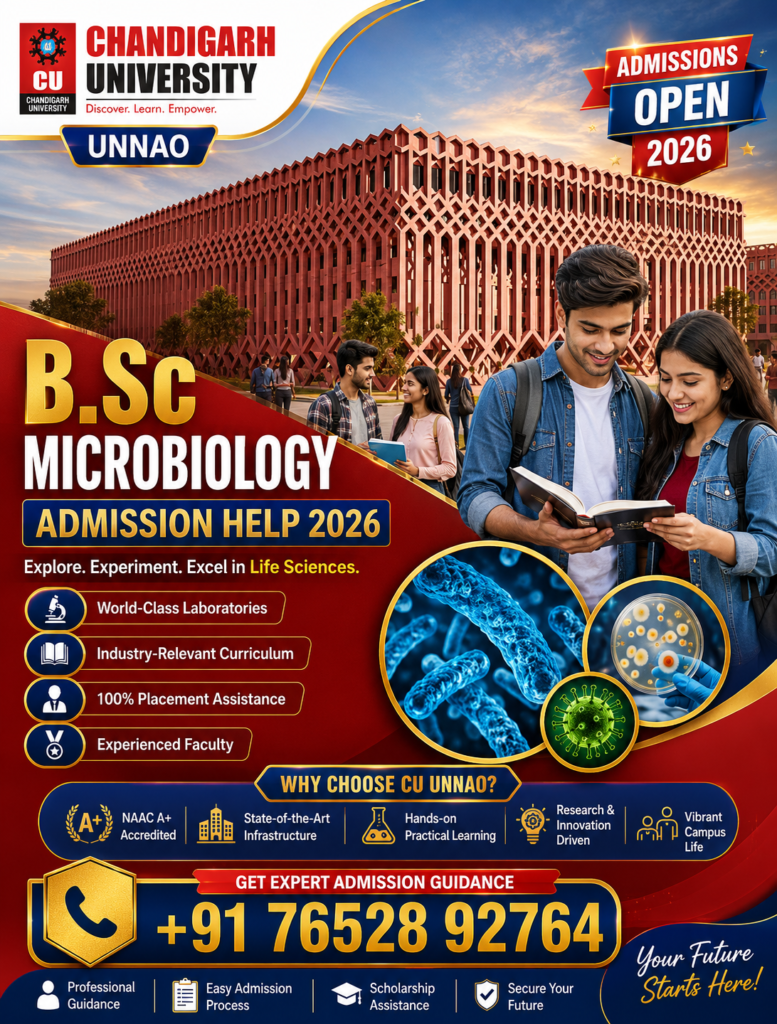
The healthcare, pharmaceutical, biotechnology, and food industries are expanding rapidly, creating a growing demand for skilled microbiologists. If you have an interest in biological sciences, laboratory research, disease diagnosis, and industrial biotechnology, B.Sc Microbiology CU Unnao Admission Help can guide you through every stage of the admission process.
The B.Sc Microbiology program at Chandigarh University Uttar Pradesh (CU Unnao) is designed to provide students with strong theoretical knowledge and practical laboratory skills in microbiology, molecular biology, immunology, genetics, and biotechnology. The curriculum focuses on understanding microorganisms and their applications in medicine, agriculture, pharmaceuticals, food processing, environmental science, and industrial research.
Registration Open Now!
Apply now & unlock exciting scholarship opportunities at Chandigarh University.
100% OFF Application Fee
Get your coupon code instantly and apply for CUCET 2026.
💬 Get Coupon
Get Up to 100% Scholarship on
Your Chosen Program.
your admission opportunity.
Why Choose B.Sc Microbiology at CU Unnao?
Microbiology has become one of the most promising life science disciplines due to increasing opportunities in healthcare, biotechnology, pharmaceuticals, diagnostics, food safety, and environmental research.
Students choosing this program benefit from:
- Industry-oriented curriculum
- Modern microbiology laboratories
- Practical-based learning
- Experienced faculty
- Research-oriented education
- Internship opportunities
- Skill development programs
- Career guidance and placement support
The course emphasizes laboratory work alongside classroom learning to help students develop scientific and analytical skills.
Course Highlights in B.Sc Microbiology
| Particular | Details |
|---|---|
| Course Name | B.Sc Microbiology |
| Duration | 3 Years (6 Semesters) |
| Course Type | Undergraduate |
| Mode | Full-Time |
| Eligibility | 10+2 with Science stream |
| Admission | Merit/University Admission Process |
| Scholarship | Merit-based scholarships available |
| Practical Training | Laboratory & Research Based |
Eligibility Criteria
Students seeking CU Unnao B.Sc Microbiology Admission 2026 should generally meet the following requirements:
- Pass Class 12 from a recognized board.
- Science background with Biology as a major subject.
- Physics and Chemistry in the qualifying examination as applicable.
- Meet the minimum percentage prescribed by the university.
Applicants should verify the latest eligibility requirements during the admission cycle, as they may be updated by the university.
Admission Process 2026
The admission process generally involves the following steps:
- Register online.
- Fill out the application form.
- Upload academic documents.
- Verify eligibility.
- Receive admission confirmation.
- Pay the admission fee.
- Complete document verification.
- Report to campus for enrollment.
Students are encouraged to apply early to improve their chances of securing admission and scholarship consideration.
Subjects Covered
The curriculum introduces students to both fundamental and advanced concepts in microbiology.
Major subjects include:
- General Microbiology
- Cell Biology
- Microbial Genetics
- Immunology
- Biochemistry
- Molecular Biology
- Medical Microbiology
- Industrial Microbiology
- Food Microbiology
- Environmental Microbiology
- Virology
- Mycology
- Parasitology
- Biotechnology
- Bioinformatics
- Fermentation Technology
- Research Methodology
- Laboratory Techniques
The program combines theory with extensive laboratory sessions.
Practical Learning
One of the biggest strengths of the program is hands-on laboratory experience.
Students gain practical exposure through:
- Microbiology Laboratory
- Molecular Biology Lab
- Biotechnology Lab
- Cell Culture Techniques
- DNA Isolation
- Microbial Identification
- Culture Techniques
- Industrial Visits
- Mini Research Projects
- Scientific Workshops
These activities help students become familiar with modern laboratory practices and research methods.
Skills Developed
During the course, students learn:
- Laboratory Skills
- Scientific Research
- Sample Analysis
- Microbial Identification
- Data Interpretation
- Molecular Techniques
- Analytical Thinking
- Problem Solving
- Communication Skills
- Teamwork
- Scientific Writing
These skills prepare graduates for higher studies as well as industry roles.
Career Opportunities
After completing B.Sc Microbiology, graduates can work in diverse sectors such as healthcare, pharmaceuticals, biotechnology, food processing, agriculture, environmental science, and research.
Popular job profiles include:
- Microbiologist
- Research Assistant
- Laboratory Technician
- Quality Control Analyst
- Food Safety Officer
- Medical Laboratory Executive
- Pharmaceutical Executive
- Biotechnology Associate
- Clinical Research Assistant
- Environmental Microbiologist
- Production Executive
- Research Scientist (after higher studies)
The demand for microbiologists is increasing due to advancements in biotechnology, diagnostics, vaccines, and pharmaceutical research.
Higher Education Options
Students can pursue:
- M.Sc Microbiology
- M.Sc Biotechnology
- M.Sc Molecular Biology
- M.Sc Medical Microbiology
- MBA Healthcare Management
- MSc Clinical Research
- Ph.D. in Life Sciences
- Research Fellowships
- International Master’s Programs
Higher education can open opportunities in research institutions, universities, pharmaceutical companies, and biotechnology firms.
Scholarship Opportunities
Eligible students may receive scholarships based on academic merit and university policies. Scholarship availability, eligibility criteria, and benefits are announced during the admission process and may vary from year to year.
Why Choose CollegeKampus Admission Help?
CollegeKampus provides complete admission support by offering:
- Free career counselling
- Admission guidance
- University selection assistance
- Scholarship information
- Documentation support
- Application assistance
- Admission updates
- Personalized counselling
- Post-admission support
FAQs
1. What is the duration of the B.Sc Microbiology program at CU Unnao?
The program is generally completed in 3 years (6 semesters).
2. Who is eligible for B.Sc Microbiology admission?
Students who have completed 10+2 in the Science stream, typically with Biology and other required science subjects, can apply, subject to the university’s eligibility criteria.
3. Is practical training included in the course?
Yes, the curriculum includes extensive laboratory work, research projects, and practical sessions.
4. What are the career opportunities after B.Sc Microbiology?
Graduates can work as microbiologists, research assistants, quality analysts, laboratory technicians, biotechnology associates, and food safety professionals.
5. Can I pursue higher studies after B.Sc Microbiology?
Yes. Popular options include M.Sc Microbiology, Biotechnology, Molecular Biology, Clinical Research, and Ph.D. programs.
6. Does CU Unnao provide placement support?
The university offers placement assistance and career guidance to help eligible students connect with recruiters.
7. Is Microbiology a good career option in 2026?
Yes. Growth in pharmaceuticals, diagnostics, biotechnology, food safety, and healthcare has increased the demand for trained microbiology professionals.
8. How can CollegeKampus help with admission?
CollegeKampus provides counselling, application support, scholarship guidance, document verification assistance, and end-to-end admission help for CU Unnao aspirants.
CU Unnao B.Sc Microbiology Admission 2026 is an excellent opportunity for students who aspire to build a career in life sciences, biotechnology, healthcare, pharmaceuticals, and scientific research. The B.Sc Microbiology program at Chandigarh University Uttar Pradesh (CU Unnao) is designed to provide students with a strong foundation in microbiology while developing practical laboratory skills, research aptitude, and industry-relevant knowledge. The curriculum combines classroom learning with hands-on experiments, enabling students to understand microorganisms and their applications in medicine, agriculture, food technology, environmental science, and biotechnology. This interdisciplinary approach prepares graduates for careers in both industry and higher education.
The three-year undergraduate program is ideal for students who have completed their 10+2 education in the Science stream and are interested in studying bacteria, viruses, fungi, algae, protozoa, and other microorganisms. During the course, students gain knowledge about microbial physiology, genetics, molecular biology, immunology, biochemistry, environmental microbiology, industrial microbiology, and biotechnology. Along with theoretical concepts, significant emphasis is placed on laboratory-based learning, allowing students to perform microbial culture techniques, staining methods, biochemical testing, DNA isolation, microbial identification, and modern diagnostic procedures. This practical exposure helps students develop the analytical and technical skills required by healthcare and biotechnology industries.
The admission process for CU Unnao B.Sc Microbiology Admission 2026 is simple and student-friendly. Interested candidates must complete the online registration process, fill out the application form with accurate academic details, upload the necessary documents, and submit the application before the deadline. After verification of eligibility and academic records, shortlisted candidates receive admission offers based on the university’s admission policy. Students should apply as early as possible to improve their chances of securing admission and becoming eligible for available merit-based scholarships. Since admission schedules and seat availability may change each academic session, applicants are advised to regularly check official university announcements.
To be eligible for admission, candidates should have passed Class 12 from a recognized board with a Science background. Students who have studied Biology along with relevant science subjects such as Physics and Chemistry are generally eligible to apply, subject to the university’s prescribed admission requirements. Applicants should also ensure they meet the minimum qualifying marks specified by the university for the 2026 admission cycle. Before applying, students are encouraged to verify the latest eligibility criteria and admission guidelines published by the university.
One of the key strengths of the B.Sc Microbiology program at CU Unnao is its modern curriculum, which aligns with current industry requirements. Throughout the course, students study subjects such as Cell Biology, General Microbiology, Medical Microbiology, Industrial Microbiology, Molecular Biology, Microbial Genetics, Immunology, Virology, Mycology, Food Microbiology, Environmental Microbiology, Biotechnology, Bioinformatics, Fermentation Technology, and Research Methodology. These subjects provide comprehensive knowledge of microorganisms and their applications in healthcare, pharmaceuticals, agriculture, environmental management, and industrial production. Practical laboratory sessions complement classroom teaching, ensuring students develop confidence in handling scientific equipment and conducting microbiological experiments.
Practical learning is an essential component of the program. Students receive training in microbiology laboratories equipped with modern instruments used for microbial culture, microscopy, molecular analysis, and biochemical testing. Laboratory work includes microbial isolation, staining techniques, culture preparation, antibiotic sensitivity testing, fermentation experiments, DNA extraction, and microbial identification. Students also participate in workshops, industrial visits, seminars, research projects, and internship opportunities that enhance their technical expertise and improve their employability. This hands-on approach enables graduates to adapt quickly to professional laboratory environments and research organizations.
The program also focuses on developing professional skills that are highly valued by employers. Students improve their laboratory techniques, analytical thinking, scientific writing, research methodology, data interpretation, communication skills, teamwork, and problem-solving abilities. These competencies are essential for careers in pharmaceutical companies, biotechnology firms, diagnostic laboratories, hospitals, food processing industries, environmental agencies, agricultural research organizations, and quality assurance laboratories.
Career opportunities after completing CU Unnao B.Sc Microbiology Admission 2026 are diverse and continue to expand due to the rapid growth of biotechnology, healthcare, pharmaceutical manufacturing, vaccine development, food safety, and environmental protection sectors. Graduates can work as Microbiologists, Laboratory Technicians, Research Assistants, Quality Control Analysts, Food Safety Officers, Clinical Laboratory Executives, Pharmaceutical Production Executives, Biotechnology Associates, Environmental Microbiologists, and Research Scientists. Many students also choose to pursue higher education such as M.Sc. Microbiology, Biotechnology, Molecular Biology, Clinical Research, Public Health, or Ph.D. programs to specialize further and enhance their career prospects.
Scholarship opportunities are available for deserving students based on academic performance and university policies. Merit-based scholarships help reduce the financial burden of higher education and encourage talented students to pursue careers in life sciences. Students should review the scholarship criteria, required documents, and application deadlines during the admission process to maximize their chances of receiving financial assistance.
Students choosing CU Unnao B.Sc Microbiology Admission 2026 benefit from an academic environment that promotes innovation, research, practical learning, and industry interaction. With experienced faculty members, well-equipped laboratories, research-oriented education, and career-focused training, the university aims to prepare graduates who can contribute effectively to healthcare, biotechnology, pharmaceuticals, food safety, agriculture, and scientific research. As the demand for microbiology professionals continues to rise across India and globally, pursuing this program offers excellent opportunities for long-term career growth, higher education, and professional success.
Conclusion
If you are passionate about biology, laboratory research, healthcare, and scientific innovation, B.Sc Microbiology CU Unnao Admission Help 2026 can help you begin your journey toward a rewarding career. The program provides a strong academic foundation, practical laboratory training, and exposure to modern microbiological techniques that are highly valued across healthcare, biotechnology, pharmaceutical, and research industries. With increasing demand for skilled microbiologists in India and abroad, this course offers excellent opportunities for higher education and professional growth.