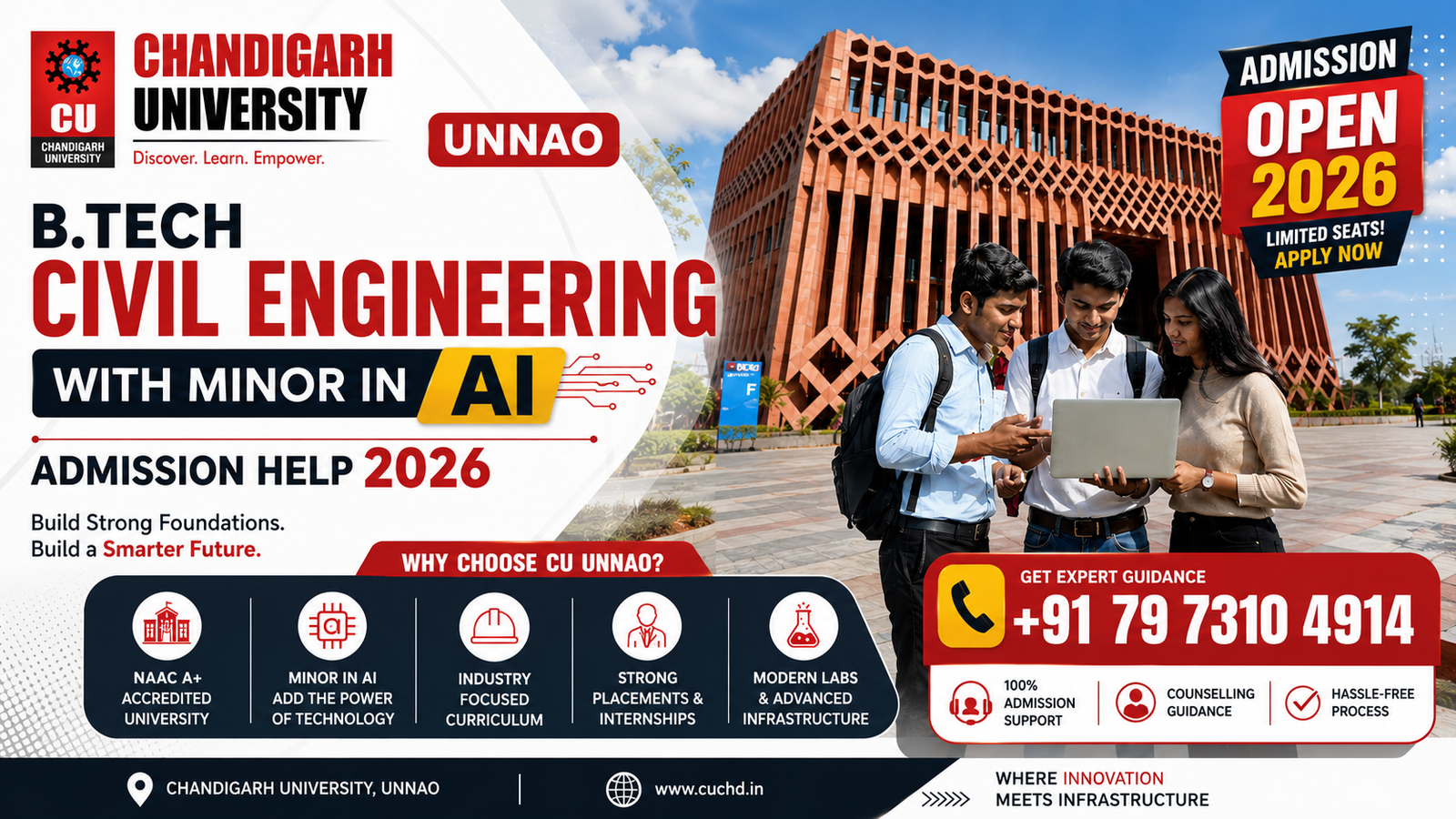
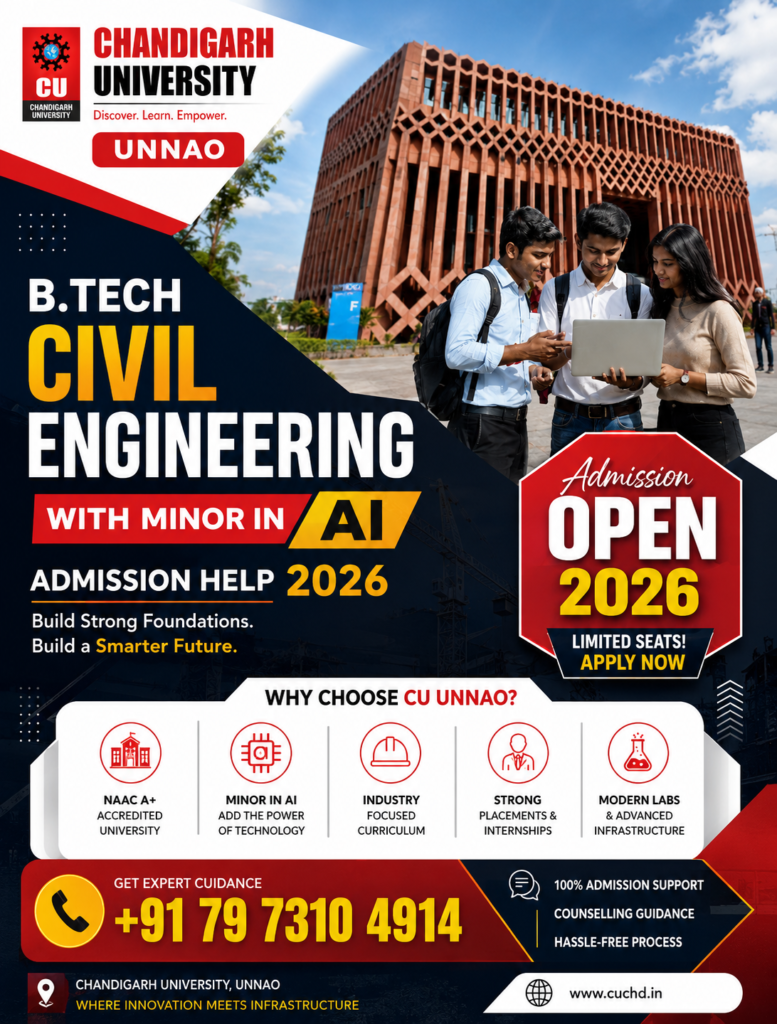
The construction and infrastructure industry is rapidly embracing Artificial Intelligence (AI), automation, digital twins, Building Information Modeling (BIM), drones, and predictive analytics. To prepare engineers for this technological shift, Chandigarh University, Uttar Pradesh (CU Unnao) offers a B.Tech Civil Engineering program with a Minor in AI, combining traditional civil engineering with modern AI applications. The university highlights AI-integrated learning across engineering disciplines, including Civil Engineering, to prepare graduates for smart infrastructure and digital construction.
If you are looking for B.Tech Civil Engineering with Minor in AI CU Unnao Admission Help, this guide covers eligibility, admission process, curriculum, career scope, placements, scholarships, and frequently asked questions.

Registration Open Now!
Apply now & unlock exciting scholarship opportunities at Chandigarh University.
100% OFF Application Fee
Get your coupon code instantly and apply for CUCET 2026.
💬 Get Coupon
Get Up to 100% Scholarship on
Your Chosen Program.
your admission opportunity.
About the B.Tech Civil Engineering
The B.Tech Civil Engineering with Minor in AI program is a four-year undergraduate degree that blends the core principles of civil engineering with emerging Artificial Intelligence technologies. Students learn structural engineering, transportation engineering, environmental engineering, surveying, and construction management while also gaining exposure to AI-driven tools for infrastructure planning, predictive maintenance, and smart city development. The university emphasizes AI-enabled education and modern laboratories to support industry-ready learning.
Why Choose Civil Engineering with Minor in AI?
The construction industry is becoming more data-driven than ever before. AI helps engineers improve project planning, optimize resources, monitor construction sites, detect structural defects, and enhance safety.
By pursuing this program, students develop expertise in:
- Smart Infrastructure
- Artificial Intelligence
- Machine Learning Basics
- Building Information Modeling (BIM)
- Construction Automation
- Drone Technology
- IoT for Smart Cities
- Data Analytics
- Sustainable Infrastructure
- Digital Construction Management
B.Tech Civil Engineering Highlights
| Particular | Details |
|---|---|
| Course Name | B.Tech Civil Engineering with Minor in AI |
| Duration | 4 Years |
| Level | Undergraduate |
| Mode | Full-Time |
| Admission Session | 2026 |
| Minor Specialization | Artificial Intelligence |
| Learning Method | Theory + Labs + Industry Projects |
| Internship | Available |
| Placement Support | Yes |
Eligibility Criteria of B.Tech Civil Engineering
Students applying for B.Tech Civil Engineering with Minor in AI CU Unnao Admission Help generally need to fulfill the following eligibility requirements:
- Pass 10+2 from a recognized board.
- Physics and Mathematics as compulsory subjects.
- Chemistry, Computer Science, Biotechnology, Biology, or a related subject as per university norms.
- Meet the minimum qualifying marks prescribed by the university.
- Admission may be based on the university’s entrance process or other accepted criteria.
Admission Process of B.Tech Civil Engineering 2026
The admission process generally includes:
- Online registration.
- Fill out the application form.
- Upload academic documents.
- Document verification.
- Merit or entrance evaluation.
- Fee payment.
- Final admission confirmation.
Candidates are advised to complete the admission process before the application deadline announced by the university.
Curriculum of B.Tech Civil Engineering
Students study both core Civil Engineering subjects and AI-related modules.
Core Civil Engineering Subjects
- Engineering Mechanics
- Structural Analysis
- Strength of Materials
- Geotechnical Engineering
- Transportation Engineering
- Surveying
- Fluid Mechanics
- Concrete Technology
- Environmental Engineering
- Construction Management
AI Minor Subjects
- Introduction to Artificial Intelligence
- Machine Learning Fundamentals
- Data Analytics
- Python Programming
- Computer Vision Basics
- IoT Applications
- Smart Infrastructure Analytics
- Predictive Maintenance
- Intelligent Transportation Systems
Practical Learning in B.Tech Civil Engineering
Students receive practical exposure through:
- Civil Engineering Laboratories
- AI-enabled Software Training
- Site Visits
- Industrial Internships
- Research Projects
- Smart Infrastructure Case Studies
- Capstone Projects
- Technical Workshops
The university promotes hands-on learning using simulation tools and AI-enabled engineering practices.
Career Opportunities
Graduates can pursue careers as:
- Civil Engineer
- Structural Engineer
- Construction Project Engineer
- Smart City Engineer
- BIM Engineer
- Infrastructure Analyst
- Transportation Engineer
- AI-enabled Construction Consultant
- Project Planning Engineer
- Urban Infrastructure Specialist
Professionals with AI knowledge are increasingly valuable for infrastructure planning, structural health monitoring, predictive maintenance, and digital construction. AI applications are becoming more prominent across civil engineering domains.
Placement Support
CU Unnao provides career support through:
- Placement Training
- Technical Workshops
- Resume Building
- Soft Skills Development
- Aptitude Preparation
- Mock Interviews
- Internship Opportunities
- Campus Recruitment Drives
Scholarship Opportunities
Eligible students may benefit from:
- Merit-Based Scholarships
- Entrance Test Scholarships
- Academic Excellence Awards
- Special Category Scholarships
Scholarship availability depends on the university’s admission policies for the 2026 academic session.
Documents Required
Applicants should keep the following documents ready:
- Class 10 Marksheet
- Class 12 Marksheet
- Passport-size Photographs
- Aadhaar Card
- Signature
- Category Certificate (if applicable)
- Transfer Certificate
- Migration Certificate
Why Choose CU Unnao?
Students choose CU Unnao because it offers:
- AI-integrated engineering education
- Industry-oriented curriculum
- Modern laboratories
- Experienced faculty
- Practical project-based learning
- Internship opportunities
- Research and innovation ecosystem
- Placement assistance
- Future-ready skill development
The university positions itself as an AI-augmented multidisciplinary institution with a focus on preparing graduates for technology-driven industries
Frequently Asked Questions (FAQs)
1. What is the duration of the B.Tech Civil Engineering with Minor in AI program?
The program is 4 years long and consists of 8 semesters.
2. Who can apply for this course?
Students who have completed 10+2 with Physics and Mathematics and meet the university’s eligibility criteria can apply.
3. What is the benefit of a Minor in AI?
A Minor in AI equips civil engineering students with skills in data analytics, automation, and intelligent infrastructure, improving career prospects.
4. Does the program include internships?
Yes, students are encouraged to participate in internships, industrial training, and live projects.
5. What are the career opportunities after graduation?
Graduates can work as Civil Engineers, Structural Engineers, BIM Engineers, Smart City Engineers, Construction Consultants, Infrastructure Analysts, and Project Engineers.
6. Does CU Unnao provide placement assistance?
Yes, the university offers placement training, internship support, and campus recruitment assistance.
7. Are scholarships available?
Yes, eligible students may apply for merit-based and other scholarship schemes offered by the university.
8. What AI technologies are introduced in the program?
Students gain exposure to AI fundamentals, Python, machine learning basics, data analytics, IoT, and intelligent infrastructure applications.
9. Is practical learning included?
Yes, the curriculum includes laboratory sessions, site visits, software training, projects, and industry interaction.
10. Why choose B.Tech Civil Engineering with Minor in AI at CU Unnao?
The program combines core civil engineering with AI-enabled technologies, helping students prepare for careers in smart infrastructure, digital construction, and next-generation engineering practices.
Civil Engineering remains one of the most important engineering disciplines in India. From highways and bridges to airports, metro systems, smart cities, and sustainable buildings, civil engineers play a key role in national development. As infrastructure investments continue to grow, qualified civil engineers are in high demand across both public and private sectors.
The curriculum focuses on developing technical knowledge, analytical thinking, and practical engineering skills. Students gain a thorough understanding of infrastructure planning, structural design, construction techniques, and project management while learning to solve real-world engineering challenges.
Throughout the program, students study core subjects such as Engineering Mechanics, Building Materials, Surveying, Strength of Materials, Structural Analysis, Fluid Mechanics, Geotechnical Engineering, Transportation Engineering, Environmental Engineering, Concrete Technology, Steel Structures, Hydraulics, Construction Planning, and Project Management.
Practical learning is an integral part of the course. Students participate in laboratory experiments, surveying exercises, engineering drawing sessions, industrial visits, workshops, and live construction projects. These experiences help bridge the gap between classroom learning and industry practices.
The program also introduces students to modern engineering technologies widely used in the construction sector. Learners gain practical exposure to AutoCAD, STAAD Pro, Civil 3D, Building Information Modeling (BIM), GIS applications, project management software, and digital surveying tools. These technologies improve the accuracy, efficiency, and sustainability of construction projects.
In addition to technical education, the university emphasizes industry exposure. Students are encouraged to participate in internships, industrial training, technical seminars, certification programs, and engineering competitions. These opportunities help them understand current industry trends and develop professional skills before graduation.
Research and innovation are also encouraged throughout the program. Students can work on projects related to smart infrastructure, green buildings, earthquake-resistant structures, water resource management, transportation systems, and sustainable construction practices. Such projects enhance creativity and prepare students for future engineering challenges.
For CU Unnao B.Tech Civil Engineering Admission 2026, candidates must have completed 10+2 or an equivalent examination from a recognized board. Physics and Mathematics are compulsory subjects, while Chemistry, Computer Science, Biotechnology, or another approved subject may be accepted according to the university’s eligibility requirements. Applicants must also satisfy the minimum academic criteria prescribed for admission.
The admission process is straightforward and student-friendly. Candidates need to complete the online registration process, fill out the application form, upload the necessary documents, and submit their application. After document verification and eligibility assessment, selected candidates receive admission confirmation upon payment of the prescribed fee.
Graduates of the program have excellent career opportunities across multiple industries. They can work as Civil Engineers, Structural Engineers, Site Engineers, Construction Managers, Project Engineers, Transportation Engineers, Survey Engineers, Environmental Engineers, Geotechnical Engineers, and Urban Planning Consultants. Employment opportunities are available in construction companies, infrastructure firms, government organizations, real estate companies, and multinational engineering enterprises.
The university also provides dedicated placement support to help students begin successful careers. Placement activities include aptitude training, technical interview preparation, communication skills development, resume-building workshops, mock interviews, internship assistance, and campus recruitment drives. These initiatives improve employability and prepare students for competitive job markets.
Overall, CU Unnao B.Tech Civil Engineering Admission 2026 is an excellent choice for students seeking a future in infrastructure and construction engineering. With its industry-oriented curriculum, experienced faculty, modern laboratories, practical learning approach, research opportunities, and placement assistance, the program equips graduates with the knowledge and skills required to succeed in today’s rapidly evolving engineering industry.
Conclusion
The B.Tech Civil Engineering with Minor in AI CU Unnao Admission Help 2026 program is an excellent option for students who want to combine the strong fundamentals of civil engineering with emerging Artificial Intelligence technologies. Through AI-integrated learning, industry exposure, practical training, and placement support, the program prepares graduates to contribute to smart infrastructure, sustainable construction, and digitally transformed engineering projects. As AI continues to reshape the construction sector, this interdisciplinary degree provides a competitive advantage for future-ready engineers