JEE Advanced 2027: Comprehensive Guide – Eligibility, Exam Pattern, Syllabus, Preparation Strategy, Important Dates, Cut-Off & Admission Process
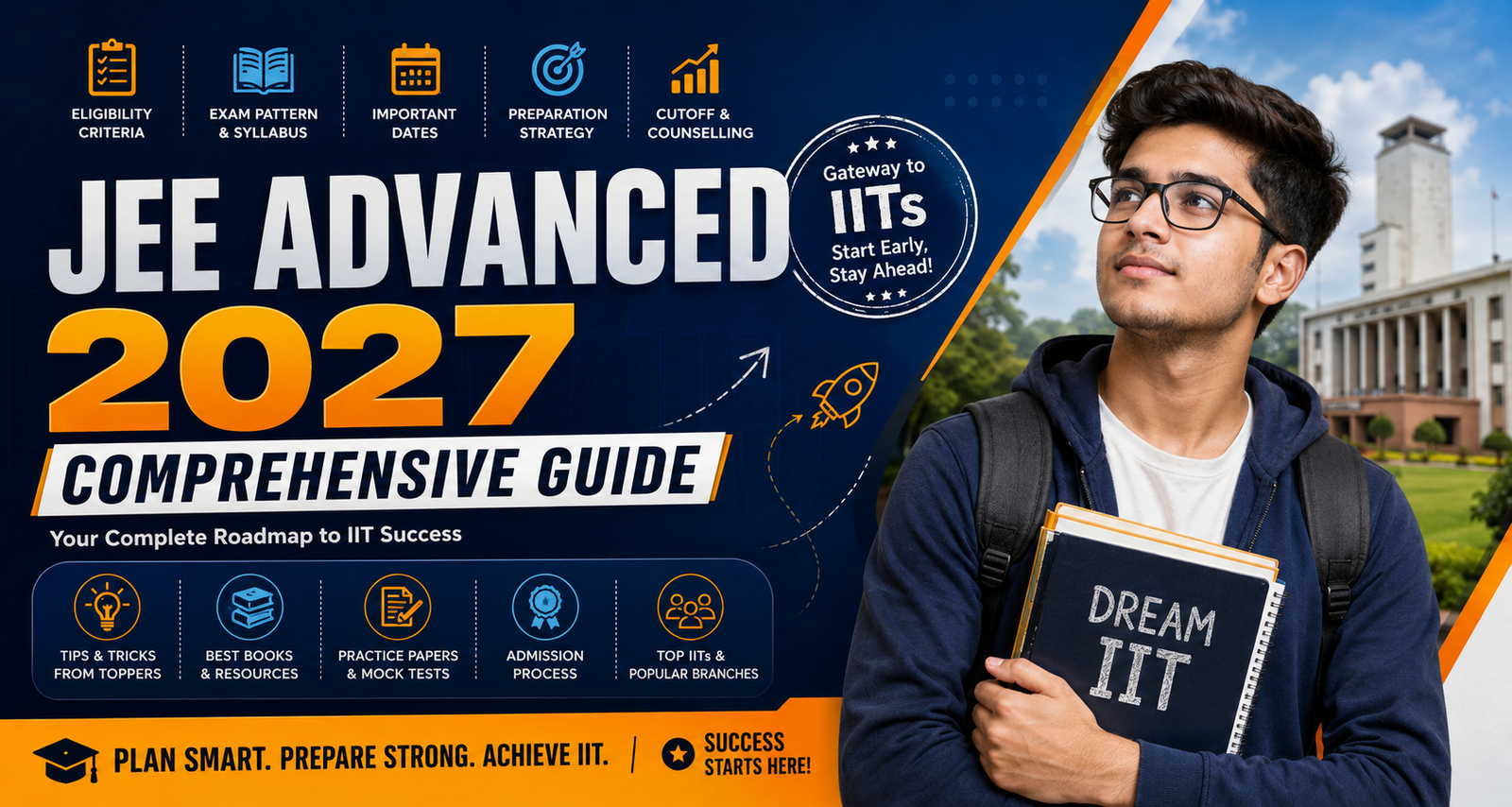
JEE Advanced 2027: The Complete Guide for IIT Aspirants
JEE Advanced 2027 is one of India’s most prestigious engineering entrance examinations. Every year, lakhs of students dream of securing admission to the Indian Institutes of Technology (IITs), but only those who qualify JEE Main and perform exceptionally well in JEE Advanced can achieve this goal. If your ambition is to study Computer Science, Artificial Intelligence, Mechanical Engineering, Electrical Engineering, Civil Engineering, or any other top engineering branch at an IIT, then understanding the complete admission process is essential.
This comprehensive guide covers everything you need to know about JEE Advanced 2027, including eligibility criteria, exam pattern, syllabus, important dates (expected), preparation strategy, counselling process, cut-off trends, top IITs, career opportunities, FAQs, and expert tips.
What is JEE Advanced 2027?
JEE Advanced is the national-level entrance examination conducted annually for admission into undergraduate engineering programs at the Indian Institutes of Technology (IITs). The examination is organized by one of the IITs under the guidance of the Joint Admission Board (JAB).
Only candidates who qualify JEE Main and rank among the eligible candidates can appear for JEE Advanced.
Admission through JEE Advanced is available for:
- B.Tech
- B.E.
- Dual Degree Programs
- Integrated M.Tech
- Integrated M.Sc
- Architecture Programs (Selected IITs)
Why is JEE Advanced Important?
JEE Advanced is the gateway to India’s premier engineering institutions.
Benefits include:
- Admission into IITs
- World-class faculty
- Excellent research facilities
- International exposure
- Outstanding placement opportunities
- High salary packages
- Strong alumni network
- Global recognition
Graduates from IITs work in leading companies such as:
- Microsoft
- Apple
- Amazon
- Meta
- Goldman Sachs
- Tata Consultancy Services
- Qualcomm
- NVIDIA
- Intel
JEE Advanced 2027 Highlights
| Particular | Details |
|---|---|
| Exam Name | JEE Advanced 2027 |
| Conducting Body | IIT (To be announced) |
| Exam Level | National |
| Mode of Examination | Computer-Based Test |
| Papers | Paper 1 & Paper 2 |
| Duration | 3 Hours Each Paper |
| Subjects | Physics, Chemistry, Mathematics |
| Language | English & Hindi |
| Admission | IITs |
Expected Important Dates for JEE Advanced 2027
| Event | Expected Date |
| JEE Main Session 1 | January 2027 |
| JEE Main Session 2 | April 2027 |
| JEE Advanced Registration | April/May 2027 |
| Admit Card Release | May 2027 |
| JEE Advanced Exam | May 2027 |
| Answer Key | June 2027 |
| Result Declaration | June 2027 |
| JoSAA Counselling | June 2027 |
Dates are tentative and subject to official announcements.
JEE Advanced 2027 Eligibility Criteria
Candidates must satisfy the following eligibility requirements:
1. JEE Main Qualification
Candidates should qualify JEE Main 2027 and rank among the eligible candidates notified for JEE Advanced.
2. Age Limit
Expected age criteria will be announced in the official notification.
3. Number of Attempts
Candidates are generally allowed limited attempts in consecutive years, subject to official rules.
4. Class 12 Qualification
Candidates must have passed Class 12 (or equivalent) with Physics, Chemistry, and Mathematics from a recognized board.
JEE Advanced 2027 Exam Pattern
The examination consists of two compulsory papers.
Paper 1
- Physics
- Chemistry
- Mathematics
Paper 2
- Physics
- Chemistry
- Mathematics
Both papers must be attempted.
Question types may include:
- Multiple Choice Questions
- Numerical Value Questions
- Multiple Correct Answers
- Match the Following
- Integer Type Questions
Negative marking may apply to certain questions.
JEE Advanced 2027 Syllabus
The syllabus focuses on conceptual understanding and problem-solving.
Physics
- Mechanics
- Rotational Motion
- Gravitation
- Oscillations
- Waves
- Thermodynamics
- Electrostatics
- Current Electricity
- Magnetism
- Electromagnetic Induction
- Optics
- Modern Physics
Chemistry
Physical Chemistry
- Mole Concept
- Atomic Structure
- Chemical Equilibrium
- Ionic Equilibrium
- Electrochemistry
- Thermodynamics
- Chemical Kinetics
Organic Chemistry
- General Organic Chemistry
- Hydrocarbons
- Alcohols
- Aldehydes
- Ketones
- Amines
- Biomolecules
Inorganic Chemistry
- Periodic Table
- Chemical Bonding
- Coordination Compounds
- p-Block Elements
- d-Block Elements
- Metallurgy
Mathematics
- Algebra
- Trigonometry
- Coordinate Geometry
- Calculus
- Probability
- Vectors
- Three-Dimensional Geometry
- Matrices
- Determinants
- Differential Equations
Best Books for JEE Advanced 2027
Physics
- Concepts of Physics by H.C. Verma
- Problems in General Physics by I.E. Irodov
- D.C. Pandey Series
Chemistry
- NCERT Chemistry
- O.P. Tandon
- Morrison & Boyd (Organic)
- J.D. Lee (Inorganic)
Mathematics
- Cengage Mathematics
- Arihant Series
- R.D. Sharma
- M.L. Khanna
JEE Advanced 2027 Preparation Strategy
1. Understand the Syllabus
Study every topic thoroughly before solving advanced-level questions.
2. Strengthen NCERT Concepts
NCERT forms the base for Chemistry and fundamental concepts.
3. Create a Timetable
Allocate dedicated hours to each subject every day.
4. Solve Previous Year Papers
Practice at least the last 10 years’ papers to understand the exam pattern and difficulty level.
5. Take Mock Tests
Attempt full-length mock tests regularly to improve accuracy and time management.
6. Analyze Mistakes
Review incorrect answers and revise weak topics consistently.
7. Focus on Conceptual Learning
JEE Advanced emphasizes application-based questions rather than rote memorization.
8. Revise Regularly
Prepare concise notes and revise them weekly.
Time Management Tips
- Study 6–8 hours daily with focused sessions.
- Allocate extra time to weak subjects.
- Maintain a revision schedule.
- Practice under timed conditions.
- Avoid unnecessary distractions.
Subject-wise Preparation Tips
Physics
- Focus on concepts.
- Solve numerical problems daily.
- Strengthen mechanics and electromagnetism.
Chemistry
- Revise NCERT regularly.
- Memorize important reactions.
- Practice physical chemistry calculations.
Mathematics
- Practice calculus daily.
- Improve speed through regular problem-solving.
- Learn shortcut methods where applicable.
Common Mistakes to Avoid
- Ignoring NCERT
- Skipping revision
- Avoiding mock tests
- Poor time management
- Focusing only on favorite subjects
- Not analyzing mistakes
- Overlooking previous years’ papers
JEE Advanced 2027 Expected Cut-Off
The cut-off varies each year depending on factors such as:
- Difficulty level
- Number of candidates
- Seat availability
- Overall performance
Higher scores generally improve the chances of securing admission to preferred IITs and branches.
JoSAA Counselling Process
After qualifying JEE Advanced:
- Register for JoSAA Counselling.
- Fill in preferred IITs and branches.
- Lock choices.
- Seat allotment based on rank and preferences.
- Document verification.
- Fee payment.
- Reporting to the allotted institute.
Top IITs Accepting JEE Advanced 2027 Scores
Some of the leading IITs include:
- IIT Bombay
- IIT Delhi
- IIT Madras
- IIT Kanpur
- IIT Kharagpur
- IIT Roorkee
- IIT Guwahati
- IIT Hyderabad
- IIT Indore
- IIT BHU
- IIT Gandhinagar
- IIT Mandi
- IIT Ropar
- IIT Jodhpur
- IIT Patna
- IIT Bhubaneswar
- IIT Tirupati
- IIT Palakkad
- IIT Goa
- IIT Jammu
- IIT Dharwad
Popular Branches in IITs
- Computer Science Engineering
- Artificial Intelligence
- Data Science
- Electronics and Communication Engineering
- Electrical Engineering
- Mechanical Engineering
- Civil Engineering
- Aerospace Engineering
- Chemical Engineering
- Biotechnology
- Engineering Physics
- Mathematics and Computing
Career Opportunities After IIT
Graduates from IITs have diverse career paths, including:
- Software Development
- Artificial Intelligence
- Machine Learning
- Data Science
- Robotics
- Research and Development
- Civil Services
- Entrepreneurship
- Higher Studies (M.Tech, MBA, MS, PhD)
Top recruiters include multinational corporations, startups, consulting firms, and research organizations.
Frequently Asked Questions (FAQs)
Is JEE Advanced tougher than JEE Main?
Yes. JEE Advanced is generally considered more challenging due to its emphasis on analytical thinking and multi-concept problem-solving.
Can I appear directly for JEE Advanced?
No. You must first qualify JEE Main and meet the eligibility criteria announced for JEE Advanced.
Is NCERT enough?
NCERT is essential, especially for Chemistry, but additional advanced-level practice is necessary for Physics and Mathematics.
Are both papers compulsory?
Yes. Candidates are required to appear for both Paper 1 and Paper 2.
How many months are enough for preparation?
A preparation period of 1–2 years with consistent study and practice is commonly recommended for strong performance.
Final Thoughts
JEE Advanced 2027 is more than an entrance examination—it is a gateway to some of the finest engineering education and career opportunities in India. Success requires discipline, conceptual clarity, regular revision, and extensive practice. By understanding the syllabus thoroughly, following a structured study plan, solving previous years’ question papers, and taking regular mock tests, aspirants can significantly improve their chances of securing admission to their dream IIT.
Stay focused, remain consistent, and remember that steady effort over time often leads to exceptional results. With the right preparation strategy, determination, and confidence, you can take a major step toward achieving your IIT dream through JEE Advanced 2027.