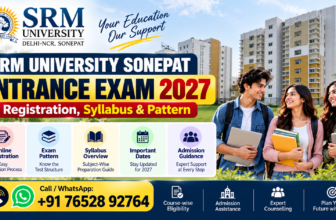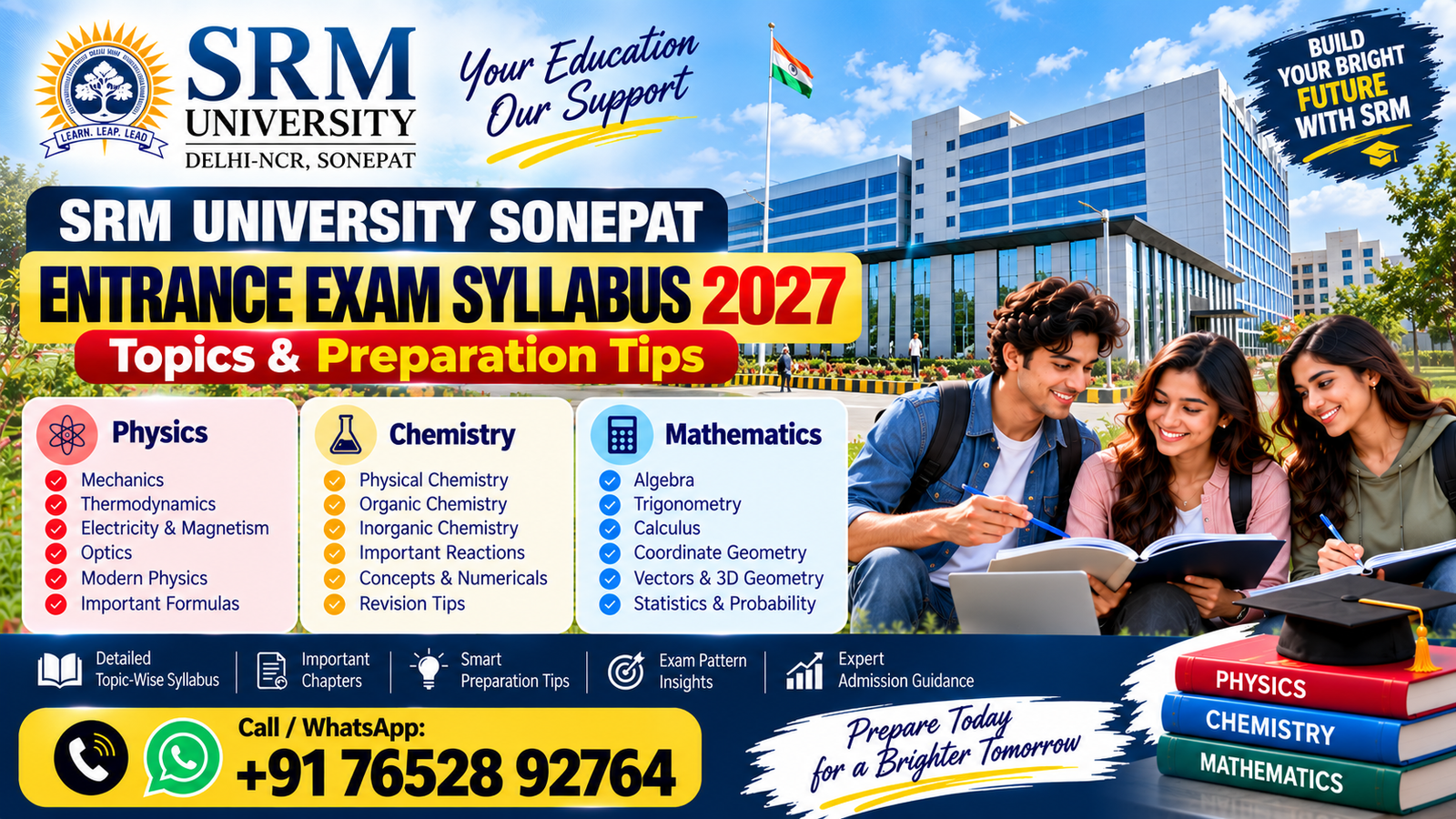
Choosing the right engineering college is an important decision for students planning to build a successful career in technology. SRM University Delhi-NCR, Sonepat, Haryana, offers several undergraduate engineering programmes, including Computer Science Engineering, Artificial Intelligence and Machine Learning, Data Science and Artificial Intelligence, Cyber Security, Electronics and Communication Engineering, Mechanical Engineering, and Robotics and Automation.
Students planning to apply for the 2027 academic session should understand the admission process, eligibility requirements, relevant entrance examination syllabus, and preparation strategy before beginning their application.
The SRM University Sonepat Entrance Exam Syllabus 2027 is an important topic for candidates preparing for B.Tech admission. Understanding the subjects and important topics can help students organise their study schedules, practise relevant questions, and prepare more confidently.
However, applicants should first confirm which entrance examination or admission route applies to their chosen programme. The university’s official admission information lists programme-specific eligibility criteria, while the examination requirements may depend on the applicable admission route. Candidates should check the latest 2027 admission notification before relying on a particular examination pattern or syllabus.
SRM University Sonepat Entrance Exam 2027: Overview
SRM University Delhi-NCR, Sonepat, is located at Rajiv Gandhi Education City in Sonepat, Haryana. The university offers multiple undergraduate programmes for students interested in engineering, technology, and related fields.
For the 2027 admission cycle, students should review the official admission portal for application updates, eligibility conditions, accepted entrance examinations, and programme availability.
The following points provide a general overview of the preparation process:
- University: SRM University Delhi-NCR, Sonepat
- Admission session: 2027–28
- Popular programme: Bachelor of Technology (B.Tech)
- Popular specialisations: Computer Science Engineering, Artificial Intelligence, Cyber Security, Data Science, Electronics and Communication Engineering, and Mechanical Engineering
- Preparation subjects: Physics, Chemistry, Mathematics, and any additional subjects required by the applicable entrance examination
- Admission requirements: Subject to the programme’s eligibility criteria and the university’s current admission policy
Students should remember that this is a general overview rather than a confirmed 2027 examination pattern. The final syllabus, examination format, and selection requirements should be checked against the relevant official notification.
Why Is the SRM University Sonepat Entrance Exam Syllabus Important?
The entrance examination syllabus helps students understand which topics they need to study and how to divide their preparation time. Instead of revising every chapter without a plan, candidates can prioritise important concepts, practise questions, and identify areas that need improvement.
A clear understanding of the syllabus can help students in several ways.
1. Better study planning: Students can create a timetable according to the subjects and chapters relevant to their entrance examination.
2. Improved conceptual understanding: Reviewing important concepts from Classes 11 and 12 helps students strengthen their fundamentals.
3. Effective revision: A topic-wise checklist makes it easier to track completed chapters and revisit difficult concepts.
4. Better time management: Regular practice helps students improve their speed and accuracy when solving objective questions.
5. Reduced exam stress: Preparation becomes more manageable when students understand the required topics and practise consistently.
Candidates should download or review the latest official syllabus for their specific examination before finalising their study plan.
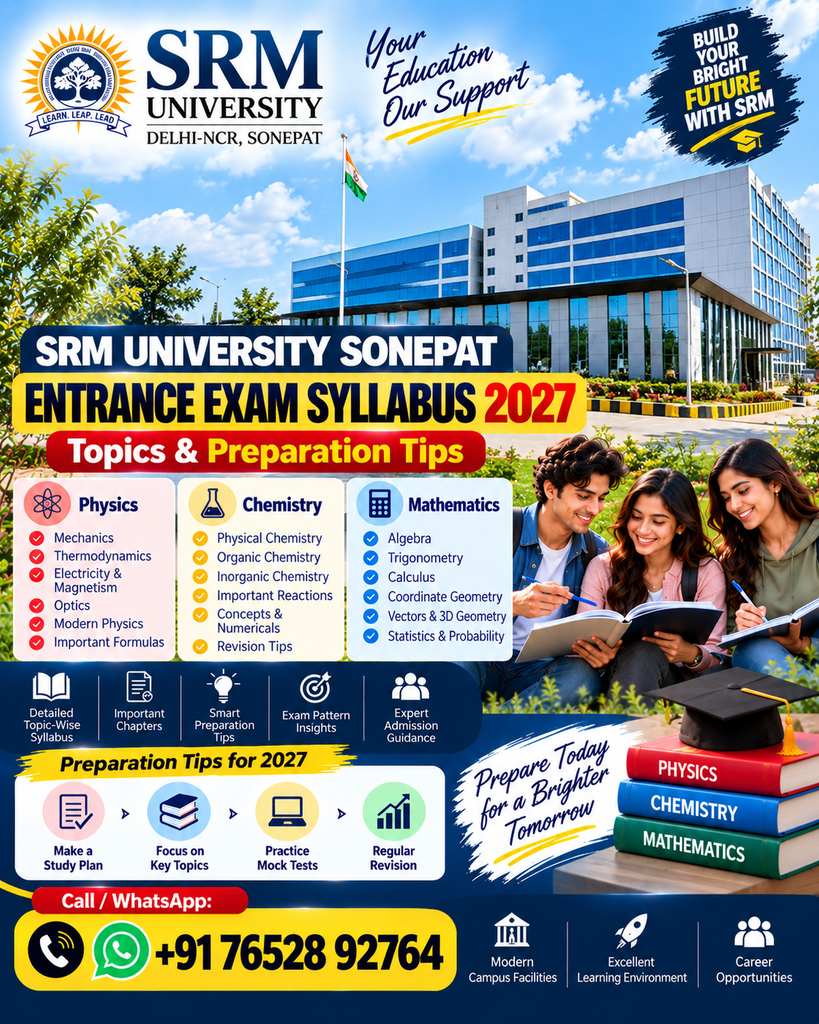
SRM University Sonepat Entrance Exam Syllabus 2027: Physics Topics
Physics is an important subject for engineering entrance examinations. Students should focus on understanding fundamental principles, learning formulas, practising numerical problems, and applying concepts to different situations.
The following are common Physics topics from the Class 11 and Class 12 curriculum that candidates may need to revise, depending on their examination.
1. Mechanics
Mechanics covers the motion of objects and the forces acting on them. It is a fundamental area of Physics and supports the understanding of several advanced concepts.
Important topics include:
- Units and measurements
- Motion in a straight line and a plane
- Laws of motion
- Work, energy, and power
- System of particles and centre of mass
- Rotational motion
- Gravitation
- Mechanical properties of solids and fluids
Preparation tip: Practise numerical questions on motion, Newton’s laws, energy conservation, and rotational motion. Learn the conditions under which different formulas can be applied.
2. Thermodynamics and Kinetic Theory
These chapters explain heat, temperature, energy transfer, and the behaviour of gases.
Topics to revise include:
- Thermal properties of matter
- Heat and temperature
- Laws of thermodynamics
- Specific heat capacity
- Heat transfer
- Kinetic theory of gases
- Thermodynamic processes
Preparation tip: Understand the relationship between heat, work, and internal energy. Practise numerical problems involving thermodynamic processes and gas equations.
3. Oscillations and Waves
Oscillations and waves are important for understanding periodic motion and the transfer of energy.
Important topics include simple harmonic motion, wave motion, sound waves, frequency, wavelength, time period, and resonance.
Preparation tip: Memorise the relevant formulas after understanding their meaning. Practise questions involving frequency, wave speed, time period, and simple harmonic motion.
4. Electricity and Magnetism
Electricity and magnetism form a major part of senior-secondary Physics.
Students should revise:
- Electric charges and fields
- Electrostatic potential and capacitance
- Current electricity
- Moving charges and magnetism
- Magnetism and matter
- Electromagnetic induction
- Alternating current
- Electromagnetic waves
Preparation tip: Practise circuit-based questions, electric field calculations, resistance combinations, and electromagnetic induction problems. Keep a separate notebook for important formulas and common mistakes.
5. Optics and Modern Physics
Optics and modern Physics introduce the behaviour of light and the principles behind several modern technologies.
Topics may include ray optics, wave optics, reflection, refraction, optical instruments, dual nature of radiation and matter, atoms, nuclei, and semiconductor electronics.
Preparation tip: Review ray diagrams, lens and mirror formulas, basic modern Physics concepts, and semiconductor principles. Use diagrams to improve conceptual understanding.
SRM University Sonepat Entrance Exam Syllabus 2027: Chemistry Topics
Chemistry requires a combination of conceptual understanding, factual revision, numerical practice, and familiarity with chemical reactions. Students should use their prescribed textbooks and the official examination syllabus to decide which chapters deserve the most attention.
1. Physical Chemistry
Physical Chemistry involves calculations, chemical principles, and the interpretation of numerical data.
Important topics to revise may include:
- Some basic concepts of chemistry
- Atomic structure
- Chemical bonding fundamentals
- States of matter, where included in the applicable syllabus
- Chemical thermodynamics
- Chemical and ionic equilibrium
- Redox reactions
- Solutions
- Electrochemistry
- Chemical kinetics
Preparation tip: Practise numerical questions regularly. Understand the formulas for mole calculations, concentration, equilibrium, electrochemistry, and reaction rates rather than memorising them without context.
2. Organic Chemistry
Organic Chemistry focuses on carbon compounds, reaction mechanisms, and the properties of different functional groups.
Common topics include:
- Basic principles of organic chemistry
- Nomenclature of organic compounds
- Isomerism
- Hydrocarbons
- Haloalkanes and haloarenes
- Alcohols, phenols, and ethers
- Aldehydes, ketones, and carboxylic acids
- Amines
- Biomolecules
The exact topics included in the entrance examination may differ, so candidates should consult the current syllabus.
Preparation tip: Prepare concise notes on named reactions, reagents, reaction conditions, and functional groups. Practise converting one organic compound into another and revise reactions frequently.
3. Inorganic Chemistry
Inorganic Chemistry involves periodic trends, bonding, coordination compounds, and the properties of elements.
Depending on the prescribed syllabus, students may need to revise:
- Periodic classification and periodic properties
- Chemical bonding and molecular structure
- Coordination compounds
- Selected p-block and d-block elements
- Important chemical properties and reactions
Preparation tip: Use short revision notes to remember periodic trends, oxidation states, coordination terminology, and important reactions. Repeated revision can help improve recall.
How to Prepare Chemistry Effectively
Students should divide Chemistry preparation into three parts: conceptual learning, numerical practice, and memorisation-based revision. Solve chapter-wise questions after completing each topic. Keep track of mistakes and revisit confusing reactions or formulas during weekly revision.
Avoid spending too much time memorising every detail before understanding the basic concepts. A balanced approach to Physical, Organic, and Inorganic Chemistry can make preparation more effective.
SRM University Sonepat Entrance Exam Syllabus 2027: Mathematics Topics
Mathematics is especially important for candidates pursuing engineering programmes that require Mathematics as an eligibility subject. Students should strengthen their problem-solving skills and practise questions from the relevant Class 11 and Class 12 curriculum.
The topics below are common areas to review, subject to the examination’s official syllabus.
1. Algebra
Algebra forms the foundation for many mathematical problems.
Important topics include:
- Sets, relations, and functions
- Complex numbers
- Quadratic equations
- Sequences and series
- Permutations and combinations
- Binomial theorem
- Matrices and determinants
- Probability
Preparation tip: Practise different question types instead of repeatedly solving the same examples. Focus on recognising which method is appropriate for a particular problem.
2. Trigonometry
Trigonometry covers relationships between angles and sides, as well as trigonometric functions and identities.
Candidates should revise trigonometric identities, equations, inverse trigonometric functions, and related applications wherever included in their syllabus.
Preparation tip: Learn the standard identities and practise simplifying expressions. Regular revision helps reduce calculation errors.
3. Calculus
Calculus is an important component of higher-level Mathematics.
Topics may include:
- Limits and continuity
- Differentiation
- Applications of derivatives
- Indefinite and definite integration
- Applications of integration
- Differential equations
Preparation tip: Understand the underlying concepts before memorising shortcuts. Practise differentiation and integration questions of varying difficulty and review the steps used in each solution.
4. Coordinate Geometry
Coordinate Geometry uses algebraic methods to study geometric figures.
Topics to revise may include straight lines, circles, conic sections, and three-dimensional geometry.
Preparation tip: Create a formula sheet for standard equations, slopes, distances, and geometric properties. Draw diagrams when necessary to understand the information provided in a question.
5. Vectors and Three-Dimensional Geometry
Vectors and three-dimensional geometry help students solve problems involving direction, position, and spatial relationships.
Important areas may include vector operations, scalar and vector products, lines in three dimensions, and planes, depending on the applicable syllabus.
Preparation tip: Practise diagrams and formula-based questions. Make sure you understand the meaning of each vector operation rather than relying only on memorised steps.
6. Statistics and Probability
Statistics and Probability involve data interpretation, probability rules, and mathematical reasoning.
Students should revise probability distributions or statistical concepts only where they are included in the examination syllabus.
Preparation tip: Solve a variety of probability questions and carefully identify the events, possible outcomes, and relevant formulas before calculating an answer.
Is English or Aptitude Included in the SRM University Sonepat Entrance Exam 2027?
Whether English, aptitude, logical reasoning, or a general test is included depends on the particular examination and admission route.
Students should not automatically assume that every applicant must take the same combination of subjects. Some entrance examinations for engineering may focus on Physics, Chemistry, and Mathematics or Biology, while other examination patterns may include additional sections.
To prepare correctly, candidates should:
- Identify the exact examination accepted for their chosen B.Tech programme.
- Review the official subject-wise syllabus.
- Confirm whether English, aptitude, or reasoning is included.
- Check the official examination duration, marking scheme, and question format.
- Practise sample papers designed for that specific examination.
If an aptitude or English section is officially prescribed, candidates can practise reading comprehension, vocabulary, grammar, numerical reasoning, and logical reasoning as relevant. These should remain supplementary preparation areas until the applicable syllabus is confirmed.
SRM University Sonepat Entrance Exam Pattern 2027
The entrance exam pattern explains how the examination is conducted, how questions are presented, how much time is available, and how marks are calculated.
For the 2027 admission session, students should confirm the following details through the university’s official admission notification or the examination authority responsible for their chosen route:
Mode of examination: Confirm whether the examination is computer-based, conducted at a test centre, or follows another approved format.
Question type: Check whether questions are multiple-choice, numerical, descriptive, or a combination of formats.
Number of questions: Review the total number of questions and the distribution across subjects.
Examination duration: Confirm the allotted time and whether individual sections have time limits.
Marking scheme: Check the marks awarded for correct answers and whether incorrect answers carry any penalty.
Subject weightage: Identify how marks are distributed among the required subjects.
These details should not be assumed from another SRM institution’s entrance examination. The examination pattern can vary by campus, programme, and admission route. Use the official 2027 information before deciding how to allocate preparation time.
SRM University Sonepat B.Tech Eligibility Criteria 2027
Entrance exam preparation should go hand in hand with checking eligibility. Candidates must ensure that they satisfy the academic requirements for their chosen B.Tech programme.
The university’s published admission information for B.Tech Computer Science Engineering and several related programmes specifies passing Class 12 with Physics and Mathematics as compulsory subjects, alongside an accepted third subject. The listed minimum is 50% marks in the specified subjects taken together for those programmes. Some programmes, including Biomedical Engineering, may have different subject combinations.
Since requirements can vary by programme and may be updated for 2027, candidates should verify the precise eligibility criteria before submitting an application.
Students should prepare the following documents where applicable:
- Class 10 marksheet or certificate
- Class 12 marksheet or qualifying examination details
- Government-issued identity proof, if required
- Recent passport-size photograph
- Scanned signature, if requested
- Entrance examination details or scorecard, where applicable
- Other documents specified in the official application instructions
Submitting complete and accurate information can help prevent avoidable delays during application verification.
How to Prepare for SRM University Sonepat Entrance Exam 2027
A well-planned preparation strategy can help candidates cover the syllabus without unnecessary stress. Students should combine concept revision, regular question practice, mock tests, and performance analysis.
1. Understand the Official Syllabus First
Before starting preparation, identify the examination applicable to your course and download its latest syllabus. Mark each topic as strong, average, or difficult.
This simple exercise helps you allocate more time to areas that require improvement. It also prevents you from spending valuable study hours on topics that are not part of your examination.
2. Build Strong Fundamentals
Start with basic concepts before moving to advanced questions. Physics requires conceptual clarity and numerical practice, Chemistry requires both understanding and revision, and Mathematics requires consistent problem-solving.
Use your school textbooks and reliable study materials to strengthen the fundamentals. If a concept is unclear, review the theory and solve basic examples before attempting difficult questions.
3. Create a Realistic Study Timetable
Prepare a weekly timetable based on your school schedule, existing knowledge, and the time remaining before the examination.
For example, you could allocate separate study sessions to Physics, Chemistry, and Mathematics, with additional time for your weakest subject. Include short breaks and reserve time for revision.
A timetable should be realistic enough to follow consistently. Completing a manageable daily target is usually more useful than creating an extremely demanding plan that is difficult to maintain.
4. Practise Questions Every Day
Reading theory alone is not enough for most entrance examinations. Solve questions after studying each topic and review the solutions carefully.
Chapter-wise practice helps identify gaps in understanding. Timed practice also helps improve speed and accuracy.
When you answer a question incorrectly, determine whether the problem arose from a conceptual misunderstanding, a calculation error, or misreading the question. Correcting the underlying cause can prevent repeated mistakes.
5. Take Mock Tests Regularly
Mock tests can help candidates become familiar with the format and time pressure of an entrance examination. Start with topic-wise tests and gradually move to full-length tests that match the confirmed examination pattern.
After each test, review your score, accuracy, time management, and weak areas. Avoid focusing only on the final score. The main purpose of a mock test is to identify what needs improvement.
6. Revise Formulas and Important Concepts
Prepare concise revision notes for Physics formulas, Mathematics identities, Chemistry reactions, and important definitions.
Review these notes regularly rather than waiting until the final few days. Frequent revision makes it easier to recall information during practice and reduces the likelihood of forgetting previously studied concepts.
7. Use Previous Papers and Sample Questions
If official sample papers or previous examination papers are available for your particular entrance examination, use them to understand the question style and expected difficulty.
Do not assume that papers from another SRM campus or another examination have an identical pattern. Always match your practice materials to the examination you will actually take.
8. Maintain Consistency and Good Study Habits
Consistent preparation is more effective than depending entirely on last-minute study sessions. Maintain a regular sleep schedule, take short breaks, and avoid distractions during focused study periods.
Students preparing alongside board examinations should integrate entrance exam practice into their regular study plan. Revising overlapping Class 11 and Class 12 topics can support both academic examinations and entrance preparation.
Best Books and Study Resources for Preparation
The most suitable study materials depend on the entrance examination and its prescribed syllabus. Candidates should begin with their standard school textbooks and then use additional resources for practice.
Useful preparation resources may include:
- NCERT textbooks: Helpful for understanding core Class 11 and Class 12 concepts, particularly in Physics, Chemistry, and Mathematics.
- Chapter-wise question banks: Useful for practising objective questions and identifying weak topics.
- Mock tests: Helpful for improving time management and examination familiarity.
- Formula and reaction notes: Useful for quick revision.
- Official admission information: Essential for confirming the examination pattern, eligibility requirements, and syllabus.
Avoid collecting too many books at once. Select a small set of reliable resources and use them consistently.
Common Preparation Mistakes to Avoid
Students can make their preparation more effective by avoiding several common mistakes.
Ignoring the official syllabus: Studying without checking the prescribed topics may waste time on irrelevant material.
Relying only on memorisation: Understanding concepts is essential for solving unfamiliar questions.
Avoiding mock tests: Without timed practice, students may struggle to manage the examination effectively.
Neglecting revision: Completing a chapter once does not guarantee that its concepts will be remembered later.
Ignoring weak subjects: Candidates should devote extra time to difficult topics instead of studying only their favourite subjects.
Trusting unverified exam details: Old or unofficial information may not match the 2027 admission requirements. Verify important details through the relevant official source.
SRM University Sonepat Admission Process 2027
Students interested in B.Tech admission should follow the latest instructions published by the university.
The general application process may involve the following steps:
- Visit the official SRM University Delhi-NCR, Sonepat admission portal.
- Review the available B.Tech programmes and their eligibility requirements.
- Register using the requested contact details.
- Complete the online application form accurately.
- Upload the required documents and submit the application fee, if applicable.
- Follow the instructions regarding the accepted entrance examination or other selection requirements.
- Check official communications for application status, counselling, selection, and subsequent admission steps.
The exact process, deadlines, examination requirements, and applicable fees for the 2027–28 session should be confirmed through the official admission portal. Candidates should keep their registration details and application confirmation for future reference.
Frequently Asked Questions (FAQs)
1. What is the SRM University Sonepat Entrance Exam Syllabus 2027?
The syllabus depends on the entrance examination applicable to the selected programme. Engineering candidates commonly revise relevant Class 11 and Class 12 Physics, Chemistry, and Mathematics topics, but the official syllabus must be checked before finalising preparation.
2. Which subjects should I study for SRM University Sonepat B.Tech admission?
Physics and Mathematics are compulsory eligibility subjects for several B.Tech programmes, with an additional accepted subject as specified by the university. The subjects required for the entrance examination depend on the applicable admission route.
3. Is the SRM University Sonepat Entrance Exam Pattern 2027 confirmed?
Candidates should consult the official 2027 admission notification or the relevant examination authority. Do not rely on an old examination pattern or assume that all SRM campuses use identical rules.
4. How can I prepare for the SRM University Sonepat Entrance Exam 2027?
Start by checking the official syllabus, revising fundamental concepts, practising chapter-wise questions, taking mock tests, and reviewing mistakes. A consistent timetable and regular revision can improve preparation.
5. Are NCERT books sufficient for preparation?
NCERT textbooks are a useful foundation for many Class 11 and Class 12 topics. Depending on the examination, candidates may also need objective question banks, mock tests, and other practice resources.
6. What are the eligibility criteria for B.Tech at SRM University Sonepat?
Eligibility varies by programme. The university’s published criteria for several B.Tech programmes require Physics and Mathematics in Class 12, an accepted additional subject, and at least 50% marks in the specified subjects taken together. Applicants should verify the current requirements for their chosen course.
7. Where can I check SRM University Sonepat admission updates for 2027?
Check the official university website and admission portal for the latest programme information, application dates, eligibility rules, and selection instructions.
8. When should I start preparing for the entrance examination?
Starting early gives students more time to revise concepts, practise questions, and take mock tests. The ideal schedule depends on the confirmed examination date, the syllabus, and the student’s current level of preparation.
Conclusion
The SRM University Sonepat Entrance Exam Syllabus 2027: Topics & Preparation Tips is an important starting point for students planning to pursue B.Tech at SRM University Delhi-NCR, Sonepat. Reviewing the relevant Physics, Chemistry, and Mathematics topics, building strong fundamentals, practising questions, and taking mock tests can help candidates prepare in a structured way.
Before beginning intensive preparation, confirm the examination accepted for your selected programme and review the official 2027 syllabus, eligibility criteria, examination pattern, and application schedule. Accurate information and consistent study habits can help you make informed admission decisions and approach the examination with greater confidence.
Admission Enquiry: Students can contact the university through its official admission portal for verified information about B.Tech programmes, eligibility, entrance examinations, and the 2027–28 admission process.