

Introduction
Choosing the right engineering college is an important decision for students who want to build a successful career in technology and engineering. Electronics and Communication Engineering (ECE) is one of the most popular engineering specializations because it combines electronics, communication systems, computer technology, and modern innovations. Students interested in telecommunications, semiconductor technology, embedded systems, robotics, and wireless communication can consider pursuing a B.Tech in Electronics and Communication Engineering.
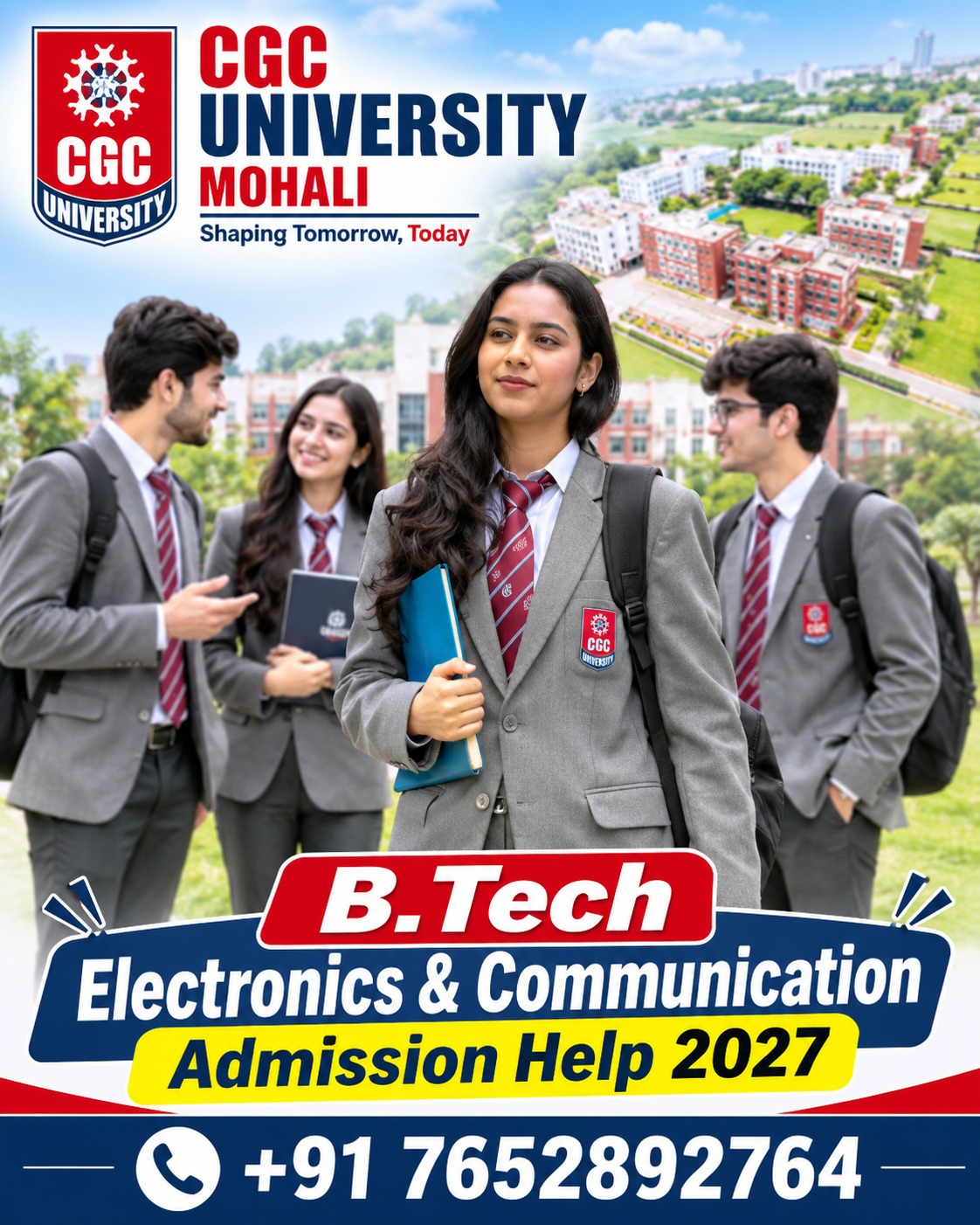
CGC University Mohali B.Tech Electronics & Communication Admission 2027 is an opportunity for students who want to explore engineering education in a technology-focused academic environment. The university offers students an opportunity to develop technical knowledge, practical skills, and industry awareness through engineering education.
This admission guide explains the expected admission requirements, eligibility criteria, application process, course structure, career opportunities, and important considerations for students planning to apply for the 2027 academic session.
Students who need assistance with course information, application guidance, eligibility, and admission-related queries can contact the admission assistance helpline at +91 7652892764.
About CGC University Mohali
CGC University Mohali is an educational institution located in Punjab, India. It provides academic opportunities across different disciplines, including engineering, management, computer applications, and other professional fields.
The university aims to provide students with an educational environment that combines academic learning with practical exposure. Engineering education focuses on developing analytical thinking, problem-solving abilities, technical knowledge, and professional skills.
For students planning to pursue Electronics and Communication Engineering, selecting an institution involves evaluating the curriculum, laboratory facilities, faculty support, industry exposure, internship opportunities, placement assistance, and overall learning environment.
Before applying, students should review the latest official university information for the 2027 admission session.
What Is B.Tech Electronics and Communication Engineering?
B.Tech Electronics and Communication Engineering is a four-year undergraduate engineering programme that focuses on electronic devices, communication networks, signal processing, circuit design, and modern communication technologies.
The course helps students understand how electronic systems work and how information is transmitted through different communication channels. It combines theoretical engineering concepts with practical laboratory work and technical projects.
ECE is a multidisciplinary field that connects electronics with computer science, information technology, and communication engineering.
Students generally study subjects such as:
- Electronic Devices and Circuits
- Digital Electronics
- Analog Communication
- Digital Communication
- Signals and Systems
- Microprocessors and Microcontrollers
- Electromagnetic Theory
- VLSI Design
- Wireless Communication
- Embedded Systems
- Computer Networks
- Internet of Things (IoT)
The exact subjects and semester-wise curriculum should be checked in the university’s official programme structure for 2027.
Why Choose Electronics and Communication Engineering in 2027?
Technology is continuously developing, creating opportunities for skilled engineers in electronics, communication, automation, and digital infrastructure.
ECE is a valuable engineering specialization because it provides knowledge of both hardware and communication technologies. Graduates can explore opportunities in established industries as well as emerging technology sectors.
Some important reasons to consider this programme include:
1. Growing Electronics Industry
Electronic components are essential in smartphones, computers, automobiles, medical equipment, industrial machinery, and consumer devices. Engineers with electronics knowledge can explore different industry sectors.
2. Opportunities in Telecommunications
Communication engineers contribute to mobile networks, broadband infrastructure, satellite communication, and wireless technologies.
3. Emerging Semiconductor Technologies
Semiconductor chips are used in almost every modern electronic device. Knowledge of digital electronics, integrated circuits, and VLSI can help students explore careers in chip design and related industries.
4. Artificial Intelligence and IoT Integration
ECE students can develop skills related to smart devices, connected systems, automation, and intelligent electronic applications.
5. Multiple Career Opportunities
Graduates can explore careers in telecommunications, embedded systems, electronics manufacturing, research, software-related roles, and higher education.
CGC University Mohali B.Tech ECE Admission 2027: Eligibility Criteria
Students interested in applying for B.Tech Electronics and Communication Engineering should check the prescribed eligibility criteria before submitting an application.
The general eligibility requirements for undergraduate engineering programmes usually include the following:
- Candidates should have completed Class 12 or an equivalent examination from a recognised board.
- Physics and Mathematics are generally required subjects for conventional B.Tech eligibility.
- Students may need Chemistry, Computer Science, or another approved subject depending on the applicable admission regulations.
- Candidates must satisfy the minimum qualifying marks prescribed by the university and relevant regulatory authorities.
- Admission may depend on qualifying examination performance, entrance examination scores, or other university-approved selection criteria.
Eligibility conditions can vary depending on the admission route and applicable regulations. Therefore, students should confirm the exact subject combination, minimum marks, and entrance examination requirements for the 2027 session.
For clarification about eligibility and the application process, students can contact +91 7652892764 for admission-related assistance.
CGC University Mohali B.Tech Electronics and Communication Admission Process 2027
The admission process generally involves several steps, from selecting a programme to completing the university’s admission formalities.
Students should follow the latest official admission instructions for the 2027 academic year.
Step 1: Research the Programme
Start by reviewing the B.Tech Electronics and Communication Engineering programme. Understand the course structure, duration, eligibility requirements, available facilities, and academic opportunities.
Step 2: Check Eligibility
Verify your Class 12 subjects and marks against the university’s published eligibility requirements. Students awaiting their qualifying examination results should check whether provisional applications are permitted.
Step 3: Complete the Application Form
Visit the official CGC University website and locate the undergraduate engineering admission section. Complete the application form using accurate personal and academic details.
Step 4: Upload Required Documents
Applicants may need to provide scanned copies of their academic certificates, photographs, identity documents, and other documents specified by the university.
Step 5: Follow the Selection Process
The university will assess applications according to its applicable admission and selection guidelines. If an entrance examination, counselling session, or interview is required, applicants should follow the relevant instructions.
Step 6: Confirm Admission
Students who receive an admission offer should review the programme details, fee structure, payment deadlines, and admission conditions before completing the required formalities.
Step 7: Complete Enrolment
After admission confirmation, complete the remaining documentation and enrolment procedures as instructed by the university.
For help understanding these steps, applicants can reach the admission assistance number +91 7652892764.
Documents Required for B.Tech Admission 2027
Students should prepare their academic and personal documents before beginning the application process. The university may request the following documents:
- Class 10 marksheet and certificate.
- Class 12 marksheet or qualifying examination details.
- Passport-size photographs.
- Aadhaar card or another accepted identity document.
- Transfer certificate, if applicable.
- Migration certificate, if required.
- Character certificate.
- Entrance examination scorecard, if applicable.
- Category or reservation certificate, if applicable.
- Other documents requested by the university.
Students should ensure that the information submitted in the application matches their official documents. The final document checklist should be verified through the university admission office.
Course Duration and Academic Structure
B.Tech Electronics and Communication Engineering is generally a four-year undergraduate programme divided into eight semesters.
The programme is designed to introduce students to fundamental engineering concepts before progressing towards advanced electronics and communication subjects.
First Year: Engineering Fundamentals
Students generally study mathematics, physics, basic electrical engineering, programming fundamentals, engineering graphics, and introductory electronics.
Second Year: Core Electronics Subjects
The curriculum usually introduces electronic devices, digital circuits, network theory, signals and systems, and communication fundamentals.
Third Year: Advanced ECE Concepts
Students may study microprocessors, communication systems, control systems, VLSI, embedded systems, and other specialised subjects.
Fourth Year: Projects and Specialisation
The final year generally focuses on advanced electives, technical projects, internships, research activities, and preparation for professional careers.
The actual subjects, elective choices, and semester structure depend on the approved university curriculum.
Important Subjects in Electronics and Communication Engineering
The B.Tech ECE curriculum covers several technical areas that help students understand electronic systems and communication technologies.
Digital Electronics
This subject explains digital circuits, logic gates, Boolean algebra, combinational circuits, and sequential systems. It provides a foundation for understanding modern digital devices.
Analog Electronics
Students learn about electronic components, amplifiers, transistors, operational amplifiers, and circuit behaviour.
Communication Systems
Communication engineering explains how information is transmitted and received through different channels. Students learn the fundamentals of modulation, transmission, and signal reception.
Microprocessors and Microcontrollers
These subjects introduce programmable electronic systems used in industrial equipment, automobiles, consumer electronics, and embedded applications.
Signal Processing
Signal processing focuses on analysing and modifying signals used in communication, audio systems, image processing, and other applications.
VLSI Design
Very Large Scale Integration involves designing integrated circuits containing a large number of electronic components. It is an important area in semiconductor and chip-design industries.
Wireless Communication
This subject introduces wireless transmission technologies, mobile communication, antenna systems, and communication networks.
Practical Learning and Laboratory Exposure
Practical learning plays an important role in engineering education. Electronics and Communication Engineering students need opportunities to apply theoretical concepts through experiments, circuit development, simulation, and technical projects.
Laboratory-based learning can help students understand electronic components, digital systems, communication circuits, microcontrollers, and signal-processing techniques.
Students should review the available laboratory infrastructure and practical training opportunities at CGC University Mohali before selecting the programme.
Technical projects can also help students develop confidence in designing, testing, and troubleshooting electronic systems.
Examples of project areas include:
- Smart home automation systems.
- IoT-based monitoring devices.
- Wireless communication applications.
- Microcontroller-based projects.
- Robotics and automation systems.
- Electronic security systems.
- Sensor-based monitoring solutions.
These projects can help students develop technical knowledge and demonstrate their capabilities during internships and placement interviews.
CGC University Mohali B.Tech ECE Fees 2027
Course fees are an important consideration when selecting an engineering programme. The total cost of pursuing B.Tech Electronics and Communication Engineering may depend on tuition fees, registration charges, examination fees, hostel accommodation, and other applicable expenses.
Students should not rely on outdated fee information because the university may revise its fee structure for the 2027 academic session.
Before taking admission, applicants should verify:
- Semester-wise tuition fees.
- Annual or programme-level fee details.
- Registration and examination charges.
- Hostel and accommodation expenses.
- Transportation charges, if applicable.
- Scholarship and financial assistance options.
- Payment schedules and refund policies.
Students should request the official 2027 fee structure directly from the university to understand the complete financial commitment.
For assistance with fee-related queries, applicants can contact +91 7652892764.
Scholarships and Financial Assistance
Scholarships can make higher education more accessible for deserving students. Engineering applicants should explore the scholarship policies available for the 2027 admission session.
Scholarship eligibility may depend on academic performance, entrance examination results, financial background, sports achievements, or other university-approved criteria.
Students should check the following details before applying:
- Scholarship eligibility conditions.
- Required academic performance.
- Application deadlines.
- Supporting documents.
- Renewal conditions.
- Applicable fee concessions.
Scholarship availability and benefits should always be confirmed through official university notifications.
Career Opportunities After B.Tech Electronics and Communication Engineering
ECE graduates can explore opportunities across several industries because their education combines electronics, communication, programming, and engineering fundamentals.
Some career options include:
1. Electronics Engineer
Electronics engineers work on designing, testing, developing, and maintaining electronic devices and circuits.
2. Communication Engineer
Communication engineers work with communication networks, wireless technologies, signal transmission, and telecommunications infrastructure.
3. Embedded Systems Engineer
Embedded systems engineers develop software and hardware solutions for electronic devices, automobiles, industrial equipment, and smart products.
4. VLSI Design Engineer
VLSI professionals work on integrated circuit design, semiconductor technologies, verification, and chip development.
5. Network Engineer
Network engineers help develop, maintain, and troubleshoot communication and computer networks.
6. IoT Engineer
IoT professionals develop connected devices and intelligent systems that communicate through the internet and other networks.
7. Testing and Quality Engineer
Testing engineers evaluate electronic products and systems to ensure that they meet technical and quality requirements.
8. Research and Development Engineer
R&D engineers work on developing new technologies, improving existing systems, and creating innovative engineering solutions.
Career opportunities depend on individual skills, academic performance, practical experience, and industry requirements.
Placement Opportunities After B.Tech ECE
Placement opportunities are an important factor for students choosing an engineering programme. Electronics and Communication Engineering graduates may apply for positions in electronics manufacturing, telecommunications, semiconductor companies, IT organisations, automation firms, and technology companies.
Students should develop a combination of technical and professional skills to improve their employment prospects.
Important skills include:
- Programming languages such as C, C++, and Python.
- Digital and analog circuit fundamentals.
- Microcontroller programming.
- Embedded systems development.
- Communication protocols.
- Problem-solving and analytical thinking.
- Technical communication.
- Teamwork and project management.
Applicants should review the university’s latest placement reports, eligible recruiter information, internship opportunities, and branch-wise placement statistics rather than relying only on general placement claims.
Higher Education Options After B.Tech ECE
Students who want to continue their education after completing their undergraduate degree can explore several postgraduate opportunities.
Popular options include:
- M.Tech in Electronics and Communication Engineering.
- M.Tech in VLSI Design.
- M.Tech in Embedded Systems.
- M.Tech in Wireless Communication.
- M.Tech in Signal Processing.
- MBA in Technology Management.
- Master’s programmes in Artificial Intelligence and related areas.
Graduates may also prepare for competitive examinations, research opportunities, and specialised professional certifications depending on their career goals.
Why Is Admission Guidance Important?
Choosing an engineering programme involves understanding academic eligibility, fees, documents, application deadlines, scholarships, and selection procedures.
Students and parents may have several questions before completing the admission process. Proper admission guidance can help applicants understand the requirements and avoid common application mistakes.
Admission assistance may help students with:
- Understanding B.Tech ECE eligibility.
- Checking available admission options.
- Getting information about fees.
- Understanding the application procedure.
- Preparing the required documents.
- Learning about scholarship conditions.
- Getting clarification about admission deadlines.
- Understanding the next steps after submitting an application.
Students seeking assistance with CGC University Mohali B.Tech Electronics and Communication Admission 2027 can contact +91 7652892764 for admission-related information and guidance.
Important Tips for Students Applying in 2027
Students planning to apply for B.Tech ECE should start preparing early to make the admission process more organised.
- Research the university and engineering programme carefully.
- Review the official eligibility requirements.
- Prepare Class 10 and Class 12 academic documents.
- Check the latest application opening and closing dates.
- Understand the complete fee structure.
- Explore scholarship opportunities.
- Review the curriculum and available practical facilities.
- Compare internship and placement information.
- Submit the application with accurate details.
- Keep track of official admission notifications.
Early preparation gives applicants more time to understand their options and complete the admission formalities.
Conclusion
CGC University Mohali B.Tech Electronics & Communication Admission 2027 can be an option for students interested in building careers in electronics, telecommunications, semiconductor technology, embedded systems, and other technology-driven industries.
The four-year B.Tech programme provides a foundation in electronic circuits, communication systems, digital technology, signal processing, and engineering applications. Students should carefully evaluate the course curriculum, eligibility requirements, fees, laboratory facilities, scholarship policies, and career opportunities before making their final decision.
Understanding the admission process in advance can help students complete their applications more confidently. Applicants should always verify the latest 2027 admission announcements and programme details through the official university website or admission office.
For information and assistance regarding CGC University Mohali B.Tech Electronics & Communication Admission Help 2027, eligibility, application procedures, course details, fees, and admission-related queries, students can contact +91 7652892764.