

Introduction
Cloud computing has become one of the most important technologies in the modern digital world. Businesses, government organizations, educational institutions, healthcare companies, and technology startups increasingly depend on cloud-based platforms to store data, manage applications, improve security, and deliver digital services. As organizations continue shifting towards cloud infrastructure, the demand for skilled cloud computing professionals is growing rapidly.
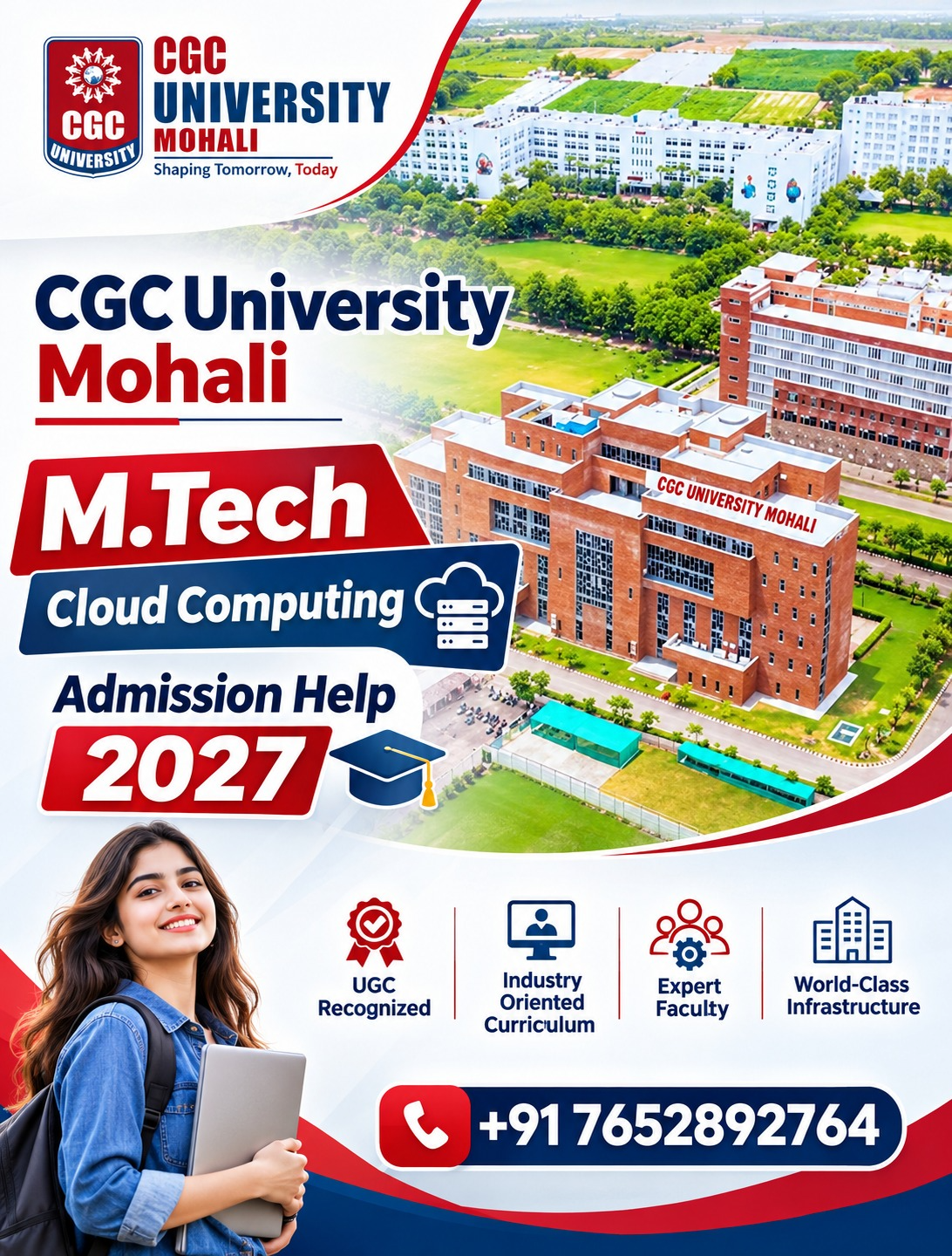
For engineering graduates who want to build advanced technical knowledge and pursue careers in cloud infrastructure, cloud architecture, cybersecurity, and distributed systems, an M.Tech in Cloud Computing can be a valuable postgraduate qualification.
Students planning to pursue higher education in this field can explore the M.Tech Cloud Computing program at CGC University Mohali for the 2027 academic session. The university offers an academic environment where students can explore advanced engineering concepts, practical learning opportunities, and industry-oriented technical skills.
If you are looking for information about CGC University Mohali M.Tech Cloud Computing Admission Help 2027, this guide covers eligibility, admission procedures, course subjects, career opportunities, fees, important documents, and other admission-related details.
About CGC University Mohali
CGC University Mohali is a higher education institution located in Punjab, India. The university provides undergraduate and postgraduate programs across different academic disciplines, including engineering, management, computer applications, and other professional fields.
The institution focuses on academic learning, skill development, practical exposure, and career-oriented education. Students interested in advanced engineering programs can explore the available postgraduate opportunities and understand how these programs align with their professional goals.
For students considering M.Tech Cloud Computing Admission 2027, it is important to review the university’s latest program information, eligibility requirements, curriculum, fee structure, and admission guidelines before applying.
What Is M.Tech in Cloud Computing?
M.Tech in Cloud Computing is a postgraduate engineering program designed to develop advanced knowledge of cloud infrastructure, distributed computing, virtualization, cloud security, data storage, and network technologies.
Cloud computing allows individuals and organizations to access computing resources such as servers, databases, applications, and storage through the internet rather than depending entirely on physical infrastructure.
The program generally focuses on the design, development, management, and maintenance of cloud-based systems.
Students may learn about popular cloud computing concepts and platforms, including:
- Cloud infrastructure and architecture
- Virtualization and containerization
- Cloud security and data protection
- Distributed systems
- Cloud storage technologies
- Network management
- Database administration
- DevOps and automation
- Artificial intelligence integration with cloud platforms
- Internet of Things and cloud computing
The program is suitable for engineering graduates who want to strengthen their technical expertise and develop specialized knowledge for advanced technology careers.
CGC University Mohali M.Tech Cloud Computing Admission 2027: Course Overview
Before applying for admission, students should understand the basic structure of the postgraduate program.
| Particular | Details |
|---|---|
| University | CGC University Mohali |
| Program | Master of Technology (M.Tech) |
| Specialization | Cloud Computing |
| Academic Session | 2027 |
| Course Level | Postgraduate |
| Field | Engineering and Technology |
| Admission Mode | As per university admission guidelines |
| Eligibility | Relevant engineering qualification, subject to current university criteria |
| Study Mode | Confirm with the university |
| Location | Mohali, Punjab, India |
Students should verify the availability of the specific M.Tech Cloud Computing specialization for the 2027 session directly with the university.
Why Choose M.Tech Cloud Computing in 2027?
Cloud technology is transforming the way organizations operate. Companies are increasingly adopting cloud platforms to improve operational efficiency, reduce infrastructure costs, and manage large volumes of information.
Pursuing an M.Tech in Cloud Computing can help engineering graduates develop specialized knowledge in this growing technology sector.
1. Growing Demand for Cloud Professionals
Organizations require professionals who can manage cloud infrastructure, develop cloud applications, monitor performance, and protect digital information.
Cloud computing knowledge can create opportunities across IT companies, financial institutions, healthcare organizations, e-commerce businesses, and technology startups.
2. Advanced Technical Knowledge
An M.Tech program provides an opportunity to study advanced engineering concepts beyond undergraduate-level education.
Students can develop knowledge of distributed systems, cloud architecture, data management, virtualization, and network security.
3. Practical Learning Opportunities
Cloud computing requires practical technical knowledge. Students should look for opportunities to work on programming assignments, laboratory exercises, infrastructure projects, and cloud-based applications.
Practical experience can help students understand how cloud systems operate in professional environments.
4. Opportunities in Multiple Industries
Cloud computing is not limited to software companies. Industries such as banking, education, healthcare, retail, manufacturing, and telecommunications also use cloud-based technology.
This creates opportunities for professionals with relevant technical skills.
5. Career Advancement
For graduates with an engineering background, postgraduate education can support specialization in advanced technology fields and help prepare them for technical responsibilities.
CGC University Mohali M.Tech Cloud Computing Eligibility Criteria 2027
Eligibility is one of the most important factors students should consider before applying for admission.
For M.Tech admission, universities generally require applicants to hold a relevant bachelor’s degree in engineering or technology.
The commonly applicable eligibility considerations may include:
- A B.E. or B.Tech degree in Computer Science, Information Technology, or another relevant engineering discipline.
- A qualifying undergraduate degree from a recognized university or institution.
- The minimum qualifying marks or CGPA prescribed by the university.
- Compliance with any additional specialization-specific admission requirements.
- Entrance examination or interview requirements, if applicable.
Candidates from related technical backgrounds should check whether their undergraduate specialization is accepted.
Important: The final eligibility requirements for CGC University Mohali M.Tech Cloud Computing Admission 2027 must be confirmed through the official admission department. Minimum marks, accepted degrees, and entrance requirements may change.
Students who need help understanding eligibility requirements can contact +91 79 7310 4914 for admission-related guidance.
CGC University Mohali M.Tech Cloud Computing Admission Process 2027
The admission process generally involves several steps, starting with program selection and ending with admission confirmation.
Students should follow the official university instructions for the 2027 admission cycle.
Step 1: Research the Program
Begin by reviewing the M.Tech Cloud Computing program details. Check the specialization availability, course structure, eligibility criteria, duration, and academic requirements.
Step 2: Check Eligibility
Review your undergraduate qualification and academic performance against the latest admission criteria.
Students should confirm whether their engineering branch is accepted for the program.
Step 3: Complete the Application Form
Visit the official CGC University admission website and locate the postgraduate engineering admission section.
Fill in the application form with accurate personal, educational, and contact information.
Step 4: Upload Required Documents
Applicants may need to submit scanned copies of academic certificates, identity documents, photographs, and other supporting documents.
Make sure that the uploaded documents meet the university’s prescribed requirements.
Step 5: Participate in the Selection Process
Depending on the university’s admission policy, applicants may need to complete additional selection formalities, such as document verification, an entrance examination, or an interview.
Step 6: Review the Fee Details
After receiving admission-related instructions, review the applicable tuition fees, additional charges, and payment deadlines.
Step 7: Confirm Admission
Complete the prescribed admission formalities and fee payment through the authorized university channels.
Students should retain their payment receipts and admission confirmation documents.
For assistance with the application procedure, students can reach the admission support contact at +91 79 7310 4914.
M.Tech Cloud Computing Syllabus and Subjects
The curriculum of an M.Tech Cloud Computing program generally covers advanced computer science, engineering, networking, infrastructure, and cloud technology concepts.
The exact subjects and semester-wise structure should be checked in the official 2027 curriculum.
Some important subjects that students may encounter include:
1. Cloud Computing Fundamentals
This subject introduces cloud computing models, service delivery systems, deployment models, and cloud infrastructure.
Students learn about public, private, hybrid, and community cloud environments.
2. Cloud Architecture and Infrastructure
Cloud architecture explains how computing resources are designed, deployed, managed, and maintained.
Students explore infrastructure components, resource allocation, scalability, and cloud service management.
3. Virtualization Technologies
Virtualization enables multiple computing environments to operate on shared physical resources.
Students may explore virtual machines, hypervisors, resource management, and virtual infrastructure.
4. Distributed Computing
Distributed computing involves multiple interconnected systems working together to complete computing tasks.
This subject introduces distributed processing, communication, coordination, and system reliability.
5. Cloud Security
Security is a critical part of cloud infrastructure.
Students learn about access control, encryption, authentication, security policies, data protection, and cloud risk management.
6. Cloud Storage and Database Management
This subject focuses on storing, organizing, accessing, and managing data in cloud environments.
Students may explore distributed databases, cloud storage solutions, data backup, and recovery.
7. DevOps and Automation
DevOps combines software development and IT operations to improve application delivery.
Students may study automation, continuous integration, continuous deployment, and infrastructure management.
8. Research Project and Dissertation
Postgraduate engineering programs generally include research-oriented activities or projects.
These activities help students apply technical knowledge to practical problems and develop analytical skills.
CGC University Mohali M.Tech Cloud Computing Fees 2027
The fee structure is another important consideration when selecting a postgraduate engineering program.
The total cost of an M.Tech program may depend on several factors, including:
- Tuition fees
- Registration charges
- Examination fees
- Laboratory or academic charges
- Hostel accommodation
- Transportation
- Other applicable university charges
Students should request the latest official M.Tech Cloud Computing fee structure for the 2027 academic session.
It is advisable to understand the complete cost of the program rather than considering tuition fees alone.
Applicants should also ask about available scholarships, merit-based concessions, payment schedules, and installment options, if applicable.
For information about admission fees and the payment procedure, students can contact +91 79 7310 4914.
Documents Required for M.Tech Cloud Computing Admission 2027
Applicants should prepare the necessary documents before beginning the application process.
The commonly requested documents may include:
- Class 10 marksheet and certificate.
- Class 12 marksheet and certificate.
- B.E. or B.Tech marksheets.
- Undergraduate degree certificate or provisional certificate.
- Transfer certificate, if required.
- Migration certificate, if applicable.
- Government-approved identity proof.
- Recent passport-size photographs.
- Entrance examination scorecard, if applicable.
- Category certificate, if applicable.
- Any additional documents requested by the university.
The university may require original documents for verification during the admission process.
Applicants should ensure that all information provided in their application matches their official academic records.
Career Opportunities After M.Tech Cloud Computing
An M.Tech in Cloud Computing can prepare students for different technical positions in the IT and technology sectors.
The career opportunities available to graduates depend on their technical abilities, practical experience, academic background, and employer requirements.
Some potential career paths include:
1. Cloud Computing Engineer
Cloud computing engineers help design, develop, and maintain cloud-based infrastructure.
Their responsibilities may include managing cloud resources, improving system performance, and supporting cloud deployment activities.
2. Cloud Solutions Architect
Cloud solutions architects design technology solutions based on business requirements.
They work on cloud infrastructure planning, system integration, scalability, and security.
3. Cloud Security Engineer
Cloud security engineers help protect cloud platforms, applications, and sensitive information.
Their responsibilities may involve security monitoring, access management, vulnerability assessment, and data protection.
4. DevOps Engineer
DevOps engineers help automate software development and deployment processes.
They work with development teams and operations professionals to improve application delivery and infrastructure management.
5. Cloud Infrastructure Engineer
These professionals manage cloud-based computing environments, virtual machines, storage systems, and networking resources.
6. Systems Engineer
Systems engineers work on designing, maintaining, and improving complex computing environments.
Their responsibilities may include infrastructure planning, performance monitoring, and system troubleshooting.
7. Cloud Database Administrator
Cloud database administrators manage databases hosted on cloud platforms.
They work on database configuration, backup, recovery, security, and performance optimization.
8. Research and Development Professional
Graduates interested in advanced technology research may explore opportunities in cloud architecture, distributed computing, data management, and emerging computing systems.
Skills Required for a Career in Cloud Computing
An M.Tech qualification can provide advanced academic knowledge, but students should also develop practical and professional skills.
Some important skills include:
Programming Skills: Knowledge of programming languages such as Python, Java, and other relevant technologies can help students develop cloud-based applications.
Networking Knowledge: Understanding computer networks, protocols, IP addressing, and network architecture is useful for cloud infrastructure management.
Operating Systems: Familiarity with Linux and Windows environments can support cloud administration tasks.
Database Management: Knowledge of SQL, database architecture, and data management is valuable.
Cloud Platforms: Practical familiarity with services offered by AWS, Microsoft Azure, and Google Cloud can improve industry readiness.
Cybersecurity: Understanding encryption, identity management, authentication, and access control is important.
Problem-Solving: Cloud professionals frequently troubleshoot infrastructure issues and optimize system performance.
Students should build practical projects and explore relevant certifications alongside their academic education.
Importance of Cloud Certifications
Professional certifications can help students demonstrate their knowledge of specific cloud technologies.
Some popular certification pathways include:
- AWS Certified Solutions Architect.
- Microsoft Certified: Azure Administrator Associate.
- Microsoft Certified: Azure Solutions Architect Expert.
- Google Cloud Associate Cloud Engineer.
- Google Cloud Professional Cloud Architect.
- Relevant Kubernetes and DevOps certifications.
Certification requirements and examination structures may change over time. Students should consult the respective certification providers for updated information.
These certifications are optional professional development opportunities and do not automatically guarantee employment.
Higher Education Opportunities After M.Tech Cloud Computing
Students interested in research and advanced academic development can explore further educational opportunities after completing their postgraduate degree.
Possible pathways include:
- Ph.D. in Computer Science and Engineering.
- Ph.D. in Cloud Computing or Distributed Systems.
- Research in Artificial Intelligence and Cloud Infrastructure.
- Research in Cybersecurity and Network Technologies.
- Advanced studies in High-Performance Computing.
- Specialized research in Data Science and Big Data Technologies.
A strong research project, academic performance, and relevant technical experience can help students prepare for higher education.
Why Consider CGC University Mohali for M.Tech Admission 2027?
When selecting a postgraduate institution, students should consider more than the program name.
Important factors include academic quality, curriculum relevance, faculty expertise, infrastructure, practical learning, industry exposure, and career development opportunities.
Students exploring CGC University Mohali should evaluate the following aspects:
Academic Environment: Review the teaching approach, faculty qualifications, and postgraduate engineering curriculum.
Technical Infrastructure: Understand the laboratory facilities, computing resources, and practical learning environment available to students.
Industry Exposure: Explore opportunities for internships, technical workshops, industry interactions, and professional development.
Project-Based Learning: Check whether students get opportunities to work on real-world engineering problems and cloud-based projects.
Placement Support: Ask about placement assistance, recruiter participation, internship opportunities, and relevant career outcomes.
Student Support: Consider the availability of academic guidance, career counselling, and administrative support.
Applicants should verify the latest university information and evaluate whether the program meets their academic and professional expectations.
Important Factors to Consider Before Applying
Before submitting an application for the 2027 academic session, students should carefully review the following points:
- Confirm whether M.Tech Cloud Computing is available for the 2027 intake.
- Check the accepted undergraduate engineering specializations.
- Verify the minimum academic eligibility requirements.
- Request the complete fee structure.
- Understand the semester-wise syllabus.
- Review the admission and selection process.
- Ask about scholarships and financial assistance.
- Check laboratory and infrastructure facilities.
- Understand internship and placement support.
- Confirm the application deadline through official university communication.
Students can use +91 79 7310 4914 to seek admission-related assistance and understand the next steps in the application process.
Frequently Asked Questions (FAQs)
1. What is CGC University Mohali M.Tech Cloud Computing Admission 2027?
It refers to the admission process for students interested in pursuing a postgraduate engineering qualification in Cloud Computing at CGC University Mohali for the 2027 academic session, subject to program availability.
2. What is the eligibility for M.Tech Cloud Computing Admission 2027?
Applicants generally need a relevant B.E. or B.Tech qualification from a recognized institution. The university’s official eligibility requirements and minimum marks criteria should be checked before applying.
3. How can I apply for M.Tech Cloud Computing at CGC University Mohali?
Students can visit the official university website, review the postgraduate engineering admission requirements, complete the application form, submit the required documents, and follow the prescribed selection process.
4. What is the duration of an M.Tech program?
An M.Tech program in India is generally structured as a two-year postgraduate engineering qualification divided into four semesters. Students should verify the applicable program structure.
5. What subjects are covered in M.Tech Cloud Computing?
Common subjects include cloud architecture, virtualization, distributed systems, cloud security, cloud storage, networking, DevOps, and research projects.
6. What are the career opportunities after M.Tech Cloud Computing?
Graduates may explore careers as cloud engineers, cloud architects, DevOps engineers, cloud security professionals, infrastructure engineers, and database administrators.
7. What is the fee for M.Tech Cloud Computing at CGC University Mohali?
The exact 2027 fee structure should be obtained directly from the university because tuition fees and additional charges may vary.
8. Are scholarships available for M.Tech students?
Scholarships and financial assistance may depend on university policies, eligibility requirements, and the applicable academic session. Students should confirm the available options with the admission department.
9. What documents are required for admission?
Common documents include Class 10 and 12 certificates, undergraduate marksheets, degree certificates, identity proof, photographs, and other documents required by the university.
10. How can I get M.Tech Cloud Computing admission assistance?
Students can contact the admission assistance number +91 79 7310 4914 to seek guidance regarding eligibility, application requirements, program details, and admission-related queries.
Conclusion
M.Tech in Cloud Computing can be a valuable postgraduate option for engineering graduates who want to develop advanced expertise in cloud infrastructure, distributed systems, virtualization, cybersecurity, and modern computing technologies.
With businesses increasingly adopting cloud-based solutions, professionals with relevant technical knowledge can explore career opportunities across several industries.
Students planning to pursue CGC University Mohali M.Tech Cloud Computing Admission Help 2027 should carefully review the eligibility requirements, course structure, fees, admission procedure, and program availability before applying.
Choosing the right postgraduate program requires proper research and an understanding of long-term career goals. Applicants should also evaluate practical learning opportunities, technical facilities, faculty expertise, and placement support before making their final decision.
For further information and admission-related assistance regarding CGC University Mohali M.Tech Cloud Computing Admission 2027, contact +91 79 7310 4914 and get guidance on the application process.