ME in Environmental Engineering at Chandigarh University (CU) 2027: Scholarship, Registration Last Date, Admission Process, Fees, Syllabus, Placement & Highest Package – Complete Guide in Details
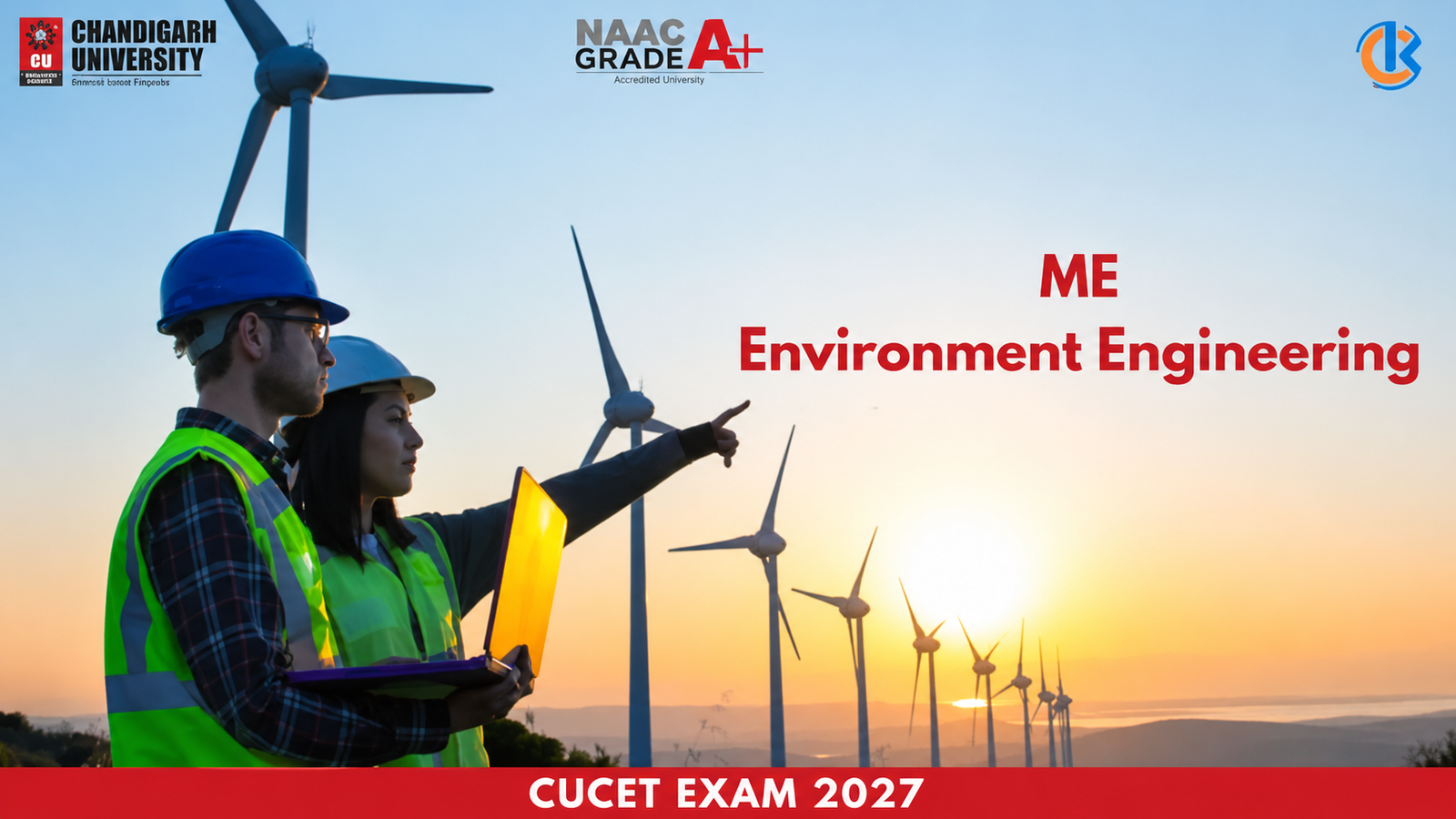
ME in Environmental Engineering at Chandigarh University (CU) Admission 2027 is an important topic for engineering graduates interested in environmental protection, sustainable infrastructure, pollution control, wastewater treatment, and advanced environmental technologies. Students planning to pursue postgraduate engineering studies can explore Chandigarh University for its academic environment, research-oriented learning opportunities, engineering facilities, and industry-focused education.
Environmental Engineering is becoming increasingly relevant as industries, governments, and infrastructure organizations focus on climate change, clean water, waste management, air pollution, and sustainable development.
Students searching for Chandigarh University ME Environmental Engineering Admission 2027, eligibility criteria, course fees, CUCET scholarships, registration last date, syllabus, placements, and highest salary package will find the essential information in this detailed guide.
Important: The availability of the specific ME Environmental Engineering specialization, its 2027 fee structure, admission deadlines, scholarships, and placement statistics must be confirmed through Chandigarh University’s official 2027 admission information. Figures for other engineering programs should not be treated as verified figures for this specialization.
1. Overview of ME in Environmental Engineering at Chandigarh University 2027
The Master of Engineering (ME) in Environmental Engineering is a postgraduate engineering qualification designed to develop advanced technical knowledge in environmental systems, sustainable engineering practices, and pollution prevention.
The program generally combines theoretical engineering concepts, laboratory investigations, environmental analysis, practical projects, and research activities.
Students develop an understanding of how engineering principles can help solve environmental challenges associated with industrialization, urban development, and natural resource management.
Course highlights
| Particulars | Details |
|---|---|
| University | Chandigarh University (CU) |
| Course | ME in Environmental Engineering |
| Academic session | 2027–28 |
| Course level | Postgraduate |
| Typical duration | 2 years |
| Mode | Regular, subject to availability |
| Eligibility | Relevant engineering bachelor’s degree |
| Admission process | University application and applicable selection requirements |
| Scholarship | CUCET and other applicable schemes |
| Course fees | Official 2027 fee schedule awaited |
| Registration last date | Not yet verified for 2027 |
| Career fields | Environmental consulting, water treatment, pollution control, sustainability |
| Highest package | Program-specific figure not verified |
The two-year duration is typical of full-time ME/M.Tech programs in India. Applicants should verify the exact degree title, duration, and specialization offered by Chandigarh University for the 2027 intake.
2. Why Choose Chandigarh University for Environmental Engineering?
Chandigarh University is a private university in Punjab offering academic programs across engineering, management, sciences, and other disciplines.
Students considering postgraduate environmental engineering education may evaluate the university based on several factors.
Engineering-oriented learning: Postgraduate engineering education can provide opportunities to study environmental technologies, infrastructure planning, and advanced engineering applications.
Research and innovation: Environmental engineering involves research into water conservation, sustainable construction, pollution monitoring, and resource recovery. Students should review the university’s current research facilities and faculty expertise in these areas.
Practical exposure: Laboratory work, environmental analysis, industrial projects, and technical assignments can help students connect classroom knowledge with real-world environmental problems.
Interdisciplinary opportunities: Environmental engineering overlaps with civil engineering, chemistry, biotechnology, energy systems, and environmental science.
Career development: Students can build skills applicable to environmental consultancy, infrastructure organizations, government projects, industrial compliance, and sustainability services.
Before choosing the program, candidates should compare its curriculum, faculty, laboratories, research opportunities, fees, and verified placement outcomes with other universities.
3. Chandigarh University ME Environmental Engineering Eligibility Criteria 2027
Candidates interested in admission must satisfy the eligibility conditions specified for the postgraduate engineering program.
Educational qualification
Applicants will generally need a recognized bachelor’s degree in an appropriate engineering discipline, such as:
- Civil Engineering
- Environmental Engineering
- Environmental Technology
- Another engineering specialization accepted by the university
Candidates with related qualifications should confirm whether their degrees meet the university’s subject-specific requirements.
Minimum marks
Postgraduate engineering programs commonly prescribe a minimum qualifying percentage or CGPA. However, the exact minimum marks for Chandigarh University’s 2027 ME Environmental Engineering intake have not been confirmed.
Students should not assume that eligibility conditions applicable to other ME programs automatically apply to Environmental Engineering.
Final-year students
Candidates completing their bachelor’s degrees in 2027 may be able to apply provisionally, subject to university admission rules and submission of final academic documents.
Entrance examination
The university may consider its admission and scholarship assessment process, including CUCET, where applicable. Applicants should verify whether any entrance examination, academic merit assessment, or additional selection requirement applies to this particular postgraduate specialization.
4. Chandigarh University ME Environmental Engineering Admission Process 2027
Students planning to apply for Chandigarh University ME Environmental Engineering Admission 2027 can prepare by following these steps.
- Check program availability: Confirm that ME Environmental Engineering is accepting applications for the 2027–28 academic session.
- Review eligibility: Check the accepted bachelor’s degree disciplines, minimum academic requirements, and selection criteria.
- Complete registration: Register through Chandigarh University’s official admission system using accurate personal and academic information.
- Provide academic details: Enter graduation marks, university details, qualifying examination information, and other requested information.
- Complete applicable assessments: Follow CUCET or any other admission assessment instructions if required for the selected program.
- Submit documents: Upload or present the academic and identity documents requested by the university.
- Review admission and scholarship decisions: Check the offer, scholarship conditions, payment schedule, and seat confirmation instructions.
- Complete enrollment: Pay the prescribed admission fees within the applicable deadline and complete document verification.
Documents required for admission
Candidates should generally prepare their Class 10 and 12 mark sheets, bachelor’s degree mark sheets, provisional or final degree certificate, identity proof, passport-size photographs, and any applicable category or scholarship documents.
The final document checklist will depend on university requirements.
5. Chandigarh University ME Environmental Engineering Registration Last Date 2027
The CU ME Environmental Engineering registration last date for 2027 is one of the most important details for applicants.
As of November 2026, a confirmed program-specific 2027 application deadline was not established from the available information.
Different admission rounds may have different registration periods, scholarship examination dates, and fee payment deadlines.
| Admission event | 2027 status |
|---|---|
| Application registration | Official schedule to be confirmed |
| CUCET registration | Applicable 2027 schedule to be confirmed |
| Scholarship assessment | Dates to be confirmed |
| Merit or selection process | As notified by university |
| Admission fee deadline | As specified in admission offer |
| Classes commencement | Official academic calendar awaited |
Students should complete their academic documents in advance and regularly check the university’s admission announcements.
Applying early can provide more time for eligibility clarification, scholarship applications, document verification, and financial planning. However, early registration alone does not guarantee admission or scholarship approval.
6. Chandigarh University ME Environmental Engineering Fees 2027
The ME Environmental Engineering fee structure at Chandigarh University for 2027 is an important consideration for students and parents.
The university’s exact tuition fee for the 2027 intake needs confirmation before any amount can be presented as official.
The total cost of pursuing postgraduate engineering education may include several components.
| Fee component | Details |
|---|---|
| Tuition fee | Program-specific academic charges |
| Registration fee | Applicable application or admission charge |
| Examination fee | As prescribed by university |
| Hostel fee | Depends on accommodation category |
| Mess charges | Based on accommodation and meal plan |
| Security deposit | If applicable |
| Other charges | As stated in the official fee schedule |
How to calculate the total course cost
Students should consider both academic and living expenses.
For example, the overall two-year education budget can be calculated as:
Total estimated cost = Tuition fees + compulsory academic charges + accommodation + meals + personal expenses − confirmed scholarships.
Students receiving financial assistance should check whether the award applies only to tuition fees or also covers other academic charges.
Before paying, candidates should request a written breakdown of semester-wise fees, refund rules, scholarship renewal conditions, and any additional charges.
7. Chandigarh University ME Environmental Engineering Scholarship 2027
Scholarships can make postgraduate engineering education more accessible to eligible students.
Chandigarh University uses CUCET as part of its broader scholarship framework. However, eligibility, scholarship percentages, and award conditions can vary according to the course and admission session.
CUCET scholarship
The Chandigarh University Common Entrance Test, commonly known as CUCET, is associated with university admission and scholarship opportunities.
Students interested in ME Environmental Engineering should verify whether the program participates in the 2027 CUCET scholarship scheme.
Scholarship consideration may depend on the examination score, program eligibility, university rules, and applicable scholarship limits.
Merit-based scholarships
Some scholarship schemes may recognize strong academic performance in qualifying examinations.
Students with good undergraduate academic records should investigate whether they qualify for postgraduate merit-based financial assistance.
Other financial assistance
Depending on current policies, students may explore applicable government scholarships, education loans, or other financial support schemes.
Important scholarship conditions
Before accepting a scholarship offer, candidates should understand:
- The amount or percentage of the award.
- Whether it applies to one semester or multiple semesters.
- Minimum academic performance needed for renewal.
- Whether scholarships can be combined.
- Any attendance or conduct requirements.
- The final deadline for accepting the scholarship.
A scholarship advertisement mentioning a maximum award does not mean every applicant will receive that amount.
8. Chandigarh University ME Environmental Engineering Syllabus 2027
The ME Environmental Engineering syllabus at Chandigarh University is designed to cover advanced environmental science, pollution control technologies, environmental planning, water treatment, waste management, and engineering research.
Chandigarh University’s published 2024–2026 curriculum for ME Environment Engineering provides a useful reference for understanding the academic structure. The 2027 syllabus may contain revisions. Chandigarh University
Semester-wise syllabus
Semester 1 – Environmental Engineering Fundamentals
- Air and Noise Pollution Control Engineering
- Advanced Water Treatment
- Environmental Planning and Management
- Environmental Chemistry and Microbiology
- Research Methodology
- Environmental Software Laboratory
- Program electives
Semester 2 – Advanced Environmental Technologies
- Advanced Wastewater Treatment
- Solid Waste Management
- Advanced Environmental Engineering Laboratory
- Environmental Impact Assessment (elective)
- Green Technology and Sustainability (elective)
- Industrial Wastewater Treatment (skill-based option)
- Project work
Semester 3 – Research and Dissertation
- Dissertation Part I
- Research Seminar
- Research-based technical investigations
- Advanced problem-solving and analytical work
Semester 4 – Final Research Project
- Dissertation Part II
- Advanced environmental research
- Technical documentation and research presentation
- Final dissertation evaluation
Elective availability and semester allocation depend on the applicable academic scheme.
Important subjects explained
Water and Wastewater Treatment: Students study technologies used to remove contaminants from drinking water and wastewater. Topics may include filtration, sedimentation, biological treatment, and advanced purification processes.
Air Pollution Control: This subject examines atmospheric pollutants, industrial emissions, air quality monitoring, and pollution prevention technologies.
Solid Waste Management: Students learn about waste collection, segregation, recycling, treatment, disposal, and sustainable resource recovery.
Environmental Impact Assessment: This area focuses on evaluating the possible environmental consequences of industrial and infrastructure projects.
Environmental Modelling: Students may use mathematical and computer-based techniques to analyze pollution movement, water quality, and environmental system performance.
Sustainable Engineering: This field covers environmentally responsible technologies, green infrastructure, resource conservation, and sustainable development.
The research component is especially valuable for students considering doctoral studies or technical careers.
9. Practical Training and Research Opportunities
Practical knowledge is an essential part of environmental engineering education.
Postgraduate students may undertake laboratory experiments, software-based modelling, technical research, and industry-related projects.
Potential practical learning areas include water quality testing, wastewater treatment system design, air pollution analysis, environmental monitoring, and solid waste characterization.
Research project ideas
Students interested in environmental engineering can explore research topics such as:
- Removal of heavy metals from industrial wastewater.
- Microplastic contamination in water resources.
- Sustainable treatment of municipal wastewater.
- Air pollution monitoring using sensor technologies.
- Groundwater contamination assessment.
- Renewable energy applications in wastewater treatment.
- Recycling and recovery of industrial waste.
- Environmental impact of urban infrastructure.
Research project availability depends on faculty supervision, laboratory resources, and departmental approval.
10. Chandigarh University ME Environmental Engineering Placement 2027
Chandigarh University ME Environmental Engineering placement opportunities are an important consideration for postgraduate applicants.
Environmental engineering graduates can explore employment in infrastructure development, environmental consultancy, manufacturing, water management, pollution control, and sustainability-related industries.
However, the availability of campus recruitment opportunities varies according to employers, specialization requirements, academic performance, and industry demand.
Career opportunities after ME Environmental Engineering
| Job role | Primary responsibilities |
|---|---|
| Environmental Engineer | Design environmental protection and treatment systems |
| Water Treatment Engineer | Manage water purification and treatment processes |
| Wastewater Treatment Engineer | Develop and optimize wastewater treatment systems |
| Environmental Consultant | Support environmental compliance and assessments |
| Pollution Control Engineer | Monitor and reduce industrial pollution |
| Sustainability Analyst | Evaluate environmental performance and resource use |
| Environmental Researcher | Conduct technical research and environmental studies |
| Solid Waste Management Specialist | Plan waste treatment, recycling, and disposal systems |
Students may also explore public-sector opportunities through applicable recruitment examinations and selection procedures.
Skills that can improve employability
Employers may value practical knowledge of environmental regulations, water and wastewater treatment, environmental impact assessment, laboratory testing, data analysis, GIS, and engineering modelling software.
Communication skills, technical report writing, and research experience can also strengthen a graduate’s professional profile.
11. Chandigarh University ME Environmental Engineering Highest Package 2027
Students frequently search for the highest package for ME Environmental Engineering at Chandigarh University.
A verified highest salary package specifically for the 2027 ME Environmental Engineering graduating batch is not currently available.
It is important to distinguish between university-wide placement achievements and salary outcomes for a particular postgraduate specialization.
A university’s highest overall placement package may come from a different course, department, or employer and should not be presented as the highest package for Environmental Engineering.
Factors influencing salary packages
Graduate salaries can vary according to technical expertise, project experience, employer, location, academic performance, and interview skills.
Specialized knowledge of wastewater treatment, environmental modelling, sustainability reporting, industrial compliance, and advanced analytical techniques may improve career prospects.
Before enrolling, students should request the latest program-specific placement report, including the number of eligible students, students placed, median or average salary, highest salary, and participating employers.
12. Higher Studies After ME Environmental Engineering
Students completing postgraduate studies in Environmental Engineering can pursue higher education and research opportunities.
One possible option is a PhD in Environmental Engineering, which can support careers in academic research, university teaching, and advanced technology development.
Graduates may also explore interdisciplinary research in climate science, environmental biotechnology, sustainable infrastructure, renewable energy, and water resource management.
Students interested in research careers should focus on dissertation quality, technical publications, research methodology, and laboratory experience.
13. Scope of Environmental Engineering in India
Environmental Engineering has applications across many sectors of the Indian economy.
Increasing attention to industrial pollution, wastewater treatment, sustainable cities, resource efficiency, and environmental compliance creates a need for qualified environmental professionals.
Potential employment sectors include municipal water services, infrastructure consulting, environmental laboratories, manufacturing industries, renewable energy organizations, research institutions, and environmental management companies.
The sector also offers opportunities for entrepreneurship in environmental monitoring, waste recycling, water purification, and sustainability consulting.
However, career outcomes depend on market conditions, professional skills, relevant experience, and the availability of suitable positions.
14. Frequently Asked Questions About Chandigarh University ME Environmental Engineering Admission 2027
Q1. Does Chandigarh University offer ME Environmental Engineering?
Chandigarh University has published an ME Environment Engineering curriculum. Applicants should confirm that the specialization is accepting students for the 2027–28 session.
Q2. What is the duration of ME Environmental Engineering?
The standard full-time postgraduate engineering program generally lasts two years, divided into four semesters.
Q3. What is the eligibility for admission in 2027?
Candidates generally need a relevant engineering bachelor’s degree. The accepted disciplines and minimum qualifying marks must be checked against the university’s 2027 admission criteria.
Q4. What is the last date to apply for CU ME Environmental Engineering 2027?
A confirmed program-specific last date has not yet been established. Students should follow the official 2027 admission schedule.
Q5. What are the course fees for ME Environmental Engineering at CU?
The exact 2027 tuition fees and additional charges require confirmation from the university’s official fee schedule.
Q6. Can students receive CUCET scholarships?
CUCET is associated with Chandigarh University’s scholarship system. Students must confirm the eligibility and award conditions applicable to ME Environmental Engineering in 2027.
Q7. What subjects are included in the syllabus?
Major subjects include air pollution control, advanced water treatment, environmental chemistry, wastewater treatment, solid waste management, environmental modelling, and research methodology.
Q8. What is the highest placement package for this course?
A verified course-specific highest placement package for the 2027 graduating batch is not available. Applicants should request the latest departmental placement data.
Q9. Can Civil Engineering graduates apply?
Civil Engineering is closely related to Environmental Engineering. However, admission eligibility depends on the university’s accepted qualification requirements.
Q10. Is ME Environmental Engineering a good career option?
It can be a suitable postgraduate specialization for students interested in pollution control, environmental research, water management, sustainable infrastructure, and technical consultancy.
15. Conclusion: Chandigarh University ME Environmental Engineering Admission 2027
ME in Environmental Engineering at Chandigarh University 2027 is a postgraduate study option worth exploring for students seeking advanced knowledge of environmental technologies, pollution management, water treatment, and sustainable engineering.
The university’s published curriculum demonstrates coverage of core environmental engineering subjects, technical electives, practical laboratories, and dissertation-based research.
Before applying, students should confirm the program’s 2027 availability, eligibility criteria, registration last date, tuition fees, scholarship rules, and verified placement statistics.
Candidates should also compare the curriculum with their long-term goals, whether those involve environmental consultancy, industry, public-sector engineering, sustainability, or higher research.
With appropriate technical preparation, practical experience, and research skills, postgraduate Environmental Engineering education can provide a foundation for contributing to India’s environmental protection and sustainable development efforts.