LLB Course 2026: Complete Guide to Eligibility, Admission, Fees, Career Scope & Salary
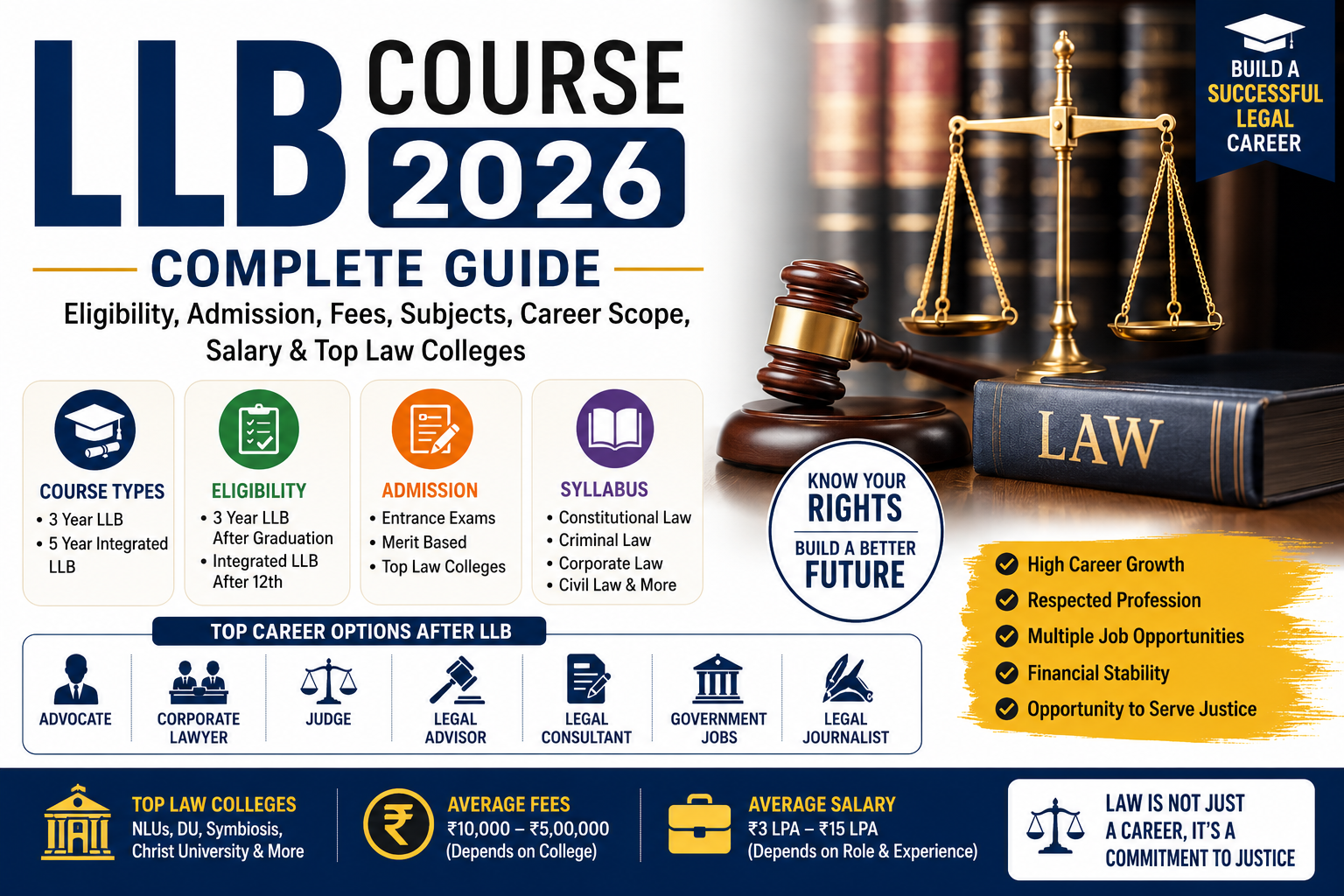
The LLB (Bachelor of Laws) is one of the most respected and career-oriented professional degrees in India. Students who dream of becoming lawyers, judges, legal advisors, corporate consultants, or legal officers often choose the LLB course after completing their graduation or higher secondary education.
With increasing awareness of legal rights, growing corporate sectors, and expanding judicial systems, the demand for qualified law professionals is rising rapidly. If you are planning to pursue an LLB course in 2026, this complete guide will help you understand eligibility, admission process, course duration, syllabus, fees, career opportunities, salary, and much more.
What is LLB?
LLB stands for Bachelor of Legislative Law or Bachelor of Laws. It is an undergraduate professional law degree designed to provide students with knowledge of legal systems, constitutional laws, criminal laws, civil laws, corporate laws, and judicial procedures.
The course prepares students for careers in:
- Advocacy
- Corporate law
- Judiciary
- Legal consultancy
- Government legal services
- Legal research
Types of LLB Courses in India
There are mainly two types of LLB programs available in India.
1. 3-Year LLB Course
This course is designed for students who have already completed graduation in any stream such as:
- BA
- B.Com
- B.Sc
- BBA
- BCA
Duration:
3 Years
2. Integrated LLB Courses
Students can pursue integrated law programs directly after Class 12.
Popular integrated law courses include:
- BA LLB
- BBA LLB
- B.Com LLB
- B.Sc LLB
Duration:
5 Years
Why Choose an LLB Course?
Law is considered one of the most prestigious professions. The LLB course offers excellent career growth, social respect, and diverse job opportunities.
Major Benefits of Pursuing LLB
- Strong career opportunities
- High earning potential
- Opportunity to become an advocate or judge
- Knowledge of legal rights and systems
- Corporate sector demand
- Government job opportunities
- Flexibility to work independently
LLB Eligibility Criteria 2026
Students must fulfill the eligibility requirements before applying.
Eligibility for 3-Year LLB
Candidates must:
- Hold a bachelor’s degree from a recognized university
- Secure minimum qualifying marks (varies by college)
Minimum Marks
- General Category: Usually 45%-50%
- Reserved Categories: Relaxation applicable
Eligibility for 5-Year Integrated LLB
Candidates must:
- Pass Class 12 from a recognized board
- Meet minimum percentage requirements
LLB Admission Process 2026
Admission to law colleges can be based on:
- Entrance exams
- Merit-based selection
Popular Law Entrance Exams in India
CLAT (Common Law Admission Test)
One of the most popular entrance exams for admission into National Law Universities.
AILET
Conducted for admission into law programs offered by top law institutes.
LSAT India
A widely accepted law entrance examination for various private law colleges.
State-Level Law Entrance Exams
Many states and universities conduct their own law entrance tests.
LLB Course Duration
| Course Type | Duration |
|---|---|
| 3-Year LLB | 3 Years |
| Integrated LLB | 5 Years |
LLB Subjects and Syllabus
The LLB syllabus includes theoretical and practical legal education.
Important Subjects in LLB
Constitutional Law
Understanding the Indian Constitution and legal framework.
Criminal Law
Study of crimes, punishments, and criminal justice systems.
Civil Law
Deals with property disputes, contracts, and civil matters.
Corporate Law
Focuses on business laws and company regulations.
Family Law
Includes marriage laws, inheritance, divorce, and related matters.
Labour Law
Covers employee rights and industrial regulations.
Environmental Law
Legal provisions related to environmental protection.
Skills Required for Law Students
Students pursuing LLB should develop important professional skills.
Essential Skills
- Communication skills
- Analytical thinking
- Research ability
- Public speaking
- Logical reasoning
- Negotiation skills
- Problem-solving ability
Best Career Options After LLB
An LLB degree opens doors to multiple career opportunities.
1. Advocate
Students can practice law in courts after registering with the Bar Council.
2. Corporate Lawyer
Corporate lawyers work with companies on legal matters and compliance.
3. Legal Advisor
Legal advisors guide organizations on legal procedures and risks.
4. Judge
Students can prepare for judicial service examinations.
5. Public Prosecutor
Represents government cases in court.
6. Legal Consultant
Provides independent legal advice to businesses and individuals.
7. Legal Journalist
Law graduates can also work in legal media and journalism.
LLB Course Fees in India
The fee structure depends on the college and course type.
Approximate Fee Range
| College Type | Average Fees |
|---|---|
| Government Colleges | ₹10,000 – ₹1,00,000 |
| Private Colleges | ₹1,00,000 – ₹5,00,000 |
Top Law Colleges in India
India has many reputed law colleges offering quality education.
Popular Law Institutes
- National Law Universities (NLUs)
- Faculty of Law, Delhi University
- Government Law Colleges
- Symbiosis Law School
- Christ University Law School
LLB Career Scope in India
The legal industry is growing rapidly due to:
- Increasing business regulations
- Rising legal awareness
- Expansion of corporate sectors
- Growth in cyber law and intellectual property law
Law graduates can work in:
- Courts
- Corporate companies
- Government departments
- Legal firms
- NGOs
- International organizations
Salary After LLB
Salary packages vary depending on experience, specialization, and organization.
Average Salary Range
| Job Role | Average Salary |
|---|---|
| Advocate | ₹3 LPA – ₹8 LPA |
| Corporate Lawyer | ₹6 LPA – ₹15 LPA |
| Legal Advisor | ₹5 LPA – ₹12 LPA |
| Judge | Government Pay Scale |
| Legal Consultant | ₹4 LPA – ₹10 LPA |
Experienced lawyers and corporate legal experts can earn significantly higher salaries.
Advantages of Studying Law
Professional Respect
Lawyers and legal professionals hold respected positions in society.
Financial Stability
The legal profession offers long-term financial growth.
Diverse Career Paths
Students can work independently or with organizations.
Opportunity to Help Society
Law professionals contribute to justice and social welfare.
Tips to Succeed in LLB
Improve Reading Habits
Law students should regularly read:
- Case studies
- Legal judgments
- Newspapers
- Legal articles
Practice Communication
Strong speaking skills are extremely important for legal professionals.
Participate in Moot Courts
Moot court competitions improve practical legal understanding.
Stay Updated
Keep learning about new laws and amendments.
Frequently Asked Questions (FAQs)
Is LLB a good career option?
Yes, LLB offers excellent career growth, diverse opportunities, and professional respect.
Can I do LLB after Class 12?
Yes, students can pursue integrated 5-year law courses after Class 12.
What is the duration of LLB?
The duration is:
- 3 years after graduation
- 5 years for integrated law programs
Is mathematics required for LLB?
No, mathematics is generally not compulsory for law courses.
What is the average salary after LLB?
Freshers may earn around ₹3–₹8 LPA depending on skills and job profile.
Conclusion
The LLB course in 2026 is an excellent option for students interested in law, justice, public speaking, and legal careers. With growing opportunities in corporate law, litigation, judiciary, cyber law, and legal consultancy, pursuing an LLB degree can provide long-term professional success and stability.
Students should carefully choose the right law college, prepare for entrance exams, and focus on developing practical legal skills during their studies. A successful legal career not only offers financial growth but also provides the opportunity to contribute positively to society and justice systems.