SRM University Sonepat CSE Fees 2027: Complete B.Tech Computer Science Fee Structure, Scholarships and Admission Guide

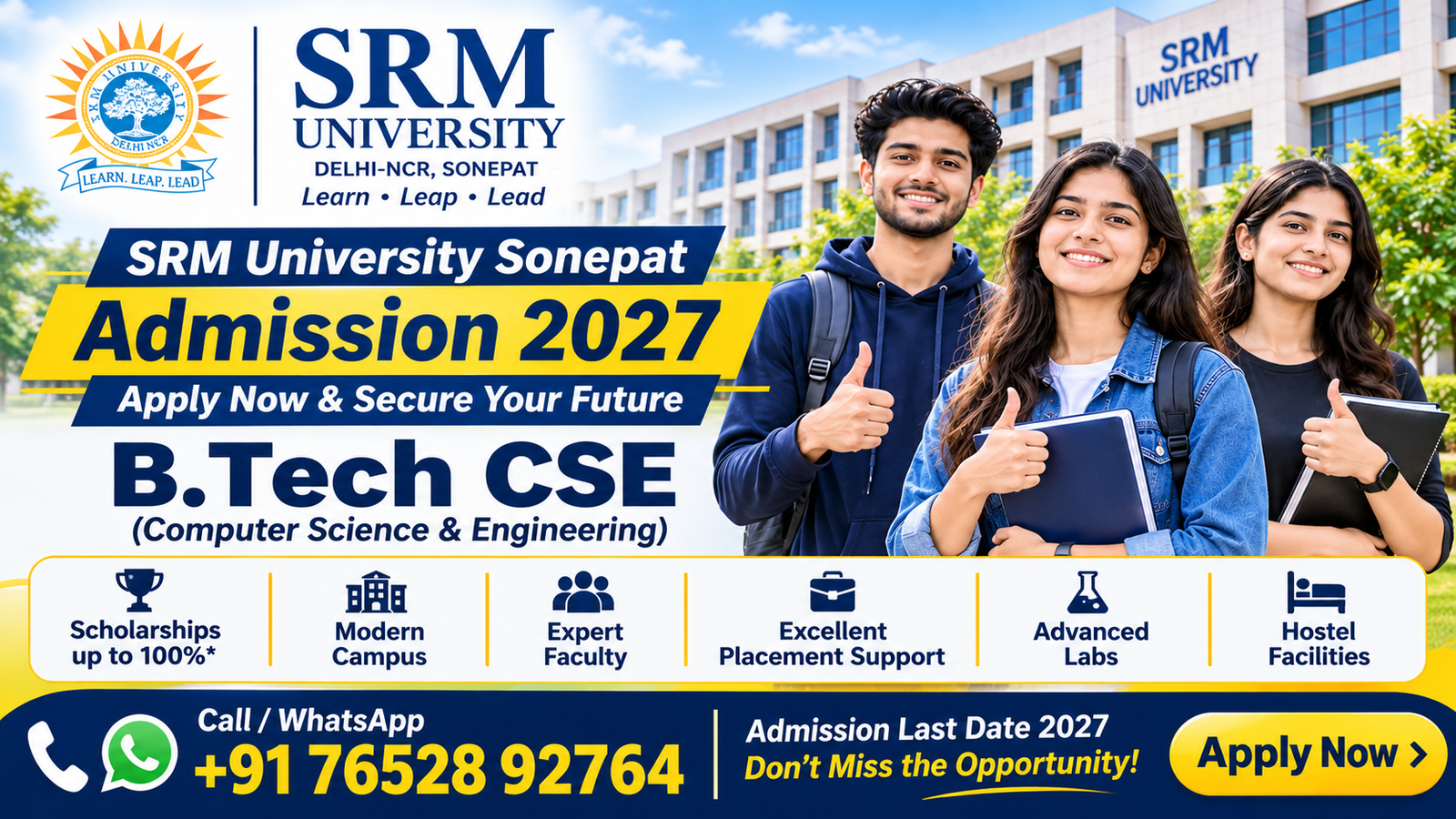
Choosing the right university for Computer Science and Engineering (CSE) is an important decision for students planning a career in software development, artificial intelligence, data science, cybersecurity, or information technology. Along with course quality and career opportunities, understanding the complete fee structure is essential before applying.
SRM University Delhi-NCR, Sonepat offers a four-year B.Tech Computer Science and Engineering programme, along with specialised options in areas such as Artificial Intelligence and Data Science, Artificial Intelligence and Machine Learning, Cyber Security, and Cloud Engineering and DevOps Automation.
For students considering admission in 2027, the university’s published 2027–28 programme information lists annual tuition fees of ₹3,00,000 for core B.Tech CSE, AI and Data Science, and AI and Machine Learning. Cyber Security and Cloud Engineering and DevOps Automation are listed at ₹2,50,000 annually. These are published tuition figures, not necessarily the complete amount payable after additional charges.
For admission guidance, call/WhatsApp: +91 76528 92764
1. SRM University Sonepat B.Tech CSE Fees 2027
The B.Tech CSE programme at SRM University Sonepat has a duration of four years, divided into eight semesters. The university’s published programme information for the 2027–28 academic year gives the following annual tuition fees:
| B.Tech programme | Annual tuition fee | Duration |
|---|---|---|
| Computer Science and Engineering (CSE) | ₹3,00,000 | 4 years |
| CSE – Artificial Intelligence and Data Science | ₹3,00,000 | 4 years |
| CSE – Artificial Intelligence and Machine Learning | ₹3,00,000 | 4 years |
| CSE – Cyber Security | ₹2,50,000 | 4 years |
| CSE – Cloud Engineering and DevOps Automation | ₹2,50,000 | 4 year |
What is the estimated four-year tuition fee?
For students who pay the published annual tuition rate throughout the programme, the basic tuition calculation is:
- Core B.Tech CSE: ₹3,00,000 × 4 = ₹12,00,000
- CSE with AI and Data Science: ₹3,00,000 × 4 = ₹12,00,000
- CSE with AI and ML: ₹3,00,000 × 4 = ₹12,00,000
- CSE with Cyber Security: ₹2,50,000 × 4 = ₹10,00,000
- CSE with Cloud Engineering and DevOps: ₹2,50,000 × 4 = ₹10,00,000
These are calculations based on the published annual tuition figures, not guaranteed four-year invoices. Confirm whether the university revises fees in later academic years.
Additional charges to consider
Tuition is not always the only amount payable during admission. SRM University’s published 2026–27 fee schedule separately lists the following charges for its Faculty of Engineering and Technology:
| Fee component | Published amount |
|---|---|
| Library and sports charges | ₹6,000 annually |
| Career development fee | ₹10,000 annually |
| Registration and counselling charges | ₹15,000 one time, non-refundable |
| Security deposit | ₹10,000 one time, refundable |
| Semester examination fee | Extra, as applicable |
These additional charges are from the 2026–27 schedule. They should not automatically be treated as confirmed 2027–28 charges. Ask the admissions office for a written, programme-specific fee breakup before paying.For admission guidance, call/WhatsApp: +91 76528 92764
2. SRM University Sonepat CSE Specialisations
Computer Science and Engineering is a broad field that covers programming, software development, computer systems, networking, databases, and emerging technologies. Students can choose a specialisation based on their interests and career plans.
B.Tech Computer Science and Engineering
The core CSE programme is suitable for students who want to develop a broad foundation in computing and software technologies. It generally covers programming, algorithms, data structures, operating systems, database management, computer networks, software engineering, and web technologies.
Students can explore career options in software development, application development, systems engineering, database administration, and IT services.
CSE with Artificial Intelligence and Data Science
Artificial Intelligence and Data Science focus on developing intelligent systems and extracting useful information from large datasets. Students interested in analytics, machine learning, and data-driven applications may consider this specialisation.
Areas of study can include:
- Artificial intelligence fundamentals
- Data analytics
- Machine learning
- Programming and statistical methods
- Database technologies
- Data visualisation
Potential career paths include data analyst, AI engineer, machine learning engineer, and business intelligence analyst.
CSE with Artificial Intelligence and Machine Learning
Artificial Intelligence and Machine Learning are increasingly used in automation, recommendation systems, predictive analysis, and intelligent applications.
This specialisation is relevant for students interested in building systems that learn from data and perform tasks with limited human intervention. Career opportunities may include machine learning developer, AI software engineer, and research assistant.
CSE with Cyber Security
Cyber Security focuses on protecting computer systems, networks, applications, and information from digital threats. As organisations increasingly depend on digital platforms, security skills are important across industries.
Students can explore subjects such as:
- Network security
- Information security
- Ethical hacking concepts
- Cryptography fundamentals
- Cyber threat analysis
- Secure software development
Possible career options include security analyst, information security associate, cyber security consultant, and network security engineer.
CSE with Cloud Engineering and DevOps Automation
Cloud Engineering and DevOps Automation is designed for students interested in cloud infrastructure, software deployment, automation, and application management. The university lists this specialisation in association with Xebia.
Students interested in cloud computing, development operations, infrastructure management, and software delivery can explore this programme. Potential roles include cloud support engineer, DevOps associate, cloud operations engineer, and automation engineer.
The university’s published programme page lists the annual tuition for these specialisations and provides programme-specific information. Students should review the latest curriculum and syllabus before selecting one.
3. B.Tech CSE Eligibility Criteria at SRM University Sonepat
Before applying for B.Tech CSE admission, students should check the university’s eligibility requirements. The published CSE programme information specifies the following general academic criteria:
- Candidates must have passed Class 12 or an equivalent examination.
- Physics and Mathematics must be compulsory subjects.
- Students must have studied one additional prescribed subject, such as Chemistry, Biotechnology, Biology, a Technical Vocational subject, Computer Science, Information Technology, Informatics Practices, Agriculture, Engineering Graphics, or Business Studies.
- At least 50% marks are required in the specified subjects taken together.
The university may update its eligibility conditions or admission requirements for a new academic session. Students should confirm the applicable rules for their chosen programme and admission year.
Can students from different boards apply?
Students who have completed Class 12 through recognised education boards can explore admission, provided they meet the university’s subject and minimum-mark requirements. Applicants should keep their marksheets and other academic documents ready for verification.
Is Mathematics compulsory for B.Tech CSE?
Yes. The published eligibility criteria specify Mathematics and Physics as compulsory subjects. Students should check the official requirements carefully before submitting an application.
4. SRM University Sonepat CSE Admission Process 2027
Students interested in the B.Tech CSE programme can follow the university’s announced admission process. The exact process, entrance examination requirements, and deadlines should be checked for the 2027–28 academic session.
A typical application process includes the following steps.
Step 1: Visit the admission website
Visit the university’s official admission portal and explore the B.Tech Computer Science and Engineering programme. Check the available specialisations, eligibility conditions, tuition fee, and admission updates.
Step 2: Complete online registration
Enter the required information in the registration form. Students may need to provide their name, email address, mobile number, academic details, and preferred course.
Step 3: Fill in the application form
After registration, complete the application form carefully. Select the B.Tech CSE programme or the preferred specialisation and provide accurate educational details.
Step 4: Upload required documents
Applicants may be asked to upload scanned copies of academic certificates, photographs, identity documents, and entrance examination scorecards, wherever applicable.
Step 5: Participate in the admission or selection process
Follow the university’s instructions regarding merit evaluation, entrance examination scores, counselling, or any other applicable selection procedure.
Step 6: Complete document verification
The university may verify the candidate’s academic qualifications and supporting documents before confirming admission.
Step 7: Pay the admission fee
Once selected, students should review the official fee offer and payment schedule. Pay the required amount through the authorised payment method and keep the receipt for future reference.
Step 8: Confirm enrolment
Complete the remaining admission formalities and follow the university’s instructions regarding orientation, registration, and commencement of classes.
Students should not rely on unofficial admission deadlines or payment instructions. Always use the official university portal.For admission guidance, call/WhatsApp: +91 76528 92764
5. Documents Required for B.Tech CSE Admission
Preparing documents in advance can make the admission process easier. Applicants should keep the following documents available:
- Class 10 marksheet and certificate
- Class 12 marksheet and certificate
- Passport-size photographs
- Aadhaar card or other valid identity proof
- Entrance examination scorecard, if applicable
- Transfer certificate, if required
- Migration certificate, if required
- Character certificate
- Category certificate, if applicable
- Haryana domicile certificate, if applying under the domicile category
The university may request additional documents depending on the applicant’s educational background and admission category.
6. Scholarships for B.Tech CSE Students at SRM University Sonepat
Scholarships can help reduce the financial burden of higher education. SRM University Sonepat publishes scholarship opportunities for eligible students under different categories.
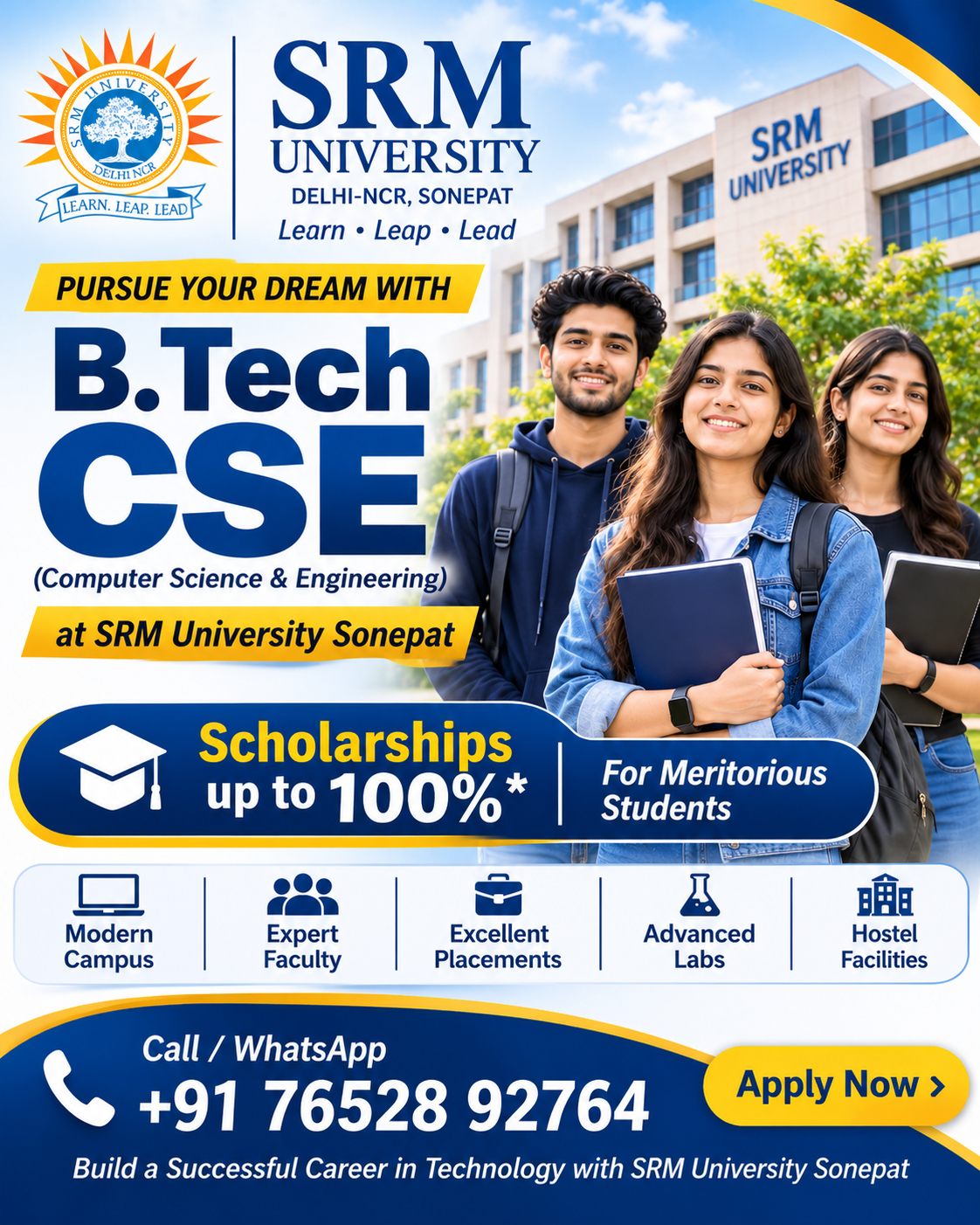
Its scholarship information describes the SRMH Scholar Search Programme, which may offer tuition fee scholarships of up to 100%, subject to eligibility, availability, applicable conditions, and academic performance requirements. mail.srmuniversity.ac.in+1
SRMHCAT-based scholarship
The university’s published scholarship information includes the following score-based structure:
| SRMHCAT score | Listed scholarship |
|---|---|
| 95 and above | 100% |
| 92–94 | 75% |
| 90–91 | 50% |
| 88–89 | 25% |
| 85–87 | 10% |
These figures are subject to the university’s scholarship terms and availability. SRM University Delhi NCR Sonepat
Class 12 merit-based scholarship
Students with strong Class 12 academic performance may also explore the School Toppers’ or Chancellor’s Scholarship categories. The published information lists these indicative slabs:
| Class 12 marks | Listed scholarship |
|---|---|
| Above 95% | 100% |
| 92–94.9% | 75% |
| 89–91.9% | 50% |
| 80–88.9% | 25% |
| 75–79.9% | 10% |
The scholarship information also mentions that the applicable SRMHCAT score and other conditions may be required. SRM University Delhi NCR Sonepat
JEE Main-based scholarship
The published scholarship page also provides a scholarship structure linked to JEE Main percentile. The listed benefits range from 10% to 100% of the first-year tuition fee, depending on the score category.
Students should check the current 2027–28 scholarship policy to confirm the applicable percentile slabs and whether the benefit continues beyond the first year.
Haryana domicile scholarship
Students belonging to Haryana may explore the university’s Haryana domicile scholarship provision. The published policy refers to scholarships for eligible Haryana domicile candidates and mentions a 25% seat provision under the relevant state private university legislation.
Applicants should submit a valid domicile certificate and verify the selection and continuation conditions with the admissions office. SRM University Delhi NCR Sonepat
Important scholarship conditions
Before depending on a scholarship while planning the course budget, students should confirm:
- Whether the scholarship applies to tuition fees only.
- Whether it is available for the selected CSE specialisation.
- Whether it is applicable for all four years or only the first year.
- The minimum CGPA required for renewal.
- Whether a separate entrance examination score is compulsory.
- Whether scholarships are subject to seat availability.
A scholarship percentage should not be assumed to apply to hostel charges, examination fees, or other additional expenses.For admission guidance, call/WhatsApp: +91 76528 92764
7. Hostel Fees and Accommodation at SRM University Sonepat
Students coming from outside Sonepat may need to consider accommodation expenses in addition to tuition fees.
The university’s published accommodation information lists separate hostel facilities for boys and girls. The listed annual hostel and mess charges are:
| Hostel accommodation | Annual fee |
|---|---|
| AC boys’ hostel – Triple occupancy | ₹1,85,000 |
| AC boys’ hostel – Double occupancy | ₹2,35,000 |
| AC boys’ hostel – Single occupancy | ₹3,35,000 |
| AC girls’ hostel – Double occupancy | ₹2,35,000 |
| AC girls’ hostel – Single occupancy | ₹3,35,000 |
SRM University Delhi NCR, Sonepat
These are published accommodation rates, which students should reconfirm for their admission session and room availability.
Hostel facilities
The university describes a range of residential facilities, including:
- Furnished hostel rooms
- Separate accommodation blocks for boys and girls
- Mess facilities
- Internet and Wi-Fi access
- Common rooms
- Reading rooms
- Indoor games facilities
- Gym and fitness facilities
- Sports courts
- Medical support
- Security arrangements
- Power backup
Students should visit the campus or speak with the accommodation department to understand room arrangements, mess services, rules, and the current fee schedule.
8. What Do Students Study in the CSE Programme?
A B.Tech in Computer Science and Engineering generally combines theoretical knowledge with practical computer skills. Students learn how computer systems work and how to design, develop, test, and maintain software applications.
The university’s CSE department lists dedicated laboratories for programming, artificial intelligence, cloud computing, software engineering, databases, computer networks, data structures, and Python programming.
Some important areas of study include:
Programming Fundamentals: Students learn programming concepts and develop logical thinking through coding exercises.
Data Structures and Algorithms: This subject introduces ways to organise information and solve computational problems efficiently.
Database Management Systems: Students understand how databases are designed, managed, and used in software applications.
Operating Systems: Learners explore the software responsible for managing computer hardware and system resources.
Computer Networks: This area covers communication between computers, networking concepts, and data transmission.
Software Engineering: Students learn about software planning, development, testing, documentation, and maintenance.
Artificial Intelligence: Students explore the concepts behind intelligent systems and automated decision-making.
Web Technologies: This subject introduces the development of websites and web-based applications.
The exact subjects, credit structure, and semester-wise syllabus should be checked in the latest official academic curriculum.
9. Campus Facilities and Learning Environment
A university’s campus environment can influence a student’s academic experience. Along with classrooms and laboratories, students should consider libraries, sports facilities, accommodation, student activities, and access to academic support.
SRM University Delhi-NCR, Sonepat, is located at Rajiv Gandhi Education City in Sonepat, Haryana. Its official website describes a campus of approximately 47.89 acres and lists academic, residential, and student facilities.
For CSE students, access to computer laboratories and practical learning resources is especially important. Students should ask about laboratory access hours, software availability, project facilities, internet access, technical clubs, hackathons, and opportunities to work on real-world projects.
A good learning environment is not limited to infrastructure. Students should also evaluate faculty support, academic mentoring, coding practice, peer learning, and opportunities to participate in technical events.For admission guidance, call/WhatsApp: +91 76528 92764
10. Placement Opportunities After B.Tech CSE
Computer Science and Engineering graduates can explore career opportunities across technology companies, IT services, consulting firms, startups, financial services, and other industries.
Some potential job roles include:
- Software Developer
- Software Engineer
- Web Developer
- Data Analyst
- AI and Machine Learning Associate
- Cyber Security Analyst
- Cloud Engineer
- DevOps Engineer
- Database Administrator
- Quality Assurance Engineer
The university publishes placement-related information on its website, including figures for companies visiting campus, jobs, paid internships, and its highest reported package. However, these are university-level figures and should not be interpreted as guaranteed CSE placement outcomes or individual salary expectations.
How can CSE students improve their placement opportunities?
Students should build technical and professional skills throughout the programme. Some useful steps include:
- Practise programming regularly.
- Develop a strong understanding of data structures and algorithms.
- Build projects that demonstrate practical knowledge.
- Participate in coding competitions and hackathons.
- Learn relevant tools and technologies.
- Complete internships and practical training.
- Prepare for technical and aptitude interviews.
- Improve communication and teamwork skills.
- Create a professional resume and portfolio.
- Explore industry certifications where relevant.
Before taking admission, request the latest CSE-specific placement report, including the number of eligible students, students placed, median salary, average salary, highest salary, and recruiter details.
11. Why Consider SRM University Sonepat for CSE?
Students comparing engineering institutions in Haryana may consider SRM University Sonepat for several reasons.
Multiple CSE specialisations: Students can explore core CSE as well as programmes related to AI, data science, machine learning, cybersecurity, and cloud engineering.
Dedicated computer laboratories: The CSE department lists laboratories covering several important areas of computing and software development.
Scholarship opportunities: Eligible students can explore merit-based, entrance-score-based, and other scholarship categories.
Residential facilities: Students coming from other cities can explore on-campus hostel accommodation.
Career development: The university publishes placement and internship information and provides career-related support.
Delhi-NCR location: The Sonepat campus is located in the Delhi-NCR region, which may provide access to a wider regional education and employment ecosystem.
These factors should be considered alongside the total course cost, academic quality, student feedback, and verified placement outcomes.
12. How to Choose the Right CSE Specialisation?
Selecting the right specialisation is an important part of planning an engineering career. Students should understand their interests and the type of work they want to pursue.
| Student interest | Programme to explore |
|---|---|
| Software development and programming | Core CSE |
| Data analysis and intelligent applications | AI and Data Science |
| Machine learning and automation | AI and Machine Learning |
| Digital safety and network protection | Cyber Security |
| Cloud infrastructure and deployment | Cloud Engineering and DevOps |
Students who are unsure about their career direction may prefer to compare the core CSE curriculum with the specialised programmes before deciding.
A specialisation should be selected based on the subjects taught, practical learning opportunities, faculty expertise, and career interests rather than only the popularity of its name.
13. Is SRM University Sonepat CSE Worth Considering?
The value of a B.Tech CSE programme depends on several factors, including tuition fees, academic quality, practical exposure, placement opportunities, and personal career goals.
The published 2027–28 tuition fee for core CSE is ₹3 lakh per year, which gives a basic four-year tuition calculation of ₹12 lakh if the annual rate remains unchanged. Students must also budget for applicable additional charges, accommodation, meals, transport, and personal expenses.
The specialised CSE programmes in Cyber Security and Cloud Engineering and DevOps Automation are listed at ₹2.5 lakh annually. This may be worth comparing for students whose interests align with these fields.For admission guidance, call/WhatsApp: +91 76528 92764
Before finalising admission, students should:
- Compare the total four-year cost with other universities.
- Review the complete syllabus.
- Check the faculty and laboratory facilities.
- Understand scholarship renewal rules.
- Request CSE-specific placement statistics.
- Verify the hostel and mess charges.
- Read the latest admission and refund policies.
The final decision should be based on verified information and the student’s budget, academic preferences, and career plans.
14. Frequently Asked Questions (FAQs)
Q1. What is the annual B.Tech CSE fee at SRM University Sonepat for 2027?
The university’s published 2027–28 programme information lists the annual tuition fee for B.Tech Computer Science and Engineering at ₹3,00,000. Additional charges may apply.
Q2. What is the total tuition fee for four years of B.Tech CSE?
At an unchanged annual tuition fee of ₹3,00,000, the estimated four-year tuition total is ₹12,00,000. This does not include other charges, hostel fees, or personal expenses.
Q3. What is the fee for CSE with Artificial Intelligence and Data Science?
The published 2027–28 annual tuition fee for CSE with AI and Data Science is ₹3,00,000.
Q4. What is the fee for CSE with Cyber Security?
The published annual tuition fee for CSE with Cyber Security is ₹2,50,000 for the 2027–28 programme information.
Q5. What is the eligibility for B.Tech CSE admission?
Candidates generally need to pass Class 12 with Physics and Mathematics as compulsory subjects and one of the other subjects specified by the university. The published criteria require at least 50% marks in the specified subjects taken together.
Q6. Does SRM University Sonepat offer scholarships for B.Tech CSE?
Yes. The university publishes several scholarship categories, including SRMHCAT-based, academic merit, JEE Main-based, and Haryana domicile opportunities. Students must verify current eligibility and availability.
Q7. Is hostel accommodation available?
Yes. The university lists separate hostel accommodation for boys and girls, with different occupancy options and annual hostel-plus-mess charges.
Q8. What is the duration of B.Tech CSE?
The B.Tech CSE programme is four years long, generally divided into eight semesters.
Q9. Does the university offer AI and Machine Learning as a CSE specialisation?
Yes. The university lists B.Tech CSE with an Artificial Intelligence and Machine Learning specialisation.
Q10. Where can students check the latest admission and fee updates?
Students should visit the university’s official website and admission portal for the latest programme details, fee schedules, eligibility criteria, and application instructions.
15. Conclusion
SRM University Sonepat offers B.Tech Computer Science and Engineering along with specialised programmes in Artificial Intelligence and Data Science, Artificial Intelligence and Machine Learning, Cyber Security, and Cloud Engineering and DevOps Automation.
For the 2027–28 academic year, the published annual tuition fee is ₹3,00,000 for core CSE, AI and Data Science, and AI and Machine Learning. Cyber Security and Cloud Engineering and DevOps Automation are listed at ₹2,50,000 annually. The estimated four-year tuition cost is therefore ₹12 lakh for the first group and ₹10 lakh for the latter programmes, assuming no fee revision.
Students should remember that tuition is only one part of the total education budget. Additional university charges, hostel accommodation, examination fees, and other expenses must also be considered. Scholarships may help eligible students reduce tuition costs.
Before applying, review the latest official fee schedule, course curriculum, admission criteria, scholarship policy, and placement information. A careful comparison will help students choose a programme that matches their academic interests and long-term career goals.For admission guidance, call/WhatsApp: +91 76528 92764