LPU Bachelor of Anaesthesia and Operation Theatre Technology Admission 2027: Eligibility, Course, Fees, Career Scope & Admission Guide
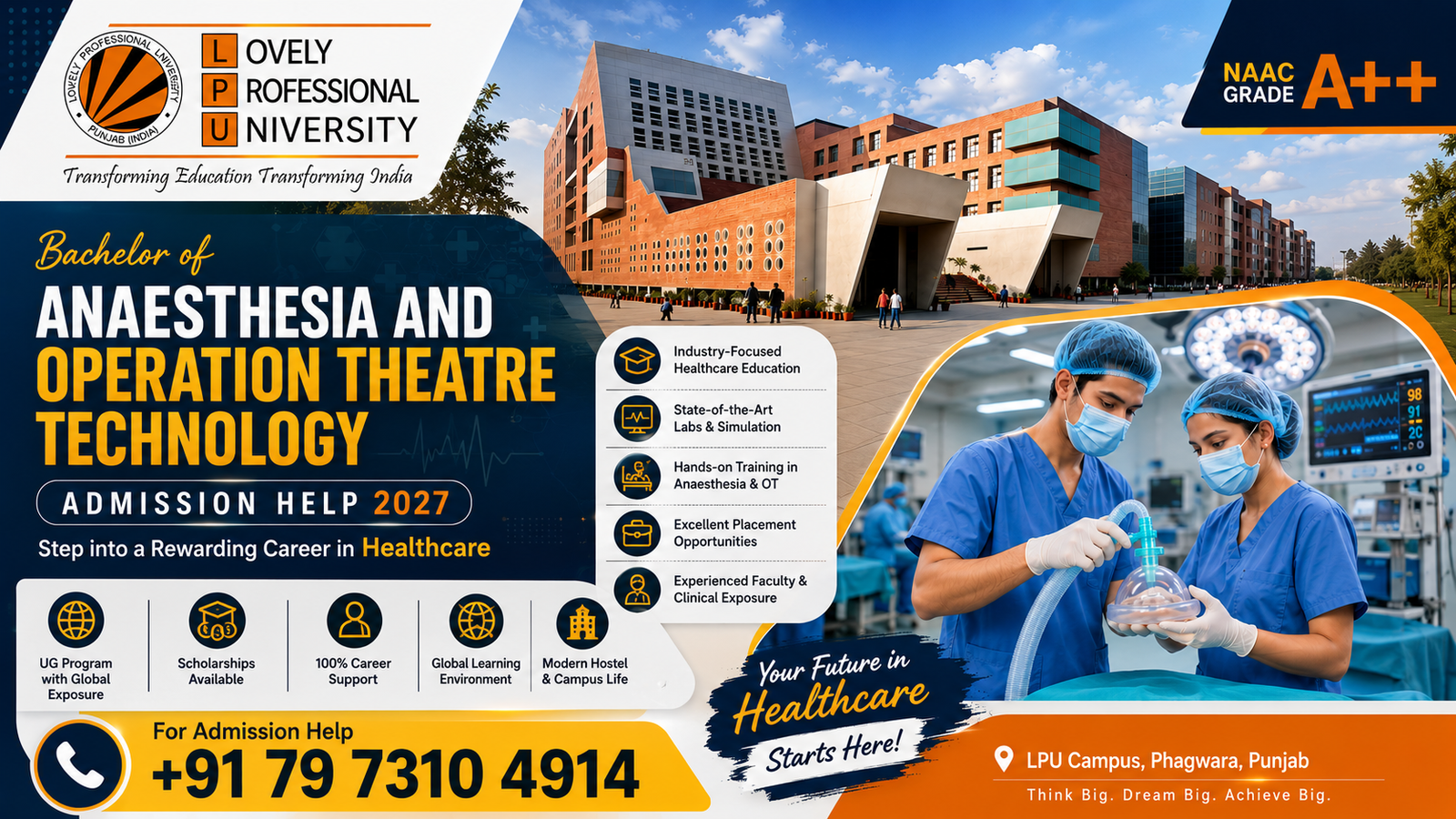
The healthcare industry continues to expand beyond traditional medical and nursing roles, creating strong demand for trained allied healthcare professionals who can support doctors, surgeons and clinical teams. Among these emerging career-oriented programs, the LPU Bachelor of Anaesthesia and Operation Theatre Technology Admission 2027 may be worth exploring for students interested in surgical environments, anaesthesia support, patient monitoring and operation theatre procedures.
Lovely Professional University (LPU) offers a range of healthcare and allied health education options. A program focused on Anaesthesia and Operation Theatre Technology is intended to develop knowledge and practical skills related to operation theatre management, anaesthesia equipment, perioperative patient care, surgical procedures, infection control and critical-care support.
This guide covers the major areas students commonly want to understand before applying for LPU Anaesthesia and Operation Theatre Technology Admission 2027, including eligibility, curriculum, practical training, fees and scholarships, career possibilities, skills and the admission process.
Note: Exact 2027 eligibility criteria, program title, duration, fees, scholarships, entrance requirements and admission policies should always be verified from LPU’s official 2027 admission information before applying.
What is Bachelor of Anaesthesia and Operation Theatre Technology?
Bachelor-level study in Anaesthesia and Operation Theatre Technology belongs to the broader field of allied healthcare. It focuses on developing professionals who can assist healthcare teams in maintaining safe, organized and technically equipped surgical environments.
Operation theatres depend on coordinated teams. Surgeons and anaesthesiologists work alongside nurses, technicians and other healthcare professionals to prepare patients, equipment and operating rooms for procedures.
Students in this field may study how operation theatres function, how anaesthesia-related equipment is prepared, how patients are monitored, how surgical instruments and equipment are handled and how infection-control procedures are followed.
It is important to understand that an anaesthesia or OT technologist does not replace an anaesthesiologist or surgeon. Their role is generally technical and supportive and must operate within applicable professional, institutional and legal requirements.
Why Consider LPU Anaesthesia and Operation Theatre Technology Admission 2027?
Students considering this field are often attracted by its combination of healthcare, technology and practical clinical work.
Unlike programs that are primarily classroom-based, allied healthcare education can involve laboratories, demonstrations, simulations and supervised practical exposure. This can help students understand how theoretical concepts are applied in healthcare environments.
Depending on the official curriculum offered for the 2027 session, students may encounter subjects connected with human anatomy, physiology, anaesthesia technology, surgical procedures, operation theatre management and patient care.
The program may appeal particularly to students who are comfortable working in structured healthcare environments and are interested in supporting clinical teams rather than pursuing a conventional desk-based career.
LPU Bachelor of Anaesthesia and Operation Theatre Technology Eligibility 2027
Eligibility is one of the first things applicants should check.
For healthcare-related undergraduate programs, universities commonly prescribe Class 12 requirements involving relevant science subjects, minimum qualifying marks and other conditions.
However, students should not assume previous-year criteria automatically apply to the 2027 admission cycle.
Before submitting an application, verify:
- Required Class 12 subjects
- Minimum qualifying percentage
- Accepted education boards
- Entrance or university-specific requirements, if applicable
- Age or other conditions, where applicable
- Requirements for international applicants, if relevant
Students awaiting their Class 12 results should also check whether provisional applications are permitted for the 2027 session.
LPU Anaesthesia and Operation Theatre Technology Course Curriculum
The exact curriculum can change, but education in this discipline generally combines basic medical sciences with specialized anaesthesia and operation theatre subjects.
Basic Medical Sciences
Students need a foundation in the structure and functioning of the human body. Relevant academic areas can include Human Anatomy, Physiology, Biochemistry, Pathology, Pharmacology and Microbiology.
These subjects help students understand the medical principles behind patient care and clinical procedures.
Anaesthesia Technology
Specialized study may introduce students to anaesthesia-related equipment, terminology, procedures and monitoring.
Topics can include anaesthesia machines, breathing systems, airway-related equipment, patient monitoring and equipment preparation.
Any actual administration of anaesthesia is subject to the responsibilities and supervision of appropriately qualified medical professionals.
Operation Theatre Technology
Another major component is understanding how operating theatres function.
Students may learn about OT preparation, surgical equipment, sterilization procedures, infection prevention, positioning and preparation of patients, biomedical waste management and maintaining an appropriate surgical environment.
Patient Monitoring and Safety
Patient safety is central to healthcare education.
Students may develop familiarity with vital signs and commonly used monitoring equipment while learning the importance of following clinical protocols and escalating concerns to qualified healthcare professionals.
Infection Control
Operation theatres require strict infection-control practices.
Training may therefore cover sterilization, disinfection, aseptic techniques, biomedical waste handling and other measures intended to reduce infection risks.
Practical Training and Clinical Exposure
Practical education is particularly important in a field such as Anaesthesia and Operation Theatre Technology.
Classroom knowledge alone cannot fully demonstrate how an operating room is organized or how medical equipment is prepared and maintained.
Depending on the university’s approved curriculum and partnerships, practical components can include laboratory exercises, simulation-based learning, demonstrations, supervised clinical exposure and internships or training.
Students should check the official LPU 2027 curriculum to determine the exact practical-training structure offered for their batch.
When comparing programs, applicants can ask about the availability of simulation facilities, laboratory infrastructure, supervised clinical exposure and the way practical competencies are assessed.
Skills Students Can Develop
A degree alone is only one part of preparing for a healthcare career. Employers can also value practical competence, professionalism and the ability to work responsibly within a clinical team.
Students in this area may develop skills such as:
Technical awareness: Understanding commonly used OT and anaesthesia-related equipment.
Attention to detail: Small mistakes in healthcare environments can have significant consequences, making careful adherence to procedures essential.
Communication: OT professionals work as part of multidisciplinary teams and need to communicate clearly.
Teamwork: Successful surgical procedures depend on coordination among multiple professionals.
Infection-control awareness: Maintaining sterile and safe environments is a major responsibility within operation theatre settings.
Time management: Healthcare environments can be fast-moving and require organized preparation.
Professional ethics: Patient privacy, dignity and safety must remain priorities.
Career Scope After Anaesthesia and Operation Theatre Technology
Graduates may explore relevant allied healthcare roles depending on their qualification, practical experience, employer requirements and applicable regulations.
Potential work environments can include:
- Hospitals
- Surgical centres
- Operation theatre departments
- Critical-care units
- Emergency-care facilities
- Specialty hospitals
- Healthcare organizations
- Medical equipment organizations
- Academic or training environments after suitable higher education
Possible job titles vary considerably between employers and jurisdictions. They can include roles associated with operation theatre technology, anaesthesia technology, surgical support and OT assistance.
Students should carefully review the professional scope of any position rather than relying only on its title.
Higher Education Opportunities
Graduation does not have to be the end of the academic journey.
Students may consider postgraduate education in an appropriate allied-health or healthcare specialization, subject to the eligibility criteria of the institution offering it.
Further education can be useful for students interested in specialization, research, academics, healthcare management or advanced professional development.
Students interested in postgraduate studies should plan early because admission requirements can vary considerably between universities and programs.
LPU Anaesthesia and Operation Theatre Technology Fees 2027
Students frequently search for LPU Bachelor of Anaesthesia and Operation Theatre Technology fees 2027.
Rather than relying on an old fee figure, applicants should check the university’s official fee schedule for the specific 2027 intake.
The total cost of university education may involve more than tuition alone. Depending on the student’s circumstances and university policies, expenses can include:
Tuition fees: Academic charges for the program.
Examination or other institutional charges: Where applicable.
Hostel charges: For students opting for university accommodation.
Mess and living expenses: Relevant for students living away from home.
Laboratory or practical requirements: Where separately applicable.
Students should calculate the estimated total cost of study, rather than comparing universities based solely on a single semester’s tuition.
LPU Scholarships for 2027
Scholarships can help eligible students reduce the financial burden of higher education.
Universities may provide scholarships based on academic performance, entrance examinations or other specified criteria. Scholarship categories, qualifying requirements, deadlines and amounts can change between admission cycles.
Therefore, applicants interested in an LPU scholarship for Anaesthesia and Operation Theatre Technology 2027 should check the university’s official scholarship policy for their admission session.
Apply within the relevant deadlines because some scholarship opportunities may depend on admission timelines or available categories.
LPU Admission Process 2027
The exact process should be confirmed from LPU’s official admission portal, but a typical university application journey may involve registering online, selecting the desired program, completing the application form, submitting the required information or documents, fulfilling any applicable eligibility or admission requirements and completing fee/payment formalities after selection.
Applicants should ensure that their name, date of birth, academic marks and contact information match their official documents.
Keep copies of application confirmations and payment receipts for future reference.
Most importantly, applicants should rely on the university’s official communications for final admission decisions, deadlines and academic requirements.
Documents to Keep Ready
Although exact requirements can vary, undergraduate applicants commonly need documents such as Class 10 and Class 12 academic records, identification documents, recent photographs and other certificates relevant to their application.
If results are pending, students should verify which documents can be submitted later.
Applicants belonging to any scholarship or special admission category should check whether additional supporting documentation is required.
Who Should Consider This Course?
Anaesthesia and Operation Theatre Technology can be particularly suitable for students who have a genuine interest in healthcare but prefer a technical and clinical support-oriented career.
It may suit students who:
Enjoy studying biological and healthcare sciences; are comfortable with hospital environments; can follow detailed safety protocols; work well in teams; have strong observational skills; remain composed in demanding situations; and are interested in surgical and perioperative healthcare.
Students who feel uncomfortable with clinical environments, surgical settings or strict procedural responsibilities should research the profession carefully before making a decision.
How to Prepare for LPU Admission 2027
Students planning for 2027 can begin by strengthening their science fundamentals and researching the profession itself.
Do not select a course solely because of its name or because it belongs to the healthcare sector. Understand what professionals in the field actually do.
Review the official curriculum when available and compare it with your interests. Pay particular attention to practical training because clinical competence is an important part of allied healthcare education.
You should also compare universities based on curriculum, facilities, practical exposure, faculty, total fees, location and career support rather than depending on a single factor.
Why Anaesthesia and OT Professionals Matter
Modern surgical care requires much more than the surgeon performing an operation.
A safe operation theatre depends on preparation, equipment management, infection-control procedures, patient monitoring and teamwork.
Trained allied healthcare professionals contribute to this broader clinical system by performing responsibilities appropriate to their qualifications and assigned roles.
As hospitals increasingly use sophisticated medical technologies, professionals working in these environments need both healthcare knowledge and technical competence.
This combination is one reason students interested in science and practical healthcare work may find Anaesthesia and Operation Theatre Technology an attractive field to investigate.
Frequently Asked Questions
Is Anaesthesia and Operation Theatre Technology a healthcare course?
Yes. It is generally categorized within allied healthcare education and focuses on areas associated with anaesthesia support, operation theatre procedures, equipment and patient-care environments.
What is the eligibility for LPU Anaesthesia and Operation Theatre Technology Admission 2027?
The university’s official 2027 eligibility criteria should be checked before applying because required subjects, marks and other conditions can change.
Does the course include practical training?
Programs in this discipline typically emphasize practical learning because the profession is closely connected with clinical environments. Students should check LPU’s official 2027 curriculum for the exact laboratory, clinical and internship components.
What can I do after completing the degree?
Graduates can explore appropriate roles in hospitals, operation theatres, surgical facilities and allied healthcare organizations, subject to employer requirements, professional scope and applicable regulations.
Can I pursue higher studies?
Yes. Graduates may consider relevant postgraduate or specialized programs provided they satisfy the admission requirements of the institution concerned.
How can I get admission guidance for 2027?
For LPU Bachelor of Anaesthesia and Operation Theatre Technology Admission Help 2027, students can contact +91 79 7310 4914 for guidance. Final eligibility, fees, admission decisions and policies should always be confirmed directly with the university.
Conclusion
The LPU Bachelor of Anaesthesia and Operation Theatre Technology Admission 2027 can be explored by students interested in combining healthcare knowledge with practical and technical skills used in surgical environments. The discipline covers areas associated with operation theatre procedures, anaesthesia support, patient monitoring, medical equipment, infection control and clinical teamwork.
Before applying, students should carefully investigate LPU Anaesthesia and Operation Theatre Technology eligibility 2027, fees, scholarships, curriculum, practical training, admission deadlines and career possibilities.
Choosing a healthcare program should be based on genuine interest, an understanding of the profession and verified academic information—not simply promotional claims.
For LPU Bachelor of Anaesthesia and Operation Theatre Technology Admission Help 2027, contact:
📞 +91 79 7310 4914