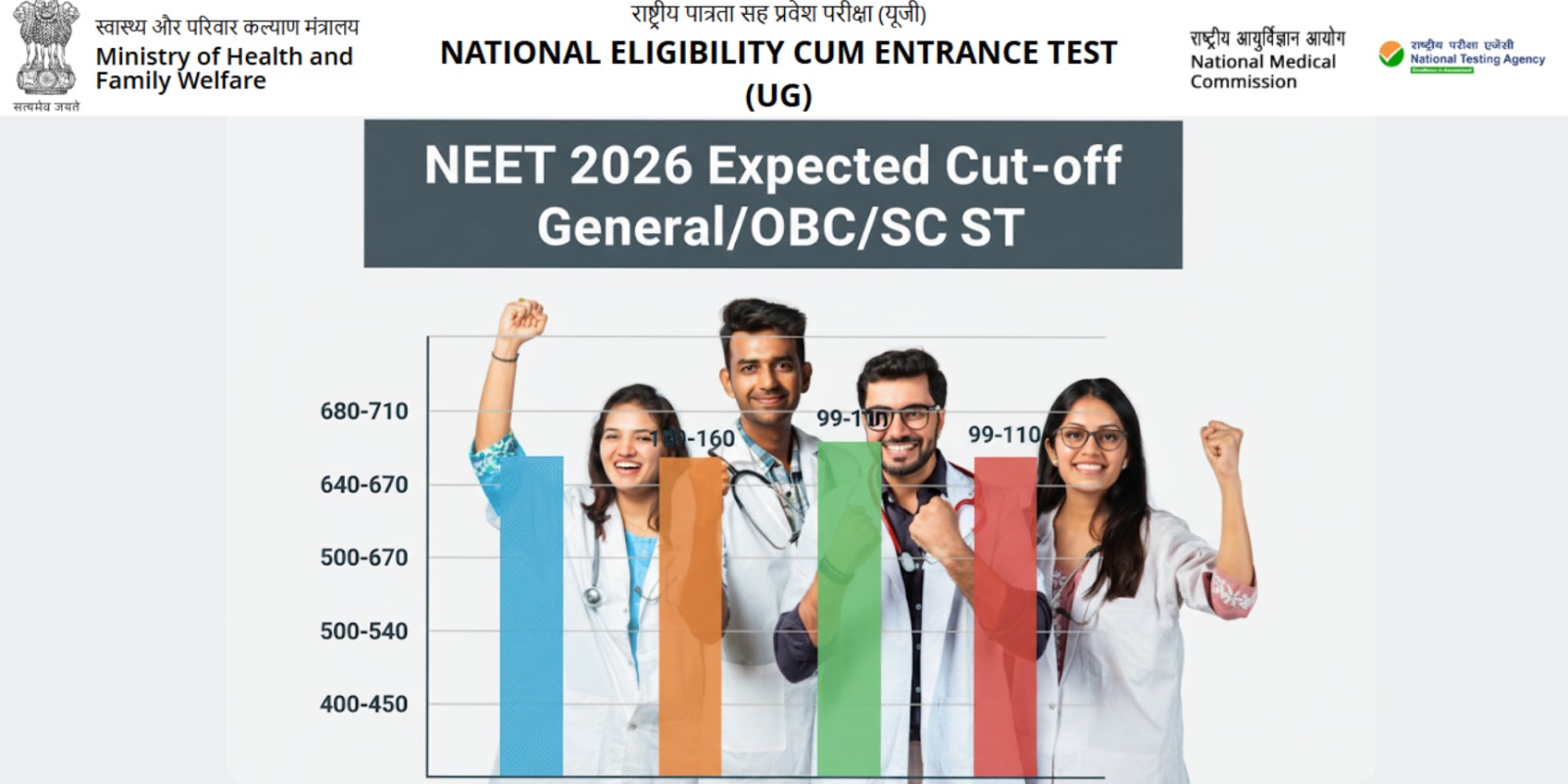
The National Eligibility cum Entrance Test (NEET) is the single gateway for admissions to medical and dental courses (MBBS/BDS) in India. As aspirants gear up for NEET 2026, understanding the expected cut-off is crucial for setting realistic preparation goals.
It’s important to differentiate between two types of cut-offs: the Qualifying Cut-off (minimum marks required to be eligible for counseling) and the Admission Cut-off (the closing rank/score for securing a seat in a specific college). The Admission Cut-off is always significantly higher, especially for government colleges.
Understanding the Expected Qualifying Cut-off for NEET 2026
The qualifying cut-off is released by the National Testing Agency (NTA) in the form of a percentile. Based on the reservation criteria and trends from previous years, here is the expected qualifying percentile and score range for NEET 2026:
| Category | Qualifying Percentile | Expected Qualifying Score Range (Tentative) |
| General/EWS | 50th Percentile | 160-170+ marks |
| OBC | 40th Percentile | 130-135+ marks |
| SC | 40th Percentile | 130-135+ marks |
| ST | 40th Percentile | 130-135+ marks |
Export to Sheets
Target Scores for Government MBBS/BDS Admission
While the qualifying marks make you eligible for counseling, securing a seat in a government medical college requires a much higher score. These scores fluctuate yearly based on competition and paper difficulty.
| Category | Expected Safe Score for Government MBBS Admission |
| General/EWS | 620+ marks |
| OBC | 600+ marks |
| SC | 500+ marks |
| ST | 480+ marks |
(Note: Scores for AIIMS Delhi, MAMC, and other top-tier colleges are generally 670+ for the General category.)
Key Factors Influencing the NEET 2026 Cut-off
The final cut-off scores are dynamic and depend on several crucial factors:
- Difficulty Level of the Exam: A tougher paper generally leads to lower cut-off scores, while an easier paper can inflate scores and raise the cut-off.
- Number of Candidates: An increase in the number of candidates appearing for the exam raises the competition, which typically pushes the cut-off higher.
- Availability of Seats: Any increase in the number of MBBS/BDS seats in colleges across India can help lower the admission cut-off, while stable seat counts against rising applicants will increase it.
- Previous Year Trends: Historically, cut-offs have generally shown an upward trend, which acts as a baseline for future predictions.
How to Prepare: Your Action Plan
Instead of fixating on the minimum qualifying score, your goal should be to maximize your score to secure a good rank and college.
- Aim High: Target at least 10–15 marks above the previous year’s closing cut-off for your desired college and category.
- Master NCERT: The NEET syllabus is primarily based on NCERT books for Physics, Chemistry, and Biology (Class 11 & 12). Strong foundational knowledge is non-negotiable.
- Practice with Mock Tests: Regularly take full-length mock tests to improve your speed, accuracy, and time management, especially focusing on avoiding negative marking.
Check Your Score: The Formula
To estimate your raw score after the exam, you can use the official answer key and the following marking scheme:
NEET Score=((Number of Correct Answers×4)−(Number of Incorrect Answers×1))
Final cut-offs and official score ranges will only be announced by the NTA after the declaration of the NEET 2026 results. Until then, use these expected ranges to guide your preparation and stay focused!
2026 NEET Qualifying Percentile and Expected Marks
The NEET cut-off is announced in two forms: the Qualifying Percentile (the minimum needed to be eligible for counseling) and the Admission Cut-off (the final score/rank at which seats close for various colleges).
Here are the expected qualifying percentiles and a broad expected qualifying marks range based on recent trends:
| Category | Qualifying Percentile | Expected Qualifying Marks Range (Out of 720) |
| General/EWS (UR) | 50th Percentile | 686−144 |
| OBC | 40th Percentile | 143−113 |
| SC | 40th Percentile | 143−113 |
| ST | 40th Percentile | 143−113 |
Export to Sheets
Note: The exact qualifying marks are released by the National Testing Agency (NTA) with the results. These figures are based on the previous year’s trends.
Expected “Safe Score” for Government MBBS Seats
While the qualifying marks are the minimum to be eligible, a much higher score is required to secure a seat in a Government Medical College (GMC).
A safe score is an estimated score range that generally gives a high probability of securing an MBBS seat under the All India Quota (AIQ) or a State Quota. These are based on past year closing ranks:
| Category | Expected Safe Score for Government MBBS (All India Quota – AIQ) | Expected Safe Score for Government MBBS (State Quota) |
| General | 650+ | 600−650+ (Varies greatly by state) |
| OBC | 630−650+ | 550−620+ (Varies greatly by state) |
| SC | 500−550+ | 420−500+ (Varies greatly by state) |
| ST | 500−545+ | 420−485+ (Varies greatly by state) |
Export to Sheets
For admission to top-tier colleges like AIIMS Delhi, the target score for the General category usually exceeds 680+ marks, with similarly high, but slightly lower, requirements for reserved categories.
Factors Influencing the Final Cut-Off
The actual NEET cut-off marks for admission fluctuate annually due to several key factors:
- Number of Candidates: An increase in the number of students appearing leads to higher competition and potentially higher cut-offs.
- Difficulty Level of the Exam: An easier paper generally results in higher scores and therefore a higher cut-off.
- Total Number of Seats: Any change in the number of MBBS seats available nationally or within a state directly impacts the final cut-off.
- Overall Performance of Candidates: The general score distribution and the number of students scoring high marks.
- Reservation Policies: The fixed percentage of seats reserved for different categories (OBC, SC, ST, EWS, PwD) ensures lower admission cut-offs for these groups compared to the General category.
NEET-UGNational Eligibility cum Entrance Test – Undergraduate. The single mandatory entrance examination for admission to MBBS, BDS, and AYUSH (BAMS, BHMS, BUMS, etc.) courses in all medical/dental colleges in India.
| NTA | National Testing Agency. The central government body in India responsible for conducting the NEET-UG examination. |
| NCERT | National Council of Educational Research and Training. The textbooks published by this body (especially for Physics, Chemistry, and Biology of Classes 11 and 12) form the fundamental and primary syllabus base for the NEET exam. |
| AIQ | All India Quota. 15% of the total seats in all government medical/dental colleges (excluding J&K, AIIMS, JIPMER, and central universities before 2024) are reserved for candidates from all states and filled through centralized counselling. |
| SQ | State Quota. The remaining 85% of seats in the government medical/dental colleges of a state are reserved for candidates who hold the domicile/residency of that specific state. |
| MBBS | Bachelor of Medicine and Bachelor of Surgery. The primary undergraduate medical degree in India. |
| BDS | Bachelor of Dental Surgery. The primary undergraduate dental degree in India. |
| PYQs | Previous Year Questions. Question papers from past NEET or AIPMT (its predecessor) exams. Essential for understanding the exam pattern, question format, and high-weightage topics. |
| Mock Test | A practice test designed to simulate the actual NEET exam environment (same duration, number of questions, marking scheme, and pattern) to improve time management and accuracy. |
| SC | Scheduled Caste. A reserved category for socially and economically disadvantaged communities, with a percentage of seats reserved (e.g., 15% in AIQ). |
| ST | Scheduled Tribe. A reserved category for indigenous tribal communities, with a percentage of seats reserved (e.g., 7.5% in AIQ). |
| OBC-NCL | Other Backward Classes – Non-Creamy Layer. A reserved category for candidates belonging to the OBC group whose family income falls below the “creamy layer” limit. (e.g., 27% reservation in AIQ for central institutions). |
| EWS | Economically Weaker Section. A reserved category for candidates not covered under SC/ST/OBC reservation but whose family’s annual gross income is below a certain limit. (e.g., 10% reservation in AIQ). |
| PwD | Persons with Benchmark Disabilities. Candidates with a minimum specified disability are eligible for a horizontal reservation (5%) across all categories (General, SC, ST, OBC, EWS). |
| Counselling | The process conducted by NTA/MCC (Medical Counselling Committee) or state authorities after the NEET result, where candidates choose their courses and colleges based on their rank and category, and seats are allocated. |
Exam Structure & Pattern
| Question | Answer |
| What is the NEET UG 2026 exam? | It is the National Eligibility cum Entrance Test (Undergraduate), a single entrance exam for admission to MBBS, BDS, and other undergraduate medical courses in India. It is conducted by the National Testing Agency (NTA). |
| When will NEET UG 2026 be conducted? | The exam is typically held once a year, usually on the first Sunday of May. The exact date is announced by the NTA. |
| What is the mode of the exam? | NEET UG is conducted in a Pen & Paper (Offline) mode. |
| What is the exam pattern (subjects, questions, marks)? | The paper consists of 180 Multiple-Choice Questions (MCQs) for a total of 720 marks across three subjects: Physics (45 Qs), Chemistry (45 Qs), and Biology (90 Qs – 45 Botany + 45 Zoology). The duration is typically 3 hours. |
| What is the marking scheme? | For every correct answer, +4 marks are awarded. For every incorrect answer, -1 mark is deducted (negative marking). Unattempted questions receive 0 marks. |
| What is the syllabus? | The syllabus primarily covers topics from the NCERT curriculum of Class 11 and Class 12 for Physics, Chemistry, and Biology. |
- Query successful
Try again without apps
It looks like you’re asking for a Frequently Asked Questions (FAQ) list. Since you haven’t specified a topic, I’ll provide FAQs for a popular and highly-searched educational topic: the National Eligibility cum Entrance Test (NEET) UG 2026 for medical admissions in India.
Here is a general FAQ on NEET UG 2026 based on the latest available information:
NEET UG 2026 – Frequently Asked Questions (FAQs)
1. Exam Structure & Pattern
| Question | Answer |
| What is the NEET UG 2026 exam? | It is the National Eligibility cum Entrance Test (Undergraduate), a single entrance exam for admission to MBBS, BDS, and other undergraduate medical courses in India. It is conducted by the National Testing Agency (NTA). |
| When will NEET UG 2026 be conducted? | The exam is typically held once a year, usually on the first Sunday of May. The exact date is announced by the NTA. |
| What is the mode of the exam? | NEET UG is conducted in a Pen & Paper (Offline) mode. |
| What is the exam pattern (subjects, questions, marks)? | The paper consists of 180 Multiple-Choice Questions (MCQs) for a total of 720 marks across three subjects: Physics (45 Qs), Chemistry (45 Qs), and Biology (90 Qs – 45 Botany + 45 Zoology). The duration is typically 3 hours. |
| What is the marking scheme? | For every correct answer, +4 marks are awarded. For every incorrect answer, -1 mark is deducted (negative marking). Unattempted questions receive 0 marks. |
| What is the syllabus? | The syllabus primarily covers topics from the NCERT curriculum of Class 11 and Class 12 for Physics, Chemistry, and Biology. |
Export to Sheets
2. Eligibility Criteria
| Question | Answer |
| What is the minimum age limit? | A candidate must have completed 17 years of age on or before December 31 of the year of admission (i.e., December 31, 2026). |
| Is there an upper age limit? | No, as per the latest ruling, there is currently no upper age limit to appear for the NEET UG exam. |
| Is there a limit on the number of attempts? | No, there is no restriction on the number of attempts a candidate can take. |
| What are the minimum qualifying marks in Class 12? | The minimum aggregate marks required in Physics, Chemistry, and Biology/Biotechnology for the qualifying exam (Class 12 or equivalent) are: – General Category: 50% – OBC/SC/ST: 40% – PwD (General): 45% |
| Are students who are appearing for Class 12 boards eligible? | Yes, candidates appearing for the Class 12 examination in 2026 are also eligible to apply. |
3. Reservation Policy (For All India Quota – AIQ)
| Category | Reservation Percentage (in AIQ) |
| OBC (Non-Creamy Layer – NCL) | 27% |
| Scheduled Castes (SC) | 15% |
| Scheduled Tribes (ST) | 7.5% |
| Economically Weaker Sections (EWS) | 10% |
| Persons with Disability (PwD) | 5% (Horizontal reservation across all categories) |