The Joint Entrance Examination (JEE) Main is the gateway to some of India’s most prestigious engineering institutes, including the NITs, IIITs, and GFTIs. As you set your sights on JEE Main 2026, understanding the crucial relationship between your Marks, Percentile, and Rank is key to setting realistic goals and strategizing your preparation.
The National Testing Agency (NTA) is responsible for conducting JEE Main and implementing a unique system of Normalization to ensure fairness across different exam shifts, which is why your raw Marks are not the final deciding factor.
Here’s a breakdown of what each term means and what you can expect for the 2026 examination, based on past trends and expert analysis.

1. JEE Main Marks: Your Raw Score
The Marks are the total raw score you achieve out of 300. This is calculated directly from your attempted questions (correct answers get 4 marks, incorrect answers typically get -1 mark).
- Significance: Marks reflect your absolute performance in the paper you attempted. However, since the exam is held in multiple sessions with varying difficulty, marks alone cannot determine your final merit.
2. JEE Main Percentile: Your Relative Performance
The Percentile Score (or NTA Score) is the most critical component. It is a measure of your performance relative to all other candidates who appeared in your specific examination session.
The percentile is calculated using the formula:
Percentile Score=Total number of candidates who appeared in the sessionNumber of candidates with raw scores equal to or less than your score×100
- Significance: A 99 percentile means you have scored higher than 99% of the candidates in your session. The highest score in any session will be 100 percentile. The NTA uses the better of your percentile scores (if you appear in both sessions) for the final merit list.
3. JEE Main Rank: Your All India Position
Your All India Rank (AIR) is the final, most crucial factor for admissions into engineering colleges. It is derived from the Percentile Score after the normalization process across all shifts and sessions is complete.
- Significance: The lower your rank, the better your chances of securing a seat in a top-tier NIT or IIIT. Rank is what is primarily used during the JoSAA counseling process.
JEE Main 2026: Expected Marks vs Percentile vs Rank
While the actual cutoff and ranking will depend on factors like the number of candidates and paper difficulty, the following table provides an expected analysis for JEE Main 2026 based on previous years’ data.
| Marks (Out of 300) | Expected Percentile Range | Expected All India Rank (AIR) Range | Admission Possibility |
| 280 – 300 | 99.99+ to 100 | 1 – 1,000 | Top NITs/IIITs (Any Branch) |
| 250 – 279 | 99.8 – 99.99 | 1,000 – 4,000 | Excellent NIT/IIIT Branches |
| 200 – 249 | 99 – 99.8 | 4,000 – 10,000 | Good NIT/IIIT Branches |
| 150 – 199 | 97 – 99 | 10,000 – 30,000 | Upper-Mid NITs/IIITs/Top GFTIs |
| 120 – 149 | 95 – 97 | 30,000 – 50,000 | Mid-level NITs/IIITs/Good GFTIs |
| 90 – 119 | 90 – 95 | 50,000 – 1,00,000 | State Engineering Colleges/Lower GFTIs |
Unlocking Your Potential: JEE Main Marks vs Percentile vs Rank 2026 (Expected Analysis)
The Joint Entrance Examination (JEE) Main is the gateway to some of India’s most prestigious engineering institutes, including the NITs, IIITs, and GFTIs. As you set your sights on JEE Main 2026, understanding the crucial relationship between your Marks, Percentile, and Rank is key to setting realistic goals and strategizing your preparation.
The National Testing Agency (NTA) is responsible for conducting JEE Main and implementing a unique system of Normalization to ensure fairness across different exam shifts, which is why your raw Marks are not the final deciding factor.
Here’s a breakdown of what each term means and what you can expect for the 2026 examination, based on past trends and expert analysis.
1. JEE Main Marks: Your Raw Score
The Marks are the total raw score you achieve out of 300. This is calculated directly from your attempted questions (correct answers get 4 marks, incorrect answers typically get -1 mark).
- Significance: Marks reflect your absolute performance in the paper you attempted. However, since the exam is held in multiple sessions with varying difficulty, marks alone cannot determine your final merit.
2. JEE Main Percentile: Your Relative Performance
The Percentile Score (or NTA Score) is the most critical component. It is a measure of your performance relative to all other candidates who appeared in your specific examination session.
The percentile is calculated using the formula:
Percentile Score=Total number of candidates who appeared in the sessionNumber of candidates with raw scores equal to or less than your score×100
- Significance: A 99 percentile means you have scored higher than 99% of the candidates in your session. The highest score in any session will be 100 percentile. The NTA uses the better of your percentile scores (if you appear in both sessions) for the final merit list.
3. JEE Main Rank: Your All India Position
Your All India Rank (AIR) is the final, most crucial factor for admissions into engineering colleges. It is derived from the Percentile Score after the normalization process across all shifts and sessions is complete.
- Significance: The lower your rank, the better your chances of securing a seat in a top-tier NIT or IIIT. Rank is what is primarily used during the JoSAA counseling process.
JEE Main 2026: Expected Marks vs Percentile vs Rank
While the actual cutoff and ranking will depend on factors like the number of candidates and paper difficulty, the following table provides an expected analysis for JEE Main 2026 based on previous years’ data.
| Marks (Out of 300) | Expected Percentile Range | Expected All India Rank (AIR) Range | Admission Possibility |
| 280 – 300 | 99.99+ to 100 | 1 – 1,000 | Top NITs/IIITs (Any Branch) |
| 250 – 279 | 99.8 – 99.99 | 1,000 – 4,000 | Excellent NIT/IIIT Branches |
| 200 – 249 | 99 – 99.8 | 4,000 – 10,000 | Good NIT/IIIT Branches |
| 150 – 199 | 97 – 99 | 10,000 – 30,000 | Upper-Mid NITs/IIITs/Top GFTIs |
| 120 – 149 | 95 – 97 | 30,000 – 50,000 | Mid-level NITs/IIITs/Good GFTIs |
| 90 – 119 | 90 – 95 | 50,000 – 1,00,000 | State Engineering Colleges/Lower GFTIs |
Export to Sheets
Disclaimer: This table is based on past trends and serves as an estimation only. The actual values may vary for JEE Main 2026.
Key Factors that Influence the Correlation
The relationship between your marks, percentile, and rank is not static. It is dynamically affected by:
- Normalization Process: Since different shifts have different difficulty levels, the NTA uses normalization to ensure a fair comparison. This is why two students with the exact same marks in different shifts can have different percentiles.
- Number of Candidates: An increase in the total number of students taking the exam makes the competition tougher. Even a slight drop in marks can lead to a significant drop in percentile and rank.
- Difficulty of the Paper: If the paper in a session is generally tougher, a lower raw score might translate to a higher percentile compared to a session with an easier paper.
Setting Your Target Score for 2026
If you are aiming for a Top Tier NIT/IIIT with a popular branch (like CSE, ECE, Mechanical), you should aim to score 200+ marks to ensure a percentile in the 99+ range and a rank within the top 15,000.
For students aspiring to qualify for JEE Advanced, the qualifying cutoff percentile for the General category usually falls around the 90-93 percentile mark (subject to change year-on-year).
| NTA Score / Percentile Score | This is the normalized score used for the JEE Main result. It is not the same as the raw marks or percentage. Your percentile score indicates the percentage of candidates who scored equal to or less than your raw score in your particular examination session. It is calculated up to 7 decimal places to minimize ties. The highest raw score in a session is equated to a 100 percentile. |
Export to Sheets
2. JEE Main Normalization Process
| Normalization Process | The statistical method adopted by the National Testing Agency (NTA) to ensure fairness in the result for an exam conducted in multiple shifts and on different days. It adjusts the raw scores to a percentile scale to account for any variation in the difficulty level of the question papers across different sessions. |
Export to Sheets
3. Qualifying Cutoff (JEE Advanced Eligibility)
| Qualifying Cutoff | The minimum percentile score a candidate must achieve in JEE Main to be eligible to appear for the JEE Advanced examination. This cutoff is released by the NTA and is different for each reservation category (General, OBC-NCL, EWS, SC, ST, PwD). This is separate from the “Admission Cutoff.” |
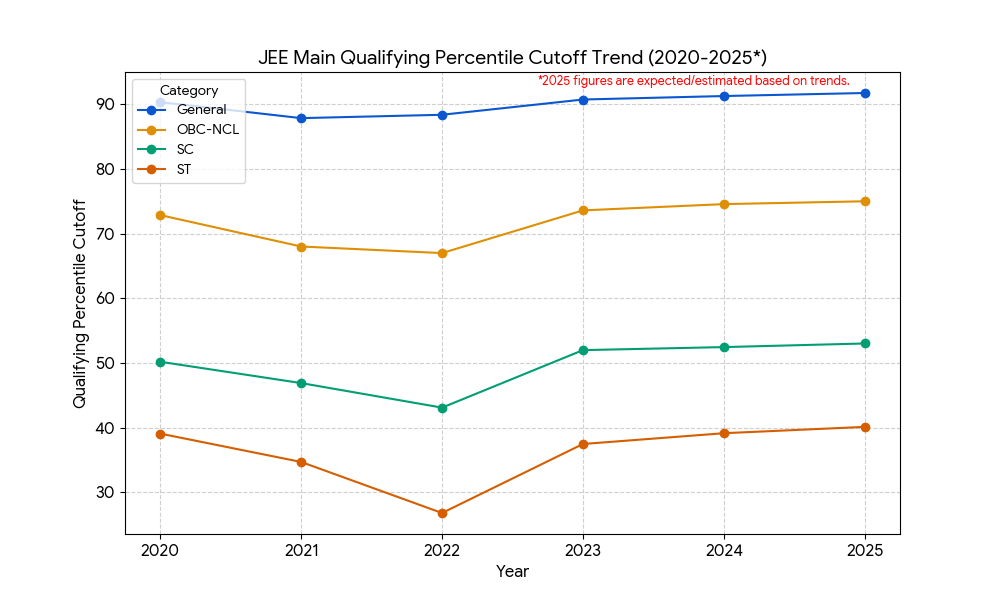
JEE Main Qualifying Percentile Cutoff for various categories from 2020 to 2025 (with 2025 being an expected value).
The Qualifying Cutoff is the minimum percentile score required to be eligible for the JEE Advanced exam.
General Category (Blue Line): The cutoff percentile remains the highest and has generally been on an upward trend, fluctuating between ≈87.89 and ≈91.78.
Reserved Categories (OBC-NCL, SC, ST): These categories consistently maintain significantly lower cutoff percentiles due to reservation policies.
Trend Stability and Fluctuation: The cutoffs for all categories saw a sharp dip in 2022, but have shown a tendency to increase again in the following years (2023-2025), reflecting rising competition.
OBC-NCL (Orange Line): The percentile has been in the range of ≈67.00 to ≈75.02.
ST (Red Line): This category consistently has the lowest cutoff, ranging from ≈26.77 to ≈40.10.
How many sessions is JEE Main conducted in?JEE Main is conducted in two sessions (Session 1 typically in January, and Session 2 typically in April).Can I apply for both sessions?Yes. You can choose to apply for one session or both sessions. You must fill out one application form, with the option to apply for the second session (if not chosen initially) during a re-opening of the application window.Which score is considered for the final result/ranking?The best NTA Score (Percentile) secured by a candidate from all the sessions they appeared in will be considered for the final merit list and All India Rank (AIR).What is the marking scheme?For both MCQ and Numerical Value questions: +4 marks for every correct answer and -1 mark for every incorrect answer (Negative Marking). There is no negative marking for unanswered questions.How many questions do I have to attempt?Out of 90 questions (30 each in Physics, Chemistry, and Mathematics), you are required to attempt 75 questions in total (20 MCQs and 5 out of 10 Numerical Value questions in each of the three subjects).What is the total mark for JEE Main?The total marks for Paper 1 (B.E./B.Tech) is 300.
Is there an age limit for JEE Main?No, there is no age limit for candidates appearing in the JEE Main examination.What is the 75% criterion for admission?For admission to NITs, IIITs, and other CFTIs, a candidate must have secured at least 75% marks in their Class 12 (or equivalent) examination, or be in the top 20 percentile of their respective board. This rule is for admission, not for appearing in JEE Main.How many attempts can I give in JEE Main?A candidate can appear for JEE Main for three consecutive years (the year of passing Class 12 and the next two years). Since the exam is held in two sessions each year, there are technically up to 6 total opportunities within those 3 years.Is the JEE Main score valid for subsequent years?No. The JEE Main score is valid only for the current academic year.
What is Normalization in JEE Main?Normalization is a statistical procedure used by the NTA to ensure fairness and equity across different exam shifts/sessions that may vary in difficulty. It converts a candidate’s raw score into a Percentile Score.What is the Percentile Score (NTA Score)?The Percentile Score indicates the percentage of candidates who scored equal to or less than a particular candidate in their respective session. The final merit list is prepared using the best percentile score obtained by the candidate.How is the All India Rank (AIR) determined?The AIR is determined by compiling the best NTA Scores (Percentiles) of all candidates across both sessions. The ranks are then assigned in descending order of the final NTA Score.How are ties in Percentile Score resolved?Ties are resolved using subject-wise percentiles in the following order: 1. Mathematics Percentile 2. Physics Percentile 3. Chemistry Percentile 4. Candidate’s Age (older candidate is given higher rank) 5. Application Number (in ascending order)What is the minimum score to qualify for JEE Advanced?You must secure a percentile score equal to or above the JEE Main Qualifying Cutoff for your respective category (General, OBC-NCL, SC, ST, EWS, PwD) to be eligible for JEE Advanced. This cutoff changes every year.
Final Takeaway
Don’t obsess over predicting your exact rank right now. Instead, focus on maximizing your raw Marks through consistent, smart preparation and practice. A higher raw score, especially coupled with high accuracy, is the best way to secure an excellent Percentile, which in turn guarantees a strong Rank for your JEE Main 2026 admissions!