Sandip University B.Tech in Aerospace Engineering Admission 2026: Eligibility, Course, Fees, Career Scope & Admission Guide
Introduction
Aerospace engineering is one of the most exciting engineering disciplines for students interested in aircraft, aviation technology, aerodynamics, propulsion systems, spacecraft, design, manufacturing, and advanced engineering. With continued developments in aviation, drones, satellites, space exploration, defense technology, and unmanned aerial systems, students are increasingly exploring aerospace engineering as a specialized career path.
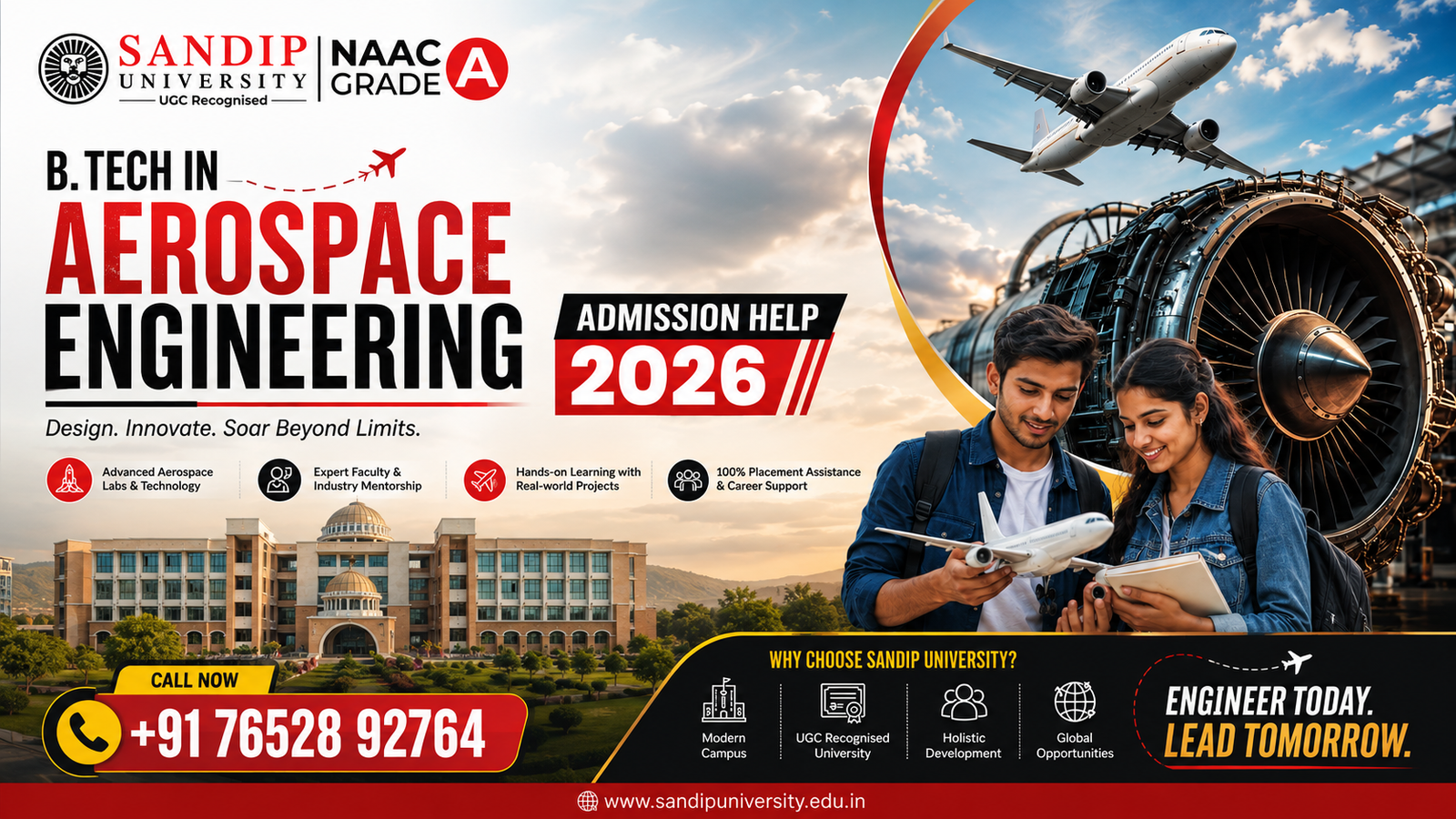
For students considering this field, Sandip University B.Tech in Aerospace Engineering Admission 2026 can be an option worth researching. The program is intended to help students develop a foundation in engineering principles while progressing toward specialized aerospace subjects.
A B.Tech in Aerospace Engineering generally combines classroom learning, laboratory work, engineering design, numerical analysis, projects, and practical exposure. Students can study how aircraft fly, how propulsion systems operate, how aerospace structures are designed, and how engineering principles are applied to aviation and space systems.
This guide explains the major aspects students should consider for Sandip University B.Tech in Aerospace Engineering Admission 2026, including eligibility, curriculum, skills, career scope, higher education options, fees, scholarships, and the admission process.
Important: Admission criteria, fees, scholarships, entrance requirements, curriculum, and other university policies can change for the 2026 session. Applicants should verify current information from Sandip University’s official admission resources before making a decision.
About B.Tech in Aerospace Engineering
B.Tech in Aerospace Engineering is typically a four-year undergraduate engineering degree focusing on the design, analysis, development, testing, and operation of aircraft and related aerospace systems.
The discipline draws heavily from mathematics, physics, mechanics, materials science, electronics, computing, and engineering design.
Students may encounter topics connected with:
- Aerodynamics
- Aircraft structures
- Flight mechanics
- Propulsion systems
- Engineering mechanics
- Thermodynamics
- Fluid mechanics
- Aerospace materials
- Aircraft design
- Control systems
- Computational methods
- Avionics fundamentals
- Manufacturing technology
- Unmanned aerial vehicles
- Engineering mathematics
The exact subjects and semester structure depend on the university’s applicable curriculum.
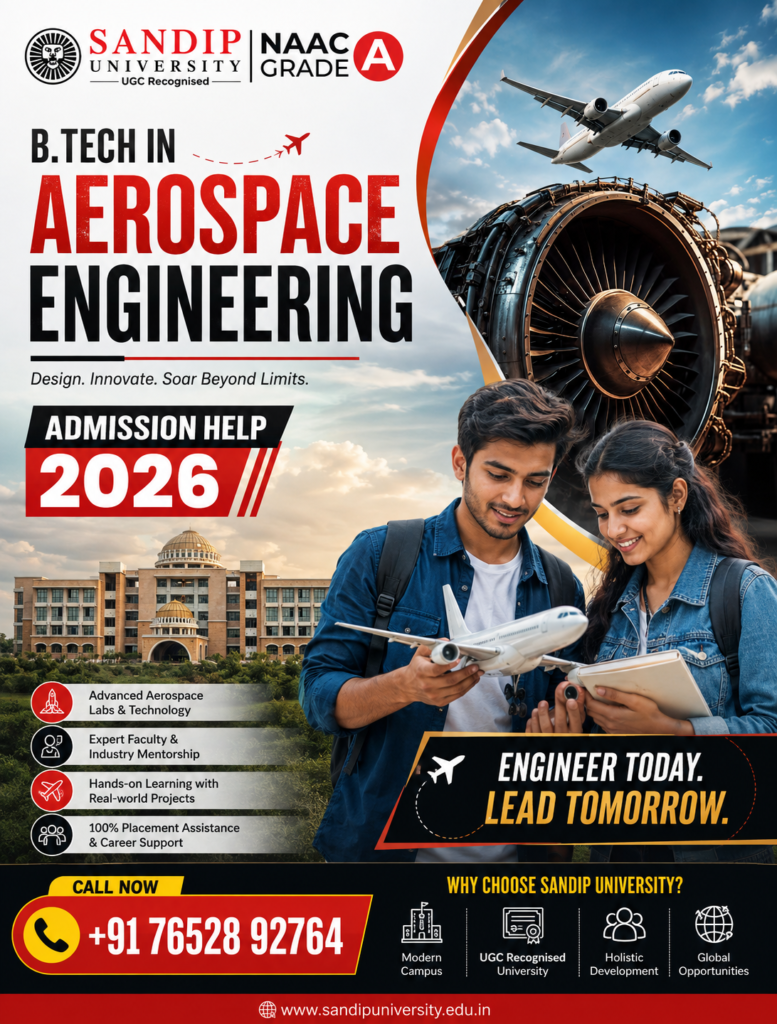
Sandip University B.Tech in Aerospace Engineering Admission 2026
Students interested in Sandip University Aerospace Engineering Admission 2026 should begin preparing early.
Admission normally involves checking the university’s eligibility requirements, completing an application, submitting academic details and required documents, and satisfying any applicable selection or entrance requirements.
Before submitting an application, students should verify the latest information regarding the 2026 academic session, particularly application deadlines and eligibility criteria.
Prospective applicants should check:
Eligibility criteria: Confirm the required Class 12 subjects, minimum academic requirements, and other conditions.
Entrance requirements: Check whether admission is based on qualifying examination marks, an entrance examination, or another selection procedure.
Application dates: Admission schedules can change each academic year.
Fees: Verify tuition and other applicable university charges.
Scholarships: Check current scholarship eligibility, application procedures, and conditions.
Documents: Keep academic and identification documents ready before beginning the application process.
Eligibility for B.Tech Aerospace Engineering Admission 2026
Eligibility is one of the first things an applicant should verify.
Engineering programs generally require candidates to have completed 10+2 or an equivalent examination with science subjects, particularly Physics and Mathematics, along with other subjects specified by the institution.
However, students should not rely solely on general engineering eligibility rules.
For Sandip University B.Tech in Aerospace Engineering Admission 2026, applicants should check the official requirements applicable to the 2026 intake.
The university’s published admission information should be treated as the final authority regarding:
- Required subjects
- Minimum percentage
- Recognized qualifying boards
- Entrance examination requirements
- Admission categories
- Diploma/lateral-entry provisions, if available
This prevents students from making application decisions based on outdated eligibility information.
B.Tech Aerospace Engineering Course Duration
A standard B.Tech program in India is generally completed over four academic years, usually divided into eight semesters.
During the initial semesters, students commonly build a foundation in mathematics, physics, programming, mechanics, engineering graphics, electrical/electronics fundamentals, and other basic engineering areas.
Later semesters generally become more specialized.
Students can progress toward aerospace-focused subjects involving aerodynamics, propulsion, aircraft structures, flight dynamics, aerospace materials, control systems, and aircraft design.
Project work may allow students to combine concepts from multiple subjects to solve practical engineering problems.
What Do Students Learn in Aerospace Engineering?
Aerospace engineering extends far beyond learning about airplanes.
Students need to understand the science and engineering principles that determine how aerospace vehicles are designed and operated.
1. Aerodynamics
Aerodynamics examines the movement of air around objects.
Students can learn concepts related to lift, drag, airflow, pressure distribution, and aerodynamic performance.
These principles are fundamental to aircraft and aerospace vehicle design.
2. Propulsion
Propulsion focuses on generating the force required to move an aircraft or aerospace vehicle.
Students may learn about different propulsion principles, thermodynamics, combustion, and engine-related concepts.
3. Aircraft Structures
Aircraft must remain strong while minimizing unnecessary weight.
Structural engineering therefore plays an important role in aerospace applications.
Students can study stresses, loads, deformation, structural analysis, and the behavior of engineering materials.
4. Flight Mechanics
Flight mechanics helps students understand the forces and moments acting on an aircraft and how those factors affect its movement and performance.
5. Aerospace Materials
Aerospace applications require materials capable of operating under demanding conditions.
Students may study metals, alloys, composites, and other engineering materials used in aerospace systems.
6. Aircraft Design
Aircraft design combines multiple disciplines.
Students may need to consider aerodynamics, propulsion, structural performance, stability, weight, safety, and other engineering constraints when developing a design.
Practical Learning in Aerospace Engineering
Engineering education becomes more valuable when theoretical concepts are connected with practical applications.
Students considering an aerospace program should therefore examine the university’s available laboratories, project opportunities, workshops, software facilities, research exposure, and industry interaction.
Practical learning can involve:
- Laboratory experiments
- Computer simulations
- CAD and engineering design
- Technical workshops
- Model development
- Group engineering projects
- Research-oriented assignments
- Internships
- Final-year projects
Applicants should verify the facilities and practical opportunities currently offered for their intended academic session.
Skills Required for Aerospace Engineering
Aerospace engineering can be academically demanding. Students who enjoy mathematics, physics, technology, design, and problem-solving may find the discipline particularly engaging.
Some useful skills include:
Mathematical ability: Engineering analysis frequently involves mathematical models and calculations.
Physics fundamentals: Mechanics, motion, energy, forces, and fluid behavior are central to aerospace engineering.
Analytical thinking: Engineers need to evaluate complex technical problems systematically.
Problem-solving: Designing and improving engineering systems requires logical and creative solutions.
Computer skills: Modern engineering frequently uses simulation, modeling, programming, and design software.
Communication: Engineers must explain designs, results, calculations, and technical decisions clearly.
Teamwork: Aerospace projects often involve multidisciplinary teams.
Students are not expected to possess all these skills before entering university. A B.Tech program is also an opportunity to develop them progressively.
Aerospace Engineering Career Scope
One of the most common questions students ask is: What can I do after B.Tech Aerospace Engineering?
The degree can provide a foundation for opportunities across aerospace, aviation, engineering, manufacturing, research, technology, and related industries.
Potential career areas can include:
- Aerospace engineering
- Aircraft design
- Aerodynamic analysis
- Aerospace manufacturing
- Engineering design
- Quality assurance
- Testing and validation
- Research and development
- UAV and drone technology
- Defense-related engineering
- Aviation technology
- Aerospace structures
- Propulsion-related engineering
- Engineering simulation
Actual job eligibility depends on the employer, job description, technical skills, academic performance, experience, regulatory requirements, and sometimes postgraduate qualifications.
A degree itself does not guarantee placement in a particular organization or role.
Government and Private-Sector Opportunities
Aerospace graduates may explore opportunities in both private and public-sector organizations, subject to recruitment criteria.
Potential sectors include aviation, aerospace manufacturing, defense, research institutions, engineering services, technology companies, drone manufacturers, component manufacturers, and government-linked aerospace organizations.
Recruitment standards vary significantly.
Some positions may require competitive examinations, specific academic qualifications, postgraduate education, technical certifications, or relevant work experience.
Students should therefore build a strong technical profile throughout their undergraduate studies rather than relying solely on the degree title.
Higher Studies After B.Tech Aerospace Engineering
B.Tech graduates who want to specialize further can consider postgraduate education.
Possible areas include:
- M.Tech in Aerospace Engineering
- M.Tech in Aeronautical Engineering
- Propulsion Engineering
- Computational Fluid Dynamics
- Structural Engineering
- Robotics
- Mechanical Engineering
- Space Engineering
- Avionics
- Control Systems
- Materials Engineering
Students interested in research may subsequently explore doctoral programs.
Others may pursue management education or interdisciplinary postgraduate programs depending on their career objectives.
Importance of Projects and Internships
For aerospace students, practical projects can significantly strengthen technical understanding.
A student might work on projects involving:
- Drone design
- UAV systems
- Aircraft models
- Aerodynamic simulations
- Wing design
- Structural analysis
- Propulsion concepts
- Computational fluid dynamics
- CAD modeling
- Flight control concepts
Internships can also expose students to professional engineering environments and help them understand how theoretical concepts are applied to real projects.
Students should actively build a portfolio of technical work during their degree.
Sandip University Aerospace Engineering Fees 2026
Students frequently search for Sandip University B.Tech Aerospace Engineering Fees 2026.
Fees are an important factor, but published figures may vary by academic year and may involve different components.
Depending on university policies, the overall cost may include tuition and other applicable academic or institutional charges.
Students should verify the official 2026 fee structure directly before paying an application or admission-related amount.
When comparing costs, also consider accommodation, transportation, food, study materials, and other personal expenses where applicable.
Scholarships for B.Tech Students
Scholarships can make higher education more accessible for eligible students.
Depending on the university’s policies, scholarships may be connected to academic performance, entrance results, specific categories, or other criteria.
Scholarship schemes and conditions can change between admission cycles.
For the 2026 admission session, applicants should verify:
- Available scholarships
- Eligibility requirements
- Scholarship amount or fee benefit
- Required documents
- Application deadlines
- Renewal conditions
Students should avoid assuming that a scholarship advertised for an earlier academic year automatically applies to 2026.
How to Apply for Sandip University B.Tech Aerospace Engineering Admission 2026
The exact application procedure should be confirmed from the university’s official admission information.
A typical process may involve:
- Reviewing B.Tech Aerospace Engineering eligibility.
- Checking the 2026 admission schedule.
- Completing the relevant application form.
- Providing personal and academic information.
- Uploading or submitting required documents.
- Completing applicable entrance or selection requirements.
- Reviewing the admission decision or offer.
- Completing fee and enrollment formalities within the specified deadline.
Applicants should carefully read the university’s instructions at every stage.
Documents Students Should Keep Ready
Depending on the admission process, students may need documents such as Class 10 and Class 12 academic records, identification documents, photographs, transfer or migration documentation, entrance examination details, and applicable category or eligibility certificates.
The exact list can vary.
Students should use the university’s current admission checklist rather than relying on an older list.
Is Aerospace Engineering a Good Career Choice?
Aerospace engineering can be an excellent academic choice for students genuinely interested in aircraft, flight, engineering design, mathematics, physics, aviation, and advanced technology.
However, it should be selected based on interest and aptitude rather than simply because the field sounds futuristic.
Students should ask themselves:
Do I enjoy physics and mathematics?
Am I interested in understanding how aircraft and aerospace systems work?
Do I like engineering design and problem-solving?
Am I willing to develop technical and computer-based skills?
Would I enjoy working on complex engineering projects?
If the answers are largely positive, aerospace engineering may be worth serious consideration.
Why Consider B.Tech Aerospace Engineering in 2026?
The aerospace sector is influenced by developments in commercial aviation, defense, space technology, drones, autonomous systems, advanced materials, simulation, digital manufacturing, and artificial intelligence.
This creates an environment in which future engineers may need multidisciplinary skills.
For students entering university in 2026, developing capabilities in programming, CAD, simulation, data analysis, communication, and core aerospace fundamentals alongside the degree can improve long-term career flexibility.
Students should focus not only on completing the curriculum but also on building demonstrable technical skills.
Frequently Asked Questions
Is Sandip University offering B.Tech in Aerospace Engineering for 2026?
Students should confirm current program availability and the 2026 intake directly through Sandip University’s official admission information before applying.
What is the duration of B.Tech Aerospace Engineering?
A B.Tech engineering degree is generally four years long and commonly divided into eight semesters, subject to the university’s academic structure.
What is the eligibility for Aerospace Engineering?
Applicants generally need a 10+2 science background with required subjects and must satisfy the university’s applicable admission criteria. Exact requirements for 2026 should be verified officially.
What are the career options after B.Tech Aerospace Engineering?
Graduates may explore aerospace, aviation, aircraft design, manufacturing, UAV technology, engineering services, R&D, testing, simulation, defense-related engineering, and related fields depending on their qualifications and skills.
Can I pursue higher studies after Aerospace Engineering?
Yes. Graduates can explore M.Tech, MS, MBA, research programs, and specialized postgraduate programs in aerospace and related engineering disciplines.
How can I get Sandip University B.Tech Aerospace Engineering Admission Help 2026?
For guidance related to admission, eligibility, fees, scholarships, and course information, students can contact the admission-help number +91 76528 92764. Applicants should independently verify final admission details with the university before making payments or enrollment decisions.
Conclusion
Sandip University B.Tech in Aerospace Engineering Admission 2026 can be explored by students who want to build their education around aircraft, aerospace technology, aerodynamics, propulsion, engineering design, and related technical areas.
Before applying, candidates should carefully research the program’s 2026 eligibility criteria, admission procedure, curriculum, fees, scholarships, facilities, and academic requirements.
At the same time, aspiring aerospace engineers should focus on developing strong fundamentals in mathematics and physics alongside practical abilities in engineering design, programming, simulation, problem-solving, and technical communication.
Aerospace engineering is a specialized field, and long-term success depends on much more than earning a degree. Consistent learning, projects, internships, technical skills, and relevant experience can play an important role in building a competitive career profile.
For students planning their next step, the best approach is to compare options carefully, verify current information, understand the financial commitment, and choose a program aligned with their interests and career goals.
Admission Help 2026: +91 76528 92764