SRM University Sonepat Admission After 12th 2027: Courses, Eligibility, Fees & Career Options

Choosing the SRM university after Class 12 is an important decision that can shape a student’s academic journey and professional future. Students should carefully compare courses, eligibility requirements, admission procedures, fees, practical learning opportunities, and career prospects before selecting an undergraduate programme. SRM University Sonepat Admission After 12th 2027 is an important topic for students who are planning their higher education and exploring suitable degree options for the next academic session.
After completing Class 12, students may consider different academic fields based on their interests, subjects, skills, and career ambitions. Some students want to pursue engineering or computer science, while others prefer management, commerce, law, or other professional disciplines. Understanding the admission process and available options can help students make a more informed decision.
Before applying, candidates should verify the latest programme list, eligibility criteria, application requirements, fee structure, and important dates for the 2027 academic session. These details can vary by programme and may change from one admission cycle to another.
For admission-related assistance, students can call +91 7652892764.
Why Consider SRM University Sonepat After Class 12?
Selecting a SRM university involves more than choosing a degree. Students should consider the learning environment, course curriculum, practical exposure, academic support, and opportunities to develop professional skills.
When researching SRM, prospective students should compare the programmes available and understand how each course aligns with their long-term goals. A suitable undergraduate degree can help students build subject knowledge, improve problem-solving abilities, and prepare for employment or further education.
Some important factors to consider include:
- Academic programmes: Explore courses that match your interests and Class 12 qualifications.
- Practical learning: Review the practical work, assignments, laboratory activities, and projects included in the curriculum.
- Skill development: Consider whether the programme helps develop communication, analytical thinking, teamwork, and technical skills.
- Career preparation: Investigate internships, placement assistance, industry exposure, and professional development opportunities.
- Financial planning: Understand the total cost of education before making a commitment.
- Future opportunities: Compare the career paths and higher education options associated with the degree.
Students should confirm the availability of particular facilities and services directly with the university rather than relying on assumptions or general promotional information.
SRM University Sonepat Courses After 12th
The right course depends on your academic background, personal interests, and future plans. Students should explore the university’s current undergraduate offerings and verify which specific programmes are available for the 2027 admission session.
1. Engineering and Technology
Engineering can be an appropriate choice for students interested in mathematics, science, technology, innovation, and problem-solving. Undergraduate engineering programmes generally focus on developing technical knowledge and applying scientific principles to practical challenges.
Depending on the programmes available, students may investigate areas such as computer science, electronics, electrical engineering, mechanical engineering, and other engineering disciplines.
Engineering education commonly includes theoretical subjects, laboratory sessions, technical assignments, and project work. Students should examine the curriculum carefully to understand the subjects covered and the skills they will develop throughout the degree.
Before applying, candidates should check the required Class 12 subjects, minimum qualifying marks, entrance examination requirements, and any programme-specific admission conditions.
Possible career paths: Software engineer, systems engineer, design engineer, technical analyst, quality engineer, and other specialised engineering positions, depending on the degree and skills acquired.
2. Computer Science and Information Technology
Students interested in programming, websites, mobile applications, databases, cybersecurity, and emerging digital technologies can investigate undergraduate programmes related to computer science and information technology.
Computer-related education may introduce students to programming concepts, software development, data structures, database management, operating systems, and other technical subjects, depending on the course curriculum.
Students should compare the available specialisations and determine whether the curriculum supports their interests. Practical assignments and independent projects can help students understand how software and digital systems work.
To prepare for a technology career, students can also practise coding, create web applications, learn version control, and maintain a portfolio of completed projects.
Possible career paths: Software developer, web developer, application developer, junior data analyst, IT support specialist, software testing trainee, and other technology-related roles, depending on qualifications and employer requirements.
3. Management and Business Administration
Students interested in business operations, marketing, leadership, communication, entrepreneurship, and organisational management may explore undergraduate management programmes.
Management education can introduce learners to business fundamentals, marketing, financial management, organisational behaviour, business communication, and decision-making. Group assignments and presentations can also help students improve their communication and teamwork abilities.
Candidates should examine the curriculum and confirm the programme’s duration, eligibility requirements, fees, and admission procedure before applying.
Students who want to build a career in business should develop practical skills alongside their academic knowledge. Presentation skills, analytical thinking, professional communication, and an understanding of customer needs can be useful in a variety of industries.
Possible career paths: Marketing executive, business development executive, sales coordinator, operations executive, management trainee, and entrepreneurship-related opportunities.
4. Commerce, Accounting, and Finance
Commerce-related programmes may suit students interested in accounting, taxation, banking, financial planning, business administration, and corporate operations.
Students should review the subjects included in each degree and determine whether the course supports their intended career. Those interested in professional qualifications should also check the relevant professional body’s eligibility requirements and examination structure.
A strong understanding of accounting principles, financial concepts, business communication, and spreadsheet tools can help students prepare for suitable entry-level roles.
Possible career paths: Accounts assistant, finance executive, audit assistant, tax assistant, banking support professional, and business operations associate, depending on qualifications and experience.
5. Law and Legal Studies
Students interested in legal systems, public policy, corporate regulations, social justice, and legal research may investigate undergraduate law programmes, subject to the university’s current offerings.
Before selecting a law programme, candidates should verify the course structure, academic eligibility, entrance requirements, and applicable professional recognition or approval. They should also understand any additional qualifications or registration requirements associated with their intended legal career.
Students can develop useful skills by practising legal research, analytical writing, public speaking, and structured argumentation.
Possible career paths: Legal research assistant, legal associate trainee, compliance assistant, and further study toward eligible legal professions.
6. Other Undergraduate Fields
Students interested in communication, humanities, social sciences, creative disciplines, or other professional subjects can investigate additional programmes offered for the 2027 session.
The suitability of a course depends on its curriculum, admission requirements, practical components, and future opportunities. Students should compare learning outcomes rather than selecting a programme simply because it is popular.
Before making a final decision, verify the exact programme name, available specialisations, course duration, and qualification awarded.
SRM University Sonepat Eligibility Criteria for 2027
SRM university Eligibility requirements differ between undergraduate programmes. Students should review the latest admission information for their chosen course before submitting an application.
Common eligibility factors include:
- Completion of Class 12 from a recognised education board.
- Minimum qualifying marks prescribed for the selected programme.
- Required subjects in Class 12, particularly for science and technical courses.
- Entrance examination or merit-based admission requirements, where applicable.
- Additional programme-specific conditions, if any.
For example, some engineering programmes may require Physics and Mathematics alongside other prescribed subjects. Management, commerce, and other programmes may have different requirements.
Students should not assume that the same eligibility criteria apply to every course. If a candidate is unsure whether their academic background meets the requirements, they should request clarification from the admissions team before applying.
Checking eligibility early can help students shortlist suitable programmes, prepare the necessary documents, and avoid preventable application delays.
SRM University Sonepat Admission Process 2027
SRM university admission process can make planning easier. The following steps provide a general guide, but the actual procedure may differ according to the programme and the university’s current admission policy.
Step 1: Research the Available Courses
Begin by identifying courses that match your interests, Class 12 subjects, academic performance, and career plans.
Compare the syllabus, course duration, specialisations, practical learning components, and future study options. Create a shortlist of programmes that suit your goals and qualifications.
Step 2: Check the Eligibility Requirements
Review the academic qualifications, minimum marks, required subjects, and entrance examination conditions for each shortlisted programme.
If a programme has specific admission requirements, confirm that you meet them before proceeding with the application.
Step 3: Understand the Application Procedure
Follow the university’s current application instructions. Provide accurate academic and personal details, and check all entries before submitting the form.
Determine whether your selected course requires an entrance examination, interview, counselling session, or additional assessment.
Step 4: Prepare the Required Documents
Applicants may be asked to provide documents such as:
- Class 10 marksheet or certificate.
- Class 12 marksheet or provisional result, where accepted.
- Valid identity proof.
- Recent passport-size photographs.
- Transfer or migration certificate, if required.
- Entrance examination scorecard, where applicable.
- Additional certificates specified by the university.
The final document list depends on the programme and the applicant’s circumstances. Follow the current instructions issued by the university.
Step 5: Review Fees and Payment Terms
Before paying, request a clear breakdown of application charges, tuition fees, other compulsory charges, payment deadlines, and refund rules.
Keep the payment receipt and application confirmation for future reference.
Step 6: Complete the Remaining Formalities
Follow the instructions regarding document verification, counselling, seat confirmation, and enrolment. Admission should be considered confirmed only after all required formalities have been completed according to the university’s rules.
SRM University Sonepat Fees 2027
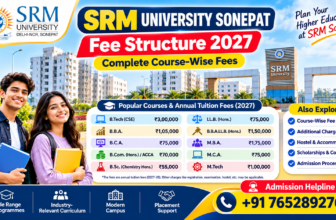
The total cost of undergraduate education is an important factor for students and families. Fees depend on the programme selected and the university’s applicable fee structure.
When comparing costs, students should consider more than tuition alone. Potential expenses may include:
- Application or registration charges.
- Tuition fees.
- Examination and academic charges.
- Hostel and accommodation expenses, if applicable.
- Transport and other optional services.
- Security deposits or other charges, where applicable.
Students should request the latest fee schedule for the 2027 academic session and confirm which charges are compulsory. They should also ask about payment deadlines, instalment options, and refund conditions.
Avoid relying on an estimated amount without confirming that it applies to the selected course and admission year. If scholarships or concessions are available, check their eligibility criteria and whether they reduce tuition fees or other charges.
A realistic budget can help families plan more effectively and avoid unexpected financial pressure during the academic year.
It can also improve navigation by connecting related articles and admission information.
For this blog, choose a relevant existing page about courses, eligibility, or admissions. Add the internal link naturally within a sentence that provides useful information to the reader.
Students exploring higher education opportunities can learn more about SRM University courses, eligibility criteria, and admission options before selecting a programme.
SRM University courses, eligibility criteria, and admission options as the anchor text if it accurately describes the destination page.
Career Opportunities After Graduation
Career opportunities depend on the selected degree, practical experience, communication skills, technical knowledge, and employer requirements. Students should research possible career paths before choosing an undergraduate programme.
Technology and Software Careers
Graduates from suitable computing and engineering programmes may explore software development, web development, software testing, technical support, systems operations, and other technology-related positions.
Practical projects can help students demonstrate their skills. Internships, coding practice, portfolio development, and familiarity with relevant tools may also improve their readiness for entry-level roles.
Business and Management Careers
Students completing relevant management programmes may investigate marketing, sales, business development, operations, customer relations, and management trainee opportunities.
Communication, teamwork, analytical thinking, and an understanding of business processes can be valuable across these fields.
Commerce and Finance Careers
Commerce graduates may explore accounting support, financial operations, taxation assistance, banking services, and administrative positions, subject to employer requirements.
Additional certifications or professional qualifications may be helpful for specialised career paths.
Law and Other Professional Careers
Students completing eligible law or other professional programmes can explore relevant entry-level opportunities and further education. Some professional roles require additional examinations, registration, or qualifications.
Students should research the actual requirements of their preferred career rather than assuming that a degree alone automatically qualifies them for every role.
How to Choose the Right Course After Class 12
Choosing a suitable degree becomes easier when you evaluate your interests, academic strengths, and long-term plans.
Identify your interests: Think about the subjects you enjoy and the type of work you would like to do in the future.
Review your academic strengths: Check whether you meet the prescribed subject and marks requirements. Choose a programme that matches your qualifications and willingness to learn.
Compare course curricula: Review the subjects, projects, practical activities, and specialisations included in each programme.
Research career paths: Identify the qualifications and skills employers expect in your preferred field.
Calculate the total cost: Compare tuition, accommodation, travel, and other study-related expenses. Investigate any eligible financial assistance.
Ask questions before applying: Clarify programme availability, eligibility, fees, and deadlines with the relevant admissions team.
The best course is not necessarily the most popular one. It is the programme that aligns with your interests, qualifications, budget, and future ambitions.
Scholarships and Financial Planning
Students should investigate whether scholarships or financial assistance options are available for their intended programme and admission year.
Before applying for financial support, check:
- Academic performance requirements.
- Entrance examination or merit conditions, if applicable.
- Income or other eligibility criteria, where relevant.
- Documents required for verification.
- Application deadlines and renewal conditions.
- Whether the benefit applies to tuition or other charges.
Scholarship policies and award amounts may change. Confirm the current rules directly with the university before including a scholarship in your education budget.
Families should also estimate accommodation, food, travel, books, and other study-related expenses. Planning the full cost of education can help students make a more informed decision.
Tips for a Successful University Application
A well-prepared application can reduce avoidable errors and delays. Students should take the following precautions:
- Keep academic documents ready before starting the application.
- Enter personal information exactly as it appears on official documents.
- Check programme eligibility before submitting the form.
- Review every application field before final submission.
- Save the application number and payment receipt.
- Monitor admission communications and respond within the specified deadlines.
- Ask for clarification whenever a requirement is unclear.
- Keep copies of submitted documents for future reference.
Applicants should always provide accurate information and follow the university’s instructions. Avoid making payments or submitting sensitive documents through unverified channels.
Frequently Asked Questions
1. When should I apply for SRM University Sonepat Admission 2027?
Students should monitor the university’s official admission announcements for the 2027 academic session. Opening dates and deadlines may differ between programmes.
2. Which courses can I pursue after Class 12?
Students can investigate fields such as engineering, computing, management, commerce, law, and other disciplines, depending on their interests. Confirm which specific programmes are offered for the relevant session.
3. What are the eligibility criteria for undergraduate admission?
Eligibility depends on the selected course. Applicants should verify the required Class 12 subjects, minimum marks, and any entrance examination or additional conditions.
4. What are the fees for 2027 admission?
Fees vary by programme and may include tuition and other charges. Request the latest fee structure before making a payment.
5. Can Commerce students apply for undergraduate programmes?
Commerce students can explore programmes for which they satisfy the published eligibility criteria. Check any subject-specific requirements before applying.
6. Are scholarships available for students?
Scholarships or financial assistance may be available under the university’s current policies. Students should confirm the eligibility requirements, award conditions, and deadlines for 2027.
7. Which documents are generally required for admission?
Commonly requested documents include Class 10 and Class 12 academic records, identity proof, photographs, and additional certificates specified for the selected programme.
8. How can I get admission-related assistance?
For information about course selection, eligibility, and the application process, call +91 7652892764. Confirm programme availability, fees, and admission conditions before making a decision.
Conclusion
Planning for undergraduate education requires research, comparison, and preparation. Students considering SRM University Sonepat Admission After 12th 2027 should identify suitable programmes, check eligibility requirements, understand the application procedure, and confirm the latest fees and admission dates before applying.
A well-informed course choice can help students build relevant knowledge, develop practical skills, and prepare for employment or further education. Reviewing the curriculum, financial requirements, and potential career paths can help students select a programme that fits their goals.
Verify all programme-specific details for the 2027 academic session and keep your documents ready to complete the application process smoothly.
For admission-related assistance, call +91 7652892764.