SRM University Sonepat BCA Admission 2027: Fees, Eligibility & Career Options | Admission Helpline

Are you planning to build a career in information technology, software development, web development, or computer applications? SRM University Sonepat BCA Admission 2027 may be worth exploring if you want to pursue an undergraduate degree focused on computing and technology. The Bachelor of Computer Applications (BCA) is a popular choice among students who want to develop practical computing skills and prepare for technology-related careers.
Choosing the right university is an important step after Class 12. Before applying, students should understand the course structure, eligibility criteria, tuition fees, admission procedure, scholarships, campus facilities, and career opportunities available after graduation.
SRM University Delhi-NCR, Sonepat, offers undergraduate programmes in several academic areas, including computer-related disciplines. Students interested in BCA admission for the 2027–28 academic session should review the latest programme details, confirm the applicable eligibility requirements, and check the official admission portal before submitting an application.
This guide explains the key information students and parents should know about SRM University Sonepat BCA Admission 2027, including fees, eligibility, the application process, potential career paths, and frequently asked questions.
Overview of SRM University Sonepat BCA Admission 2027
The Bachelor of Computer Applications is an undergraduate programme designed for students interested in computer applications, programming, software systems, databases, and related areas of information technology. It can provide a foundation for students who want to enter the technology industry or continue their education with a postgraduate qualification.
SRM University Delhi-NCR, Sonepat, is located in Haryana and provides a university campus environment for students pursuing higher education. Applicants should review the current BCA programme listing to understand the exact course duration, curriculum, eligibility conditions, and fee structure applicable to their admission year.
Key Highlights
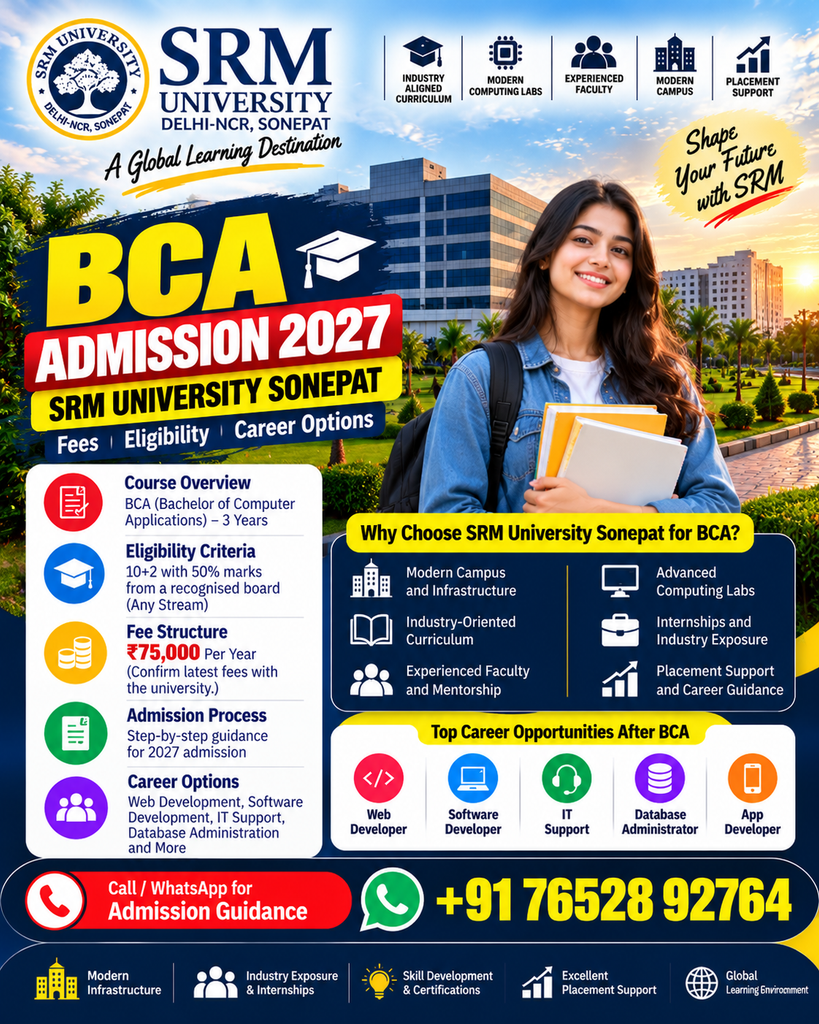
- University: SRM University Delhi-NCR, Sonepat
- Programme: Bachelor of Computer Applications (BCA)
- Admission session: 2027–28
- Level: Undergraduate
- Eligibility: Class 12 or an accepted equivalent qualification, subject to the university’s current criteria
- Study areas: Programming, computer applications, databases, web technologies, and related computing subjects
- Career possibilities: Web development, software development, IT support, database-related roles, and further studies
- Application mode: Check the current university admission portal
- Fees: Confirm the latest applicable amount with the university before payment
Admission dates, course availability, eligibility rules, and tuition fees can change. Applicants should therefore use the university’s latest published information rather than relying exclusively on older advertisements or third-party articles.
Why Choose BCA After Class 12?
The technology industry includes opportunities in software development, website creation, IT services, application support, database management, and other computing-related fields. A BCA degree can help students begin developing the technical knowledge needed for these areas.
Students who enjoy logical reasoning, solving problems, learning programming languages, and working with computers may find the course particularly interesting.
1. Build a Foundation in Computer Applications
BCA programmes commonly introduce students to programming, computer fundamentals, databases, software development concepts, and web technologies. These subjects can help students understand how applications are designed, developed, tested, and maintained.
2. Develop Practical Technology Skills
Practical assignments and projects can help students apply classroom concepts. Depending on the curriculum, students may work on programming exercises, database projects, websites, or other application-based assignments.
Applicants should review the current SRM University Sonepat curriculum to understand which subjects, laboratory sessions, and projects are included in the programme.
3. Explore Different Career Directions
BCA graduates may explore entry-level opportunities in software development, web development, technical support, application testing, and other IT-related functions. The roles available to an individual depend on their skills, practical experience, interview performance, and employer requirements.
4. Consider Further Education
Students who want to continue studying after BCA may consider postgraduate programmes such as MCA or other relevant qualifications, subject to each institution’s eligibility criteria. Certifications and practical projects can also help students develop specialised knowledge.
5. Start Building a Professional Portfolio
Students can use their time at university to create websites, small applications, database projects, and other practical work. A portfolio can help demonstrate their skills to potential employers and internship providers.
SRM University Sonepat BCA Eligibility Criteria 2027
Eligibility is one of the first things students should check before applying. Meeting the published eligibility requirements does not necessarily guarantee admission, because the final decision depends on the university’s applicable admission rules and document verification.
The currently listed BCA admission information should be checked again for the 2027–28 intake before you submit your application.
Educational Qualification
The university’s admission portal has listed eligibility for its BCA programme as Class 12 or an equivalent qualification with at least 50% marks and English as one of the subjects. A qualifying three-year diploma with the required aggregate has also been listed as an alternative route.
Students must verify whether these requirements remain applicable to the 2027–28 admission session.
Minimum Marks
Applicants should check the minimum aggregate percentage required by the university. If the current requirement is 50%, students should calculate their qualifying marks according to the university’s stated rules.
Do not assume that meeting a percentage threshold automatically guarantees admission. Additional conditions may apply.
Subject Requirements
English has been included in the published eligibility information for the BCA programme. Students should verify the exact subject requirements and whether their Class 12 stream and qualification are accepted.
Applicants from different educational boards should confirm that their qualification is recognised and satisfies the university’s admission policy.
Diploma Applicants
Students who have completed a qualifying three-year diploma may have an alternative route to eligibility, subject to the university’s published conditions. Before applying, diploma holders should confirm whether their particular diploma, aggregate marks, and other academic details meet the current requirements.
Documents to Prepare
Students may need to arrange the following documents during the application and admission process:
- Class 10 marksheet or certificate
- Class 12 marksheet or equivalent qualification documents
- Diploma documents, if applicable
- Government-issued identity proof, where required
- Recent passport-size photographs
- Contact details and other information requested on the application form
- Any additional documents specified by the university
This is a general preparation checklist, not a definitive university document list. Follow the instructions on the current application portal.
SRM University Sonepat BCA Fees 2027
Course fees are an important consideration when comparing universities. Students should understand the difference between tuition fees and the total cost of attending university.
The official admission portal has listed the BCA tuition fee at ₹75,000 per year. However, students applying for 2027–28 should confirm that this amount remains valid for their intake and obtain the latest written fee details from the university.
Estimated Tuition Fee
If the published annual tuition fee of ₹75,000 applies to a three-year programme, the tuition-only calculation would be:
| Fee component | Amount |
|---|---|
| Annual tuition fee shown on the admission portal | ₹75,000 |
| Tuition for three years at the same annual rate | ₹2,25,000 |
Important: The three-year total is a mathematical estimate based on the stated annual amount, not a guaranteed final programme fee. The university may revise fees, and additional charges may apply. The current programme structure and official fee schedule should be checked before budgeting.
Other Expenses to Consider
The overall cost of attending university may include expenses beyond tuition. Depending on the student’s arrangements and the university’s applicable charges, these may include:
- Admission or registration charges
- Examination fees
- Hostel and accommodation expenses
- Mess or meal charges
- Books and learning materials
- Laptop, internet, and software expenses
- Transportation
- Personal and daily living expenses
Not every item necessarily applies to every student. Request a complete fee breakdown from the university so you can estimate your total educational budget accurately.
How to Confirm the Latest BCA Fee
Before paying an application, admission, or tuition amount, students should:
- Visit the university’s official admission portal.
- Open the BCA programme details.
- Check the academic session and the listed tuition fee.
- Ask whether additional compulsory charges apply.
- Request the current fee schedule in writing.
- Review the refund policy and payment deadlines before making a payment.
These steps can help students avoid relying on outdated fee figures.
SRM University Sonepat BCA Admission Process 2027
Students should follow the official instructions for the 2027–28 admission session. The steps below describe a typical university application process; the exact sequence, required documents, and payment arrangements should be confirmed on the current portal.
Step 1: Visit the Official Admission Portal
Start by visiting the official SRM University Delhi-NCR, Sonepat, admission website. Find the BCA programme and read the eligibility criteria, programme information, and application instructions.
Make sure the information applies to the 2027–28 academic session.
Step 2: Complete the Application Form
Enter the requested personal, contact, and academic details carefully. Check spelling, contact information, marks, and qualification details before submitting the form.
Use accurate information and avoid leaving mandatory fields incomplete.
Step 3: Upload the Required Documents
Upload the documents requested by the application portal. Ensure that each file is readable, correctly oriented, and within the specified file-size and format limits.
Keep copies of the submitted documents for your records.
Step 4: Pay the Applicable Application Fee
If the university requires an application fee, check the amount and accepted payment methods on the official portal. Review the payment details before proceeding, and save the transaction receipt.
An application fee is different from tuition fees. Confirm the refund terms before paying.
Step 5: Follow Admission Updates
After submitting the form, check your email, phone messages, and application dashboard for updates. Respond to requests for additional documents or information within the stated deadlines.
Step 6: Verify Your Admission Offer
If you receive an admission offer, review its conditions carefully. Confirm the programme, academic session, fee schedule, payment deadlines, and any outstanding document requirements before accepting.
Step 7: Complete Enrolment
Follow the university’s instructions for fee payment, document verification, and enrolment. Keep all receipts, confirmation messages, and admission documents in a safe place.
Official admission portal: SRM University Sonepat Admission Portal
Always verify the application link and payment instructions on the university’s official website.
BCA Course Structure and Subjects
Students researching SRM University Sonepat BCA Admission 2027 should look beyond eligibility and fees. The curriculum is equally important because it determines the subjects students study and the technical foundations they develop during the programme.
BCA curricula generally cover computer fundamentals, programming, databases, web development, software engineering, and related areas. The exact subjects, semester structure, practical components, and electives depend on the university’s approved curriculum for the applicable academic session.
The following subjects are common across many BCA programmes. They are examples of what students may encounter, not a confirmed semester-wise syllabus for SRM University Sonepat.
1. Computer Fundamentals
Computer fundamentals introduce students to the basic principles of computing. Students learn about computer hardware, software, operating systems, memory, storage, and how different computer components work together.
This knowledge provides a foundation for understanding more advanced topics in computer applications.
2. Programming Languages
Programming is an important part of computer applications education. Students may learn languages such as C, C++, Java, or Python, depending on the curriculum.
Programming subjects help students understand variables, data types, conditions, loops, functions, object-oriented concepts, and problem-solving techniques.
Students should practise coding regularly instead of relying only on theoretical learning. Consistent practice helps them understand programming logic and prepare for technical assessments.
3. Database Management Systems
Databases are used to organise, store, retrieve, and manage information. A database management subject typically introduces relational databases, tables, queries, relationships, and data organisation.
Students may practise SQL and learn how applications interact with databases. These concepts are useful in web development, software development, business applications, and data-related roles.
4. Web Development
Web development focuses on building websites and web applications. Depending on the curriculum, students may learn HTML, CSS, JavaScript, and other web technologies.
Practical projects can help students understand how websites are structured, styled, and made interactive. More advanced learning may involve server-side development, APIs, or frameworks.
Students interested in this area can build a portfolio containing responsive websites, landing pages, and small web applications.
5. Data Structures and Algorithms
Data structures and algorithms help students organise data and solve computational problems efficiently. Common topics include arrays, linked lists, stacks, queues, searching, sorting, and algorithmic complexity.
These concepts are useful for technical interviews and software development. Students should practise implementing data structures and solving problems independently.
6. Software Engineering
Software engineering introduces the methods used to plan, design, develop, test, and maintain software systems. Students may learn about project requirements, software development life cycles, testing, documentation, and teamwork.
These principles help students understand how software projects are managed beyond simply writing code.
7. Computer Networks and Operating Systems
Computer networks explain how computers and other devices communicate. Operating systems cover how computers manage processes, memory, files, and system resources.
These topics can help students understand the technical foundations behind networks, applications, servers, and IT infrastructure.
8. Projects and Practical Assignments
Practical projects allow students to apply their learning to real problems. Depending on the programme, projects may involve developing a website, creating a database application, building a small software tool, or documenting a computing solution.
Before enrolling, ask the university about the current curriculum, practical laboratory facilities, project requirements, internship opportunities, and available electives.
Skills Students Should Develop During BCA
A degree can provide academic knowledge, but students also need practical skills to prepare for technology-related work. The most useful skills depend on their chosen career direction.
Programming and Logical Thinking
Students should become comfortable with at least one programming language and learn to solve problems step by step. Understanding programming logic is often more valuable than memorising syntax.
Practising coding exercises can improve confidence and help students identify areas that require further learning.
Web Development
Students interested in website development can learn HTML, CSS, JavaScript, and a modern frontend framework such as React. They may later explore backend technologies, databases, APIs, authentication, and deployment.
Building complete projects helps students understand how different technologies work together.
Database Skills
Learning SQL and database design can help students work with structured information. Students can practise designing tables, writing queries, connecting applications to databases, and handling data correctly.
Communication and Teamwork
Technical professionals often collaborate with designers, developers, testers, managers, and clients. Clear communication, documentation, time management, and teamwork can therefore be valuable in many roles.
Problem-Solving and Project Development
Students should try to build projects that solve practical problems. Examples include a student management application, a personal portfolio, an appointment booking system, or an inventory management tool.
A project portfolio can help students demonstrate what they can do, rather than relying only on academic marks.
Internship and Job Preparation
Students can prepare for internships by improving their resumes, practising interviews, learning version control, and maintaining a portfolio of projects. They should also review job descriptions to understand the skills employers expect for entry-level roles.
Career Options After BCA from SRM University Sonepat
One reason students consider BCA is the range of career directions associated with computer applications. Graduates may apply for entry-level positions in technology companies, IT service providers, startups, and organisations with internal IT teams.
However, career opportunities are not guaranteed by the degree alone. Recruitment depends on the student’s skills, practical experience, academic record, interview performance, location preferences, and the requirements of individual employers.
The following are potential career paths for BCA graduates.
1. Web Developer
Web developers build and maintain websites and web applications. Depending on their skills, they may focus on frontend development, backend development, or full-stack development.
Frontend developers work on the parts of a website that users see and interact with. Backend developers work on server-side logic, APIs, databases, and application functionality.
Students interested in web development can start with HTML, CSS, and JavaScript, then build projects using frameworks and backend technologies.
2. Software Developer
Software developers help design, create, test, and maintain software applications. Their work may involve writing code, fixing bugs, implementing features, and collaborating with other developers.
Students aiming for this career should practise programming, data structures, algorithms, debugging, and software design fundamentals.
3. IT Support Executive
IT support professionals help users resolve computer, software, account, network, and hardware-related issues. Responsibilities vary by organisation and may include troubleshooting, documenting incidents, installing software, and escalating complex problems.
This path may suit students who enjoy solving technical problems and communicating with users.
4. Application Support Analyst
Application support analysts help maintain business applications and investigate technical issues. Their work may involve checking logs, reproducing problems, answering user queries, and coordinating with development teams.
Knowledge of SQL, operating systems, troubleshooting, and communication can be useful for these roles.
5. Database Support Professional
Database-related roles involve managing, querying, monitoring, or supporting databases. Entry-level opportunities may focus on SQL queries, data accuracy, backups, reporting, or routine database operations.
Students interested in this direction should develop strong SQL skills and understand database concepts.
6. Software Tester or QA Analyst
Software testers check whether applications behave as expected. They identify defects, document test results, and help teams improve software quality.
Students can start by learning manual testing, test-case writing, defect reporting, and software testing fundamentals. Automation testing may be a further specialisation after learning the relevant tools and programming concepts.
7. Junior Frontend Developer
Frontend developers implement user interfaces using technologies such as HTML, CSS, and JavaScript. Depending on the employer, knowledge of React or another framework may be helpful.
A portfolio of responsive websites and interactive applications can help students demonstrate their frontend development abilities.
8. Technical Support Engineer
Technical support engineers assist customers or internal teams with technical products and services. The role may require troubleshooting, clear written communication, product knowledge, and the ability to follow documented procedures.
Some positions require networking, operating system, or scripting knowledge, depending on the product being supported.
9. Junior Mobile Application Developer
Students interested in mobile technology can explore Android development, cross-platform frameworks, or other mobile application tools.
The exact requirements vary by employer. Students should build and test small applications to gain practical experience.
10. IT Operations or Service Desk Associate
IT operations and service desk roles help organisations maintain daily technology services. Responsibilities may include user support, access management, incident logging, system checks, and coordination with technical teams.
These roles can offer experience in professional IT environments and help students identify a future specialisation.
11. Further Study and Specialisation
Some graduates choose postgraduate study rather than entering employment immediately. Options may include an MCA, relevant master’s programmes, professional certifications, or specialised training.
Students should check the eligibility criteria for any postgraduate course before planning their next step. Admission requirements can differ between institutions.
Career Planning Tip
Do not wait until the final semester to start preparing for employment. Use the first years of the degree to learn programming, strengthen communication, develop practical projects, explore internships, and understand entry-level job requirements.
Salary Expectations After BCA
Students often want to know how much they can earn after completing a BCA degree. There is no single salary that applies to all graduates. Compensation varies by job role, employer, location, technical skills, interview performance, and relevant experience.
Entry-level IT support positions may have different salary ranges from software development or specialised technical roles. Companies may also offer different compensation structures, including fixed pay, incentives, benefits, or training-period stipends.
Rather than relying on an advertised salary figure, students should compare recent job postings for the roles they want to pursue.
Factors That Influence Salary
Several factors can influence a graduate’s starting compensation:
- Technical skills: Practical knowledge of programming, databases, testing, or networking can affect eligibility for particular roles.
- Projects: Well-documented projects help demonstrate practical ability.
- Internships: Relevant work experience can help students understand professional expectations.
- Communication: Clear communication can be important in technical and customer-facing positions.
- Location: Compensation may vary between cities and employers.
- Job role: Development, support, testing, operations, and other roles have different responsibilities and pay structures.
- Employer requirements: Some employers require specific technologies, certifications, or assessment results.
Students should evaluate the overall learning opportunity and career progression alongside salary. A suitable first role can help build experience and prepare a graduate for future opportunities.
Scholarships and Financial Assistance
Scholarships and fee concessions can help eligible students manage the cost of higher education. However, students should not assume that every scholarship is available to every applicant or that a particular percentage of tuition will automatically be waived.
For SRM University Sonepat BCA Admission 2027, applicants should ask the university whether scholarships or financial assistance are available for the BCA programme during the 2027–28 session.
What to Check Before Applying for a Scholarship
Students should confirm the following details with the university:
- Which scholarship schemes are available for the relevant admission year?
- Are scholarships based on Class 12 marks, entrance performance, or other criteria?
- What minimum marks or other eligibility conditions apply?
- Does the scholarship cover tuition only, or does it apply to other charges?
- Is the scholarship available for the entire programme or subject to renewal?
- What academic performance must a student maintain to continue receiving it?
- What documents and deadlines apply?
Keep Scholarship Claims Verified
Promotional content sometimes mentions large discounts or full scholarships. Students should verify such claims using current university documentation and check all conditions before relying on them for financial planning.
A scholarship offer should be understood in writing, including its amount, duration, eligibility rules, renewal conditions, and exclusions.
Campus Facilities and the Student Learning Experience
The university environment can influence a student’s learning experience. When comparing colleges for BCA, students should evaluate not only the course title and tuition but also the facilities and academic support relevant to computing education.
Computing Laboratories
Students should ask about the availability of computer laboratories, software resources, internet access, and opportunities for practical work. These facilities can support programming exercises and academic projects.
Faculty and Academic Support
Qualified faculty and accessible academic guidance can help students understand difficult concepts and receive feedback on their work. Prospective students can ask how practical assignments, projects, and academic doubts are handled.
Internship and Industry Exposure
Internships, workshops, guest sessions, and project-based learning can help students connect classroom knowledge with workplace expectations. Availability and participation requirements should be confirmed with the university.
Library and Learning Resources
A library and suitable digital resources can support independent learning. Students may also use online courses and documentation to explore programming languages and tools beyond the core syllabus.
Student Activities and Collaboration
Group projects, technical events, clubs, and student activities can provide opportunities to collaborate and develop communication skills. Applicants should ask which activities are currently available to BCA students.
Career Guidance and Placement Support
Before making an admission decision, students should ask the university about its career guidance process, placement preparation, employer engagement, internship assistance, and eligibility rules for recruitment activities.
Do not assume that placement support guarantees a job. Students should request programme-specific placement information, including the reporting period, number of eligible students, number placed, types of roles, and how the results were calculated.
BCA vs B.Tech CSE: Which Course Should You Choose?
Students interested in technology often compare BCA with B.Tech in Computer Science and Engineering. Both can lead to technology-related careers, but they differ in academic approach, course structure, and admission requirements.
| Comparison | BCA | B.Tech CSE |
|---|---|---|
| Degree type | Undergraduate computer applications degree | Undergraduate engineering degree |
| Main focus | Computer applications, programming, and software-related subjects | Computer science, engineering principles, computing systems, and software |
| Course duration | Often 3 years; confirm the university’s current structure | Generally 4 years |
| Learning approach | Application-focused computing education | Engineering-oriented computing education |
| Suitable interests | Programming, web development, IT applications, and software | Software, algorithms, computing systems, and engineering |
| Further study | MCA or other eligible postgraduate programmes | M.Tech or other eligible postgraduate programmes |
| Career possibilities | IT support, development, testing, and related roles | Software development, engineering, testing, and related roles |
The best choice depends on your academic interests, budget, career goals, and preferred learning approach. Students should compare the actual curricula and eligibility requirements rather than choosing a course based on its name alone.
Is SRM University Sonepat a Good Choice for BCA?
Whether a university is the right choice depends on what a student wants from their education. Prospective BCA applicants should evaluate SRM University Delhi-NCR, Sonepat, using clear criteria.
Consider the Curriculum
Review the subjects taught during the programme. Check whether the curriculum includes the programming languages, database concepts, web technologies, practical assignments, and project work relevant to your interests.
Compare the Total Cost
Look at the complete fee schedule rather than tuition alone. Include applicable university charges, accommodation, transport, learning materials, and other personal expenses when comparing institutions.
Evaluate Career Preparation
Ask about internships, technical workshops, project opportunities, interview preparation, and career guidance specifically available to BCA students.
Review the Learning Environment
If possible, visit the campus or attend an official information session. Ask questions about classrooms, computer laboratories, faculty support, student activities, and academic services.
Verify Official Information
Confirm programme availability, admission requirements, tuition fees, scholarship conditions, and deadlines through the university’s official channels.
A careful comparison can help students make an informed decision based on their academic priorities and financial circumstances.
Tips for Getting the Most Out of Your BCA Degree
Getting admitted is only the beginning. Students can improve their learning experience by developing good study habits and gaining practical experience throughout the programme.
Start programming early. Learn one language properly before trying to master several languages at once. Practise problem-solving regularly.
Build projects. Create websites, applications, database projects, or other tools that demonstrate your knowledge. Keep the code organised and document how each project works.
Learn Git and GitHub. Version control helps students manage code changes and collaborate with others. A well-maintained portfolio can make it easier to demonstrate practical work.
Improve communication skills. Practise explaining technical concepts clearly, writing project documentation, and participating in group discussions.
Explore internships. Apply for relevant internships when you have the required foundational skills. Review the responsibilities and learning opportunities before accepting an offer.
Prepare for interviews. Practise programming questions, project explanations, technical fundamentals, and common HR questions.
Keep learning. Technology changes continuously. Students should learn to use official documentation, practise new tools, and strengthen their existing knowledge.
These habits can help students turn their academic experience into practical skills relevant to their chosen career.
Frequently Asked Questions About SRM University Sonepat BCA Admission 2027
1. When will SRM University Sonepat BCA Admission 2027 begin?
Applicants should check the official SRM University Delhi-NCR, Sonepat, admission portal for the latest 2027–28 admission announcements, application dates, and programme availability. Do not rely on an unverified deadline.
2. What is the eligibility for BCA admission at SRM University Sonepat?
The university’s published admission information has listed Class 12 or an equivalent qualification with at least 50% marks and English as one of the subjects. A qualifying three-year diploma with the required aggregate has also been listed as an alternative. Confirm the current criteria for the 2027–28 intake before applying.
3. What is the BCA fee at SRM University Sonepat?
The official admission portal has listed the BCA tuition fee as ₹75,000 per year. Students applying for 2027–28 should confirm the latest fee schedule, additional charges, and payment deadlines directly with the university.
4. What is the total tuition fee for three years of BCA?
If the annual tuition fee remains ₹75,000 for all three years, the estimated tuition total would be ₹2,25,000. This is a calculation based on the stated annual amount, not a guaranteed final fee. Revised tuition rates or other charges may affect the total cost.
5. Is BCA a three-year course?
Many BCA programmes have a three-year structure. However, programme duration and available academic pathways can vary. Students should confirm the exact structure of the BCA programme offered for the 2027–28 session.
6. Can students from any stream apply for BCA?
Some BCA programmes accept students from different Class 12 streams, subject to their eligibility requirements. Applicants should verify the current SRM University Sonepat criteria, including minimum marks, English requirements, and accepted qualifications.
7. Can diploma holders apply for BCA admission?
The university’s published eligibility information has included a qualifying three-year diploma with the required aggregate as an alternative route. Diploma holders should confirm whether their specific qualification meets the current admission conditions.
8. What documents are required for BCA admission?
Applicants may need their Class 10 and Class 12 certificates, marksheets, identity proof, photographs, and other documents specified by the university. Diploma applicants may need additional qualification documents. The official application portal provides the relevant instructions.
9. Does SRM University Sonepat offer scholarships for BCA students?
Scholarship availability, eligibility, and amounts should be confirmed with the university for the 2027–28 session. Ask about academic requirements, application deadlines, renewal conditions, and the charges covered by any scholarship.
10. What career options are available after BCA?
Depending on their skills and experience, graduates may pursue entry-level opportunities in web development, software development, IT support, application support, software testing, database support, and other technology-related fields.
11. Can I pursue MCA after BCA?
BCA graduates may be eligible to apply for MCA programmes, depending on the admission requirements of the institution. Some programmes require particular subjects, mathematics qualifications, minimum marks, or entrance examinations. Check the eligibility criteria before applying.
12. Is programming necessary for BCA?
Programming is an important part of many BCA curricula. Students who are new to coding can start with the fundamentals and gradually develop their skills through practice, assignments, and projects.
13. Does BCA guarantee a placement?
No degree guarantees employment. Job opportunities depend on a student’s skills, experience, academic record, interview performance, and employer requirements. Students should ask about programme-specific placement data and the support available to BCA graduates.
14. How can I apply for SRM University Sonepat BCA Admission 2027?
Visit the official admission portal, review the BCA programme details, check the eligibility criteria, complete the application form, submit the required documents, and follow the university’s instructions for payment and enrolment.
15. Where can I get help with the admission process?
Students can contact the university through its official admissions channels for verified details about eligibility, fees, applications, scholarships, and deadlines. For general admission guidance, you may also use the contact details provided in the admission guidance section below.
Get Admission Guidance for SRM University Sonepat BCA Admission 2027
Planning to pursue a Bachelor of Computer Applications after Class 12? Before submitting your application, review the programme details, eligibility requirements, tuition fees, and admission procedure for the 2027–28 academic session.
If you need general assistance understanding the application process, preparing your documents, or identifying the questions to ask before admission, you can contact an admission guidance representative.
Admission Guidance Call/WhatsApp: +91 76528 92764
Please note that this is an admission guidance contact and the official university helpline. Confirm all course details, fee payments, scholarship claims, and admission decisions directly with SRM University Delhi-NCR, Sonepat.
Conclusion
SRM University Sonepat BCA Admission 2027 is a topic worth exploring for students interested in computer applications, programming, software development, and other technology-related career paths. Before choosing the programme, students should evaluate the eligibility criteria, course curriculum, tuition fees, campus facilities, practical learning opportunities, and career guidance available.
The university’s published admission information has listed BCA eligibility as Class 12 or an accepted equivalent qualification with the specified marks and English requirement, while an eligible three-year diploma has also been listed as an alternative. The admission portal has shown annual tuition of ₹75,000, but both eligibility and fees should be reconfirmed for the 2027–28 session.
Students can make better decisions by comparing universities, preparing their academic documents, asking about scholarships, and understanding the complete cost of education. Developing programming skills, building projects, and gaining practical experience during the degree can also help students prepare for future employment or further study.
Visit the official admission portal to check the latest programme information and follow the university’s instructions before applying.
Official admission portal: https://admissions.srmuniversity.ac.in/