UID Graphic Design Admission 2026: Courses, Eligibility, Admission Process, Career Scope & Complete Guide
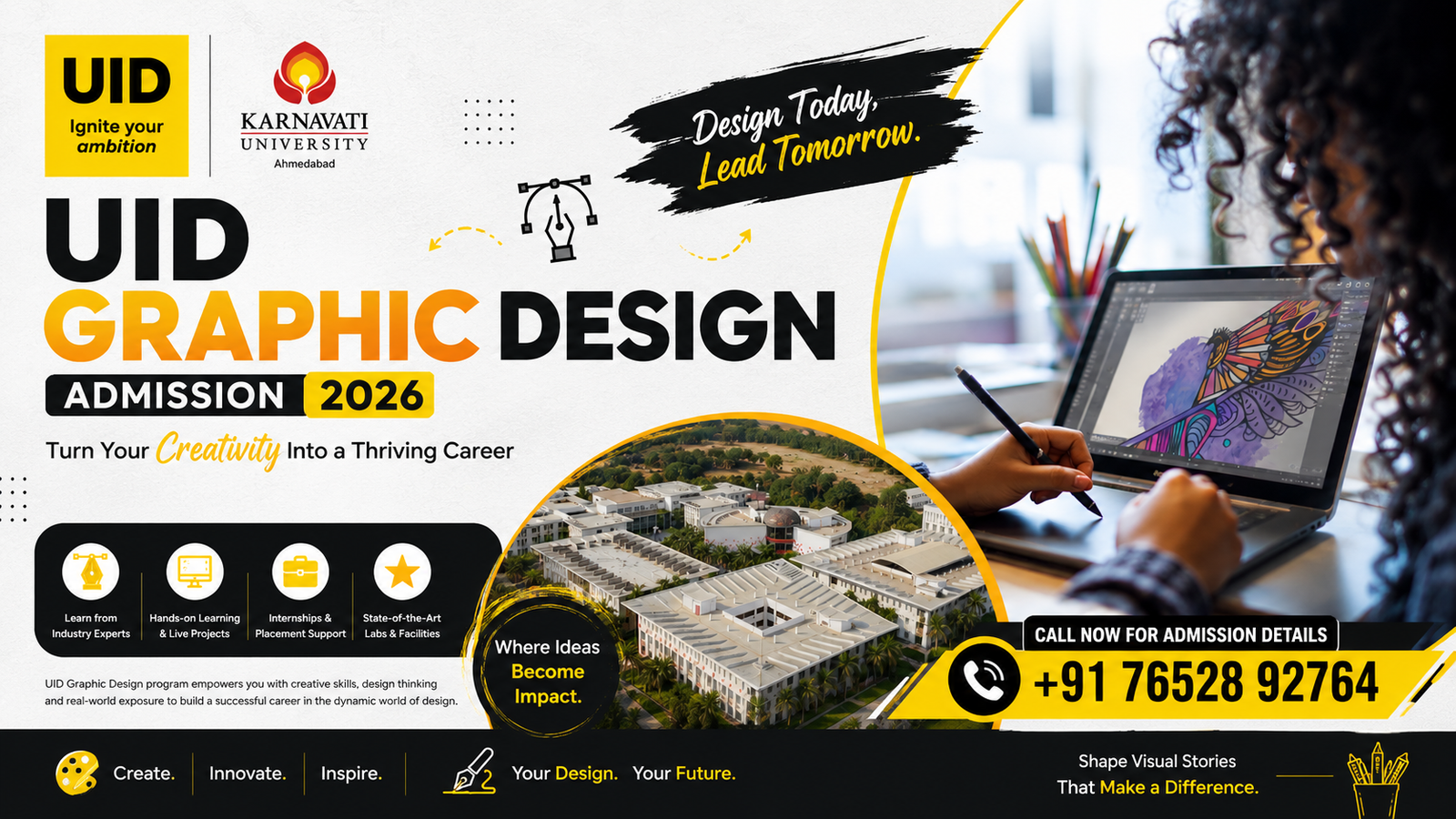
Choosing a career in graphic design can be an exciting option for students who enjoy creativity, visual communication, technology, branding, illustration and digital media. With businesses increasingly relying on strong visual identities and digital experiences, skilled designers are finding opportunities across advertising, branding, publishing, technology, entertainment, e-commerce and many other industries.
For students exploring professional design education, UID Graphic Design Admission 2026 is an important option to consider. Unitedworld Institute of Design (UID), a constituent institute of Karnavati University in Gujarat, offers a creative academic environment designed to help students develop design thinking, practical skills and professional perspectives.
This guide covers key information students may want to know about UID Graphic Design Admission 2026, including the course, eligibility, admission process, skills, curriculum, portfolio development, career opportunities and preparation tips.
About Unitedworld Institute of Design (UID)
Unitedworld Institute of Design, commonly known as UID, is associated with Karnavati University and focuses on education across different areas of design.
Design education is different from conventional classroom-based learning because students are expected to combine theoretical knowledge with experimentation, research, observation and practical projects.
Students interested in graphic design can develop their understanding of areas such as visual communication, typography, illustration, branding, digital design and creative problem-solving.
A design institute can also provide an environment where students interact with peers from different creative disciplines. Such exposure can be useful because modern design projects frequently require collaboration between graphic designers, product designers, animators, photographers, UI/UX designers and other creative professionals.
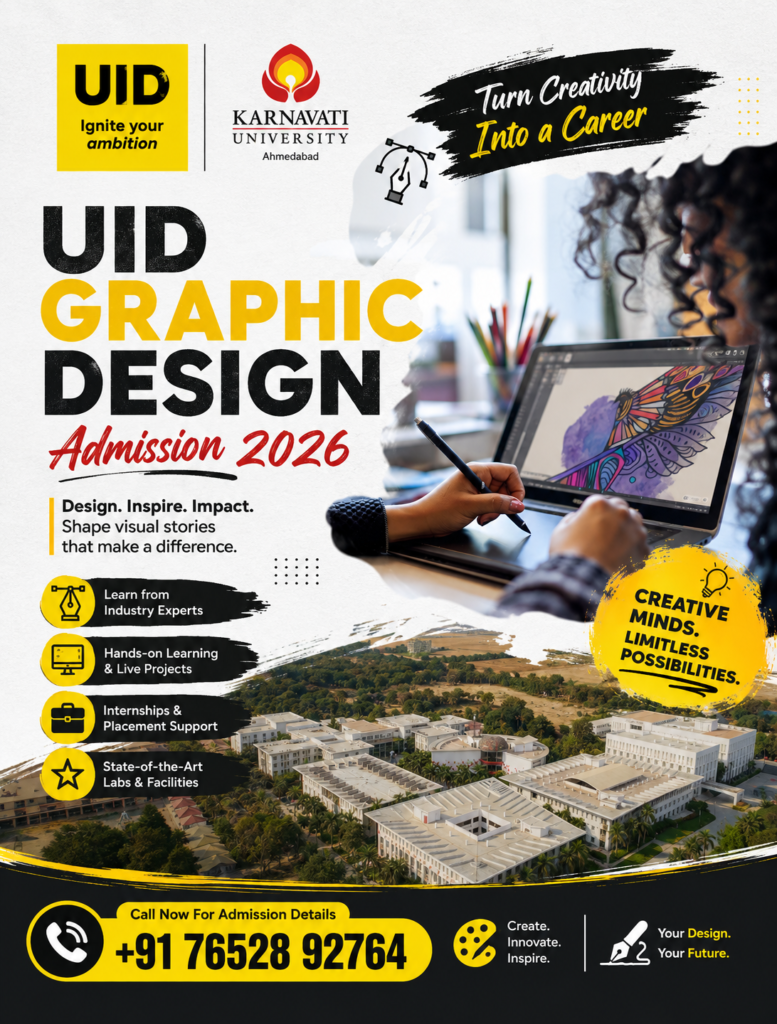
UID Graphic Design Admission 2026 – Overview
Students planning for UID Graphic Design Admission 2026 should understand that design admissions may involve more than academic marks alone.
Creative aptitude, observation, visual thinking, communication ability and problem-solving skills can play an important role in design education.
Prospective students should carefully review the official admission information for the 2026 academic session to confirm the latest requirements, application deadlines, entrance or selection procedures, fees and other conditions.
The admission journey generally involves researching the programme, checking eligibility, completing the application process and preparing for the applicable selection stages.
Starting early gives students more time to strengthen their creative skills and prepare a portfolio if required.
Why Study Graphic Design?
Graphic design is much more than creating attractive posters or social media posts. It is fundamentally about communicating ideas visually.
A graphic designer needs to understand how typography, colour, imagery, layout, hierarchy and composition work together to deliver a message.
Think about the visual elements you encounter every day: logos, websites, mobile applications, advertisements, product packaging, books, magazines, billboards, social media campaigns and digital interfaces. Graphic design contributes to many of these experiences.
Students who study graphic design can learn how to transform an idea or message into effective visual communication.
As digital platforms continue to expand, graphic designers are also increasingly working across interactive and screen-based environments rather than only traditional print media.
What Can Students Learn in Graphic Design?
The exact curriculum can differ according to the programme and academic year, so applicants should verify the latest UID curriculum before applying.
However, graphic design and visual communication education commonly exposes students to several important areas.
1. Design Fundamentals
Students begin by understanding basic principles such as balance, contrast, alignment, hierarchy, proportion, rhythm and composition.
These fundamentals become the foundation for more advanced design projects.
2. Typography
Typography is an essential part of graphic design.
Students learn how typefaces, font sizes, spacing, hierarchy and layouts affect readability and visual communication.
Typography can significantly influence how audiences perceive a brand or message.
3. Branding and Visual Identity
Branding involves creating a consistent visual language for a company, product or organisation.
Students may explore areas such as logo development, colour systems, typography, brand guidelines and visual identity applications.
4. Illustration
Illustration helps designers communicate concepts through original visual artwork.
Depending on the project, students may experiment with hand-drawn as well as digital illustration techniques.
5. Digital Design
Modern graphic designers frequently create visual content for websites, mobile devices, digital advertising and social platforms.
Understanding digital formats and screen-based design is therefore increasingly valuable.
6. Publication and Editorial Design
Editorial design focuses on arranging text, images and other visual elements for books, magazines, brochures, reports and digital publications.
Students learn how grids and visual hierarchy can improve readability.
7. Packaging and Promotional Communication
Packaging combines branding, information and visual appeal.
Graphic designers may contribute to packaging systems, promotional campaigns and other forms of marketing communication.
Eligibility for UID Graphic Design Admission 2026
Eligibility requirements can vary according to the specific programme and admission cycle.
Students interested in UID Graphic Design Admission 2026 should therefore check the official UID/Karnavati University admission information before submitting an application.
For undergraduate design programmes, applicants generally need to have completed or be appearing for their Class 12 or equivalent qualifying examination, subject to the institution’s current eligibility conditions.
Applicants should verify:
- Minimum academic requirements
- Accepted education boards
- Application deadlines
- Selection or entrance requirements
- Portfolio requirements, if applicable
- Interview requirements, if applicable
- Documents required during admission
Students should avoid relying exclusively on older admission information because requirements and dates can change between academic sessions.
UID Graphic Design Admission Process 2026
The precise admission process should always be confirmed through official 2026 admission notifications.
A prospective applicant’s journey may involve several stages.
Step 1: Research the Programme
Before applying, students should understand the programme structure, duration, curriculum, campus environment and career possibilities.
This helps applicants decide whether the course aligns with their interests and long-term goals.
Step 2: Check Eligibility
Carefully review the current eligibility criteria.
Applicants should make sure that their educational qualifications meet the programme requirements before completing the application.
Step 3: Complete the Application
Candidates generally need to provide personal, academic and contact information through the prescribed application process.
Information should be entered accurately and supporting documents should be kept ready.
Step 4: Prepare for the Selection Process
Design institutes may assess applicants through creative aptitude or other selection stages.
Students should prepare according to the requirements announced for the relevant admission cycle.
Step 5: Complete Further Admission Formalities
Shortlisted candidates may need to complete additional formalities according to the university’s instructions.
Students should regularly monitor official communication so that they do not miss important deadlines.
How to Prepare for Graphic Design Admission
Students do not necessarily need to be professional artists before entering design school.
What matters is developing curiosity, observation and creative problem-solving abilities.
Start by observing everyday objects and visual communication around you. Ask why a particular advertisement attracts attention or why one package looks more premium than another.
Practice sketching regularly. The objective is not simply to create beautiful drawings but to become comfortable expressing ideas visually.
Students can also experiment with poster design, photography, typography, illustration and digital artwork.
Another useful exercise is redesigning existing visual communication. For example, take a poorly designed poster and think about how its hierarchy, colours and typography could be improved.
Building a Graphic Design Portfolio
If a portfolio is required during any stage of the selection process, students should focus on quality and creative thinking rather than simply filling it with a large number of projects.
A beginner’s portfolio might include:
- Sketches and observational drawings
- Poster concepts
- Typography experiments
- Illustrations
- Photography
- Branding exercises
- Digital artwork
- Personal creative projects
- Process work showing how an idea developed
Showing the creative process can be particularly valuable because design is not only about the final output.
Research, experimentation, rough sketches and iterations can demonstrate how a student approaches a problem.
Applicants should always follow UID’s current portfolio instructions if specific requirements are announced.
Skills Needed for a Successful Graphic Design Career
Software knowledge is useful, but software alone does not make someone a strong designer.
Successful designers develop a broader combination of creative and professional abilities.
Creative Thinking: Designers need to generate ideas and explore different solutions.
Visual Communication: A designer should understand how to communicate information effectively through visual elements.
Typography: Strong typography skills help designers create readable and visually engaging layouts.
Problem Solving: Design usually begins with a communication problem that needs to be solved.
Communication Skills: Designers often need to explain their ideas to clients, teammates and other stakeholders.
Time Management: Professional designers frequently handle multiple projects and deadlines.
Adaptability: Design trends, platforms and technologies evolve continuously.
Students who develop these abilities alongside technical skills can become better prepared for professional environments.
Graphic Design Career Opportunities
Graphic design education can lead to opportunities across multiple creative industries.
Depending on their skills, portfolio, experience and specialisation, graduates may explore roles such as:
- Graphic Designer
- Visual Designer
- Brand Designer
- Communication Designer
- Illustrator
- Packaging Designer
- Editorial Designer
- Advertising Designer
- Digital Designer
- Social Media Designer
- Creative Designer
- Art Director
- UI/UX-related design roles
Job titles and responsibilities vary considerably between organisations.
Some graduates may work with design studios and advertising agencies, while others may join technology companies, publishing organisations, e-commerce businesses, startups or corporate marketing teams.
Freelancing and Entrepreneurship Opportunities
Graphic design also offers opportunities outside conventional employment.
Experienced designers may work independently with multiple clients as freelancers.
Freelance services can include logo design, brand identity, social media creatives, packaging, marketing materials, presentations, website graphics and other communication requirements.
Some designers eventually establish their own creative studios or branding agencies.
However, freelancing requires more than design ability. Professionals also need communication, pricing, project management, client management and business development skills.
Importance of Practical Learning
Graphic design is a practice-oriented discipline.
While theoretical knowledge provides important context, students need opportunities to apply concepts to actual design problems.
Projects, assignments, workshops, presentations and critiques can help students understand how ideas move from initial concepts to finished outcomes.
Feedback is another important part of design education.
Students learn to explain their decisions, accept constructive criticism and refine their work. This process can help develop both creative confidence and professional discipline.
Graphic Design and the Digital Future
The graphic design profession continues to evolve alongside technology.
Today, visual designers work across websites, mobile applications, social media, e-commerce, digital advertising, motion content and interactive experiences.
Artificial intelligence is also influencing creative workflows.
Rather than eliminating the importance of designers, evolving technology increases the value of skills that tools alone cannot easily replace, including original thinking, strategic communication, cultural understanding, storytelling and creative direction.
Future designers will benefit from understanding how to use emerging tools responsibly while maintaining strong design fundamentals.
Why Portfolio Development Matters
In creative industries, a portfolio can become one of the most important representations of a designer’s capabilities.
Employers and clients often want to see what a designer can actually create.
A strong portfolio does not simply display finished images. It can explain the problem, research, concept, creative process and final solution.
Students should therefore treat academic projects as opportunities to develop portfolio-quality work.
Over time, weaker projects can be replaced with stronger ones as skills improve.
Tips for Students Planning UID Admission 2026
Students considering UID Graphic Design Admission 2026 should begin their preparation early.
Research the programme thoroughly and understand what graphic design actually involves before making a decision.
Develop a habit of observing design around you.
Explore posters, books, packaging, websites, apps and brand identities. Instead of simply deciding whether you like something, ask why it works.
Practice creative thinking consistently.
Maintain a sketchbook, experiment with typography, create personal projects and document your ideas.
Most importantly, follow official admission updates. Application deadlines and selection procedures can change, so applicants should confirm all important details directly from the institution.
Frequently Asked Questions About UID Graphic Design Admission 2026
Is UID a good option for students interested in graphic design?
Students should evaluate UID based on factors such as the current curriculum, faculty, facilities, learning approach, location, fees and their personal career objectives. Comparing multiple institutions before making a final decision is recommended.
Who can apply for UID Graphic Design Admission 2026?
Eligibility depends on the specific programme and current admission guidelines. Undergraduate applicants generally need the required Class 12 or equivalent qualification, but students should verify the official 2026 criteria.
Is drawing compulsory for graphic design?
Drawing can be useful, but graphic design involves much more than drawing. Visual thinking, typography, layout, communication, research and problem-solving are also important.
Does graphic design have career opportunities?
Yes. Graphic designers work across branding, advertising, publishing, digital media, technology, e-commerce, packaging and many other industries. Opportunities depend on a candidate’s skills, portfolio and experience.
Can graphic designers work as freelancers?
Yes. Many graphic designers provide independent services in branding, marketing communication, digital design, social media and related fields.
How should I prepare for UID Graphic Design Admission 2026?
Students can strengthen observation, sketching, visual communication and creative problem-solving skills. They should also carefully review UID’s official selection requirements for the 2026 admission cycle.
Conclusion
UID Graphic Design Admission 2026 can be worth exploring for students who want to transform their creativity into professional visual communication skills.
Graphic design is a broad field that combines creativity, strategy, technology and problem-solving. From branding and advertising to digital platforms, packaging and visual storytelling, designers contribute to how people understand and interact with information.
Students planning to apply should research the programme carefully, verify the latest eligibility and admission requirements, develop their creative skills and begin preparing well before important deadlines.
Rather than focusing only on software, aspiring designers should build strong foundations in visual communication, typography, composition, research and creative thinking.
With continuous practice, a strong portfolio and willingness to adapt to new technologies, graphic design can open doors to a diverse range of creative career paths.
Looking for UID Graphic Design Admission 2026 guidance?
For assistance related to admission information, eligibility, application guidance and programme queries, contact:
📞 Admission Help: +91 76528 92764