What Are You Currently Doing After B.Com? Best Career Options, Courses, Jobs & Higher Education After B.Com 2026-27

Completing a Bachelor of Commerce (B.Com) is an important milestone, but it also brings a common question: What should I do after B.Com? Many B.Com graduates find themselves confused between getting a job, pursuing an MBA, enrolling in professional courses, preparing for competitive exams, or continuing with higher education.
The good news is that a B.Com degree provides a strong foundation for careers in accounting, finance, banking, taxation, business management, marketing, human resources, data analytics and entrepreneurship. The right choice depends on your career goals, interests, skills, financial situation and the type of professional life you want to build.
This detailed guide explains the best career options after B.Com, popular courses, job opportunities, skills to develop and factors you should consider before choosing your next step.
📞 For career guidance and assistance: +91 76528 92764
Why Is B.Com a Good Career Foundation?
B.Com is a versatile undergraduate degree that introduces students to important areas of business and commerce. Depending on the university and specialization, students may study subjects such as accounting, economics, business law, taxation, financial management, marketing, statistics and business communication.
Because of this broad academic foundation, B.Com graduates can explore multiple career paths instead of being limited to one profession.
A B.Com graduate can choose to:
- Start working immediately
- Pursue an MBA
- Take professional accounting courses
- Prepare for government and competitive examinations
- Study finance or banking
- Learn digital marketing
- Develop skills in business analytics
- Pursue higher education
- Start a business
- Build a career in taxation or accounting
- Specialize in international business
- Enter the corporate sector
The important thing is to avoid choosing a course simply because others are doing it. Your next step should support your long-term career objective.
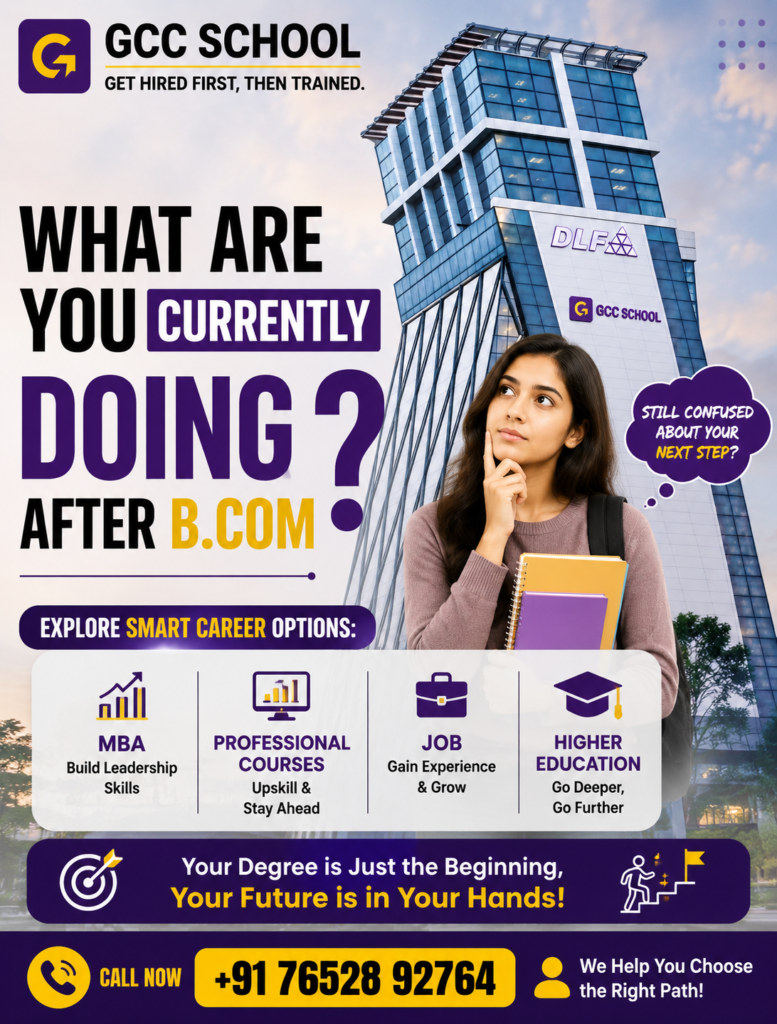
What to Do After B.Com?
There is no single answer to the question “What should I do after B.Com?” Different students have different goals.
If you want management positions, an MBA may be a suitable option. If you enjoy accounting and taxation, professional accounting and finance courses may be more appropriate. If you want to gain practical experience quickly, you can explore entry-level jobs while simultaneously developing additional skills.
If your objective is a government career, you can consider preparing for relevant competitive examinations. Students interested in technology and business can explore business analytics, financial technology, data analytics and digital business.
Therefore, the first step after B.Com should be identifying your preferred career direction.
1. MBA After B.Com
An MBA after B.Com is one of the most popular choices for graduates who want to move toward management and leadership roles.
An MBA can help students develop knowledge of areas such as:
- Marketing
- Finance
- Human Resources
- Operations
- Business Analytics
- International Business
- Entrepreneurship
- Information Technology Management
- Supply Chain Management
An MBA can be particularly useful for students who want to combine their commerce background with management skills.
For example, a B.Com graduate with an interest in finance can pursue an MBA in Finance, while someone interested in marketing can choose Marketing.
Why Consider an MBA After B.Com?
An MBA can help you develop:
- Leadership skills
- Business communication
- Decision-making abilities
- Strategic thinking
- Team management
- Financial understanding
- Problem-solving skills
- Business analysis capabilities
However, students should carefully compare institutions, curriculum, accreditation, placement support, fees and learning format before choosing an MBA program.
2. Professional Courses After B.Com
Professional courses can help B.Com graduates develop specialized knowledge and improve their employability.
Depending on your interests, you can explore courses related to:
- Accounting
- Taxation
- Financial analysis
- Banking
- Business analytics
- Digital marketing
- Investment management
- Corporate finance
- International accounting
- Human resources
- Supply chain management
Professional certifications can be especially valuable when they provide practical exposure and help you develop skills that employers actually use.
For students interested in accounting, learning modern accounting software, taxation concepts, financial reporting and spreadsheet-based analysis can strengthen their profiles.
3. Accounting and Finance Career After B.Com
Accounting and finance remain important career areas for commerce graduates.
Possible entry-level roles include:
- Accounts Executive
- Junior Accountant
- Finance Executive
- Accounts Assistant
- Tax Assistant
- Audit Assistant
- Financial Operations Executive
- Payroll Executive
- Finance Associate
To become more competitive, B.Com graduates can develop skills in advanced Excel, accounting software, financial reporting, taxation, data analysis and communication.
Modern finance professionals increasingly need both commerce knowledge and digital skills. Therefore, learning technology alongside accounting can create additional career opportunities.
4. Banking Career After B.Com
Banking is another popular career choice among commerce graduates.
B.Com students already have exposure to areas such as economics, accounting and finance, which can provide a useful foundation for banking-related careers.
Career opportunities may include roles in:
- Retail banking
- Corporate banking
- Financial services
- Credit operations
- Customer relationship management
- Loan processing
- Banking operations
- Financial administration
Students interested in public-sector banking careers may also prepare for relevant competitive examinations, while others can explore private-sector banking and financial services organizations.
Strong communication, numerical ability, customer service skills and financial awareness can be useful in this field.
5. Government Jobs After B.Com
Students looking for stability and public-sector career opportunities may consider government examinations after B.Com.
Depending on eligibility requirements and the specific recruitment process, graduates can explore examinations and recruitment opportunities related to:
- Banking
- Government administration
- Finance
- Taxation
- Public-sector organizations
- Staff selection
- State-level government services
Government recruitment rules, eligibility criteria and examination patterns can change, so students should always check the official notification for the examination they intend to pursue.
Government exam preparation generally requires consistency, time management, reasoning ability, quantitative aptitude, general awareness and strong preparation habits.
6. Business Analytics After B.Com
Business analytics is becoming increasingly relevant because organizations use data to make business decisions.
A B.Com graduate who develops analytical skills can combine commerce knowledge with data-driven decision-making.
Useful skills include:
- Advanced Excel
- Data visualization
- Statistics
- SQL
- Business intelligence tools
- Financial analysis
- Reporting
- Data interpretation
Business analytics can be useful for students who enjoy working with numbers but also want to move beyond traditional accounting.
A combination of commerce + analytics + communication can help graduates understand both business requirements and data.
7. Digital Marketing After B.Com
Digital marketing is another option for graduates who enjoy communication, creativity and technology.
Students can learn:
- Search engine optimization (SEO)
- Social media marketing
- Content marketing
- Email marketing
- Search advertising
- Web analytics
- Online branding
- Performance marketing
A B.Com graduate can use business and marketing knowledge to understand customers, pricing, sales and market behavior.
Digital marketing can also provide opportunities in agencies, startups, e-commerce companies and corporate marketing departments.
Students interested in entrepreneurship can additionally use digital marketing skills to promote their own businesses or services.
8. Human Resources After B.Com
Human resources is another management-oriented career path.
HR professionals work in areas such as:
- Recruitment
- Employee engagement
- Training and development
- Payroll coordination
- Performance management
- HR operations
- Organizational development
A B.Com graduate who enjoys communication, teamwork and people management can consider an MBA or specialized course related to human resources.
Strong interpersonal and communication skills are particularly important for HR professionals.
9. Higher Education After B.Com
Higher education can be a good option for students who want deeper academic knowledge or specialized career opportunities.
Depending on your objectives, you may consider postgraduate programs in areas such as:
- Commerce
- Economics
- Finance
- Business Administration
- Management
- Accounting
- Economics and related disciplines
A postgraduate qualification can also support students interested in academic or research-oriented careers, subject to the relevant eligibility requirements.
10. Entrepreneurship After B.Com
Not every B.Com graduate needs to follow a traditional employment path.
If you have a business idea, you can consider entrepreneurship. Your commerce background can help you understand fundamental business concepts such as:
- Accounting
- Budgeting
- Revenue
- Costs
- Pricing
- Business finance
- Taxation
- Marketing
However, entrepreneurship requires more than a degree. You need market research, customer understanding, financial planning, execution skills and the ability to manage uncertainty.
Starting small, validating an idea and learning from customers can be more practical than investing heavily before understanding market demand.
Skills B.Com Graduates Should Develop
A degree is important, but employers increasingly look for practical skills as well.
1. Communication Skills
Good communication helps professionals interact with customers, colleagues, managers and clients.
Work on:
- Written communication
- Presentation skills
- Professional email writing
- Public speaking
- Interview communication
2. Excel and Digital Skills
Excel remains highly useful across accounting, finance, operations and business roles.
Learn:
- Formulas
- Pivot tables
- Charts
- Data cleaning
- Basic dashboards
- Financial calculations
You can also explore additional digital tools relevant to your target career.
3. Analytical Thinking
Commerce graduates frequently work with financial and business information. Developing analytical thinking can help you understand problems, identify patterns and make better decisions.
4. Problem-Solving
Employers value candidates who can identify problems and suggest practical solutions rather than simply completing assigned tasks.
5. Industry Knowledge
Stay informed about changes in finance, technology, taxation, business and employment trends. Industry awareness can help you perform better in interviews and professional environments.
Job or Higher Education After B.Com: Which Is Better?
This is one of the most important decisions after graduation.
Choose a Job If:
- You want immediate work experience.
- You want to become financially independent.
- You want to understand the corporate environment.
- You already have relevant skills.
- You want to learn through practical experience.
Choose Higher Education If:
- Your desired career requires additional qualifications.
- You want specialized knowledge.
- You are targeting management positions.
- You want to change your career direction.
- You want to build a stronger academic profile.
There is also a third approach: work while learning.
For example, you can start with an entry-level job and simultaneously complete a relevant professional course or certification.
How to Choose the Right Career After B.Com
Before selecting a course or career, ask yourself these questions:
What subjects do I enjoy?
If you enjoy finance and accounting, explore finance-related careers. If you enjoy marketing and communication, consider marketing or digital business.
What type of work environment do I prefer?
Some people prefer corporate offices, while others enjoy sales, consulting, entrepreneurship or analytical roles.
What skills do I already have?
Identify your strengths and weaknesses. Then select a course that fills your skill gaps.
What is my long-term goal?
Think beyond your first job. Consider where you want to be five years from now.
What is the return on my education investment?
Compare course fees, duration, curriculum, practical exposure, career relevance and placement support.
Common Mistakes B.Com Graduates Should Avoid
One of the biggest mistakes is choosing a course simply because it is popular.
Other mistakes include:
- Collecting certificates without practical skills
- Ignoring communication skills
- Depending only on the degree
- Not gaining internship experience
- Avoiding technology
- Choosing a career without researching it
- Not preparing for interviews
- Comparing your career journey with others
Remember that career development is a process. Your first job does not necessarily determine your entire professional future.
Build a Strong Career Profile After B.Com
A strong profile should ideally combine education + practical skills + experience + communication + professional awareness.
For example:
B.Com Degree + Advanced Excel + Accounting Software + Internship + Communication Skills
can create a stronger profile than a degree alone.
Similarly:
B.Com + MBA + Internship + Business Analytics Skills
can provide a broader management-oriented profile.
The exact combination should depend on your desired career.
Why Career Guidance Matters After B.Com
Career confusion is common because B.Com opens multiple possibilities. Students may hear different advice from friends, relatives, social media and online communities.
Professional career guidance can help students evaluate their interests, strengths and career objectives before choosing a course.
At GCC School, the focus is on helping learners understand career possibilities, develop relevant skills and move toward becoming job-ready.
The idea is simple: your B.Com degree is not the end of your education journey—it can be the beginning of your professional journey.
Frequently Asked Questions About Career After B.Com
What is the best career option after B.Com?
There is no single best career for everyone. Popular options include MBA, accounting and finance, banking, professional courses, business analytics, digital marketing, government careers and entrepreneurship.
Is MBA good after B.Com?
Yes, an MBA can be a suitable option for students interested in management, leadership, business strategy and specialized management careers.
Can I get a job immediately after B.Com?
Yes. Graduates can explore entry-level opportunities in accounting, finance, banking operations, sales, customer service, administration and other business functions, depending on their skills and eligibility.
Which skills should I learn after B.Com?
Useful skills include Excel, accounting software, financial analysis, communication, business analytics, digital marketing and industry-specific tools.
Should I do a job or an MBA after B.Com?
The answer depends on your goals. If you want immediate practical experience, consider working. If you want specialized management education, an MBA may be worth considering.
Can B.Com students enter the technology-driven business sector?
Yes. By developing skills such as business analytics, data interpretation, digital marketing, financial technology and business intelligence, commerce graduates can explore technology-enabled business careers.
Final Thoughts: Your B.Com Degree Is Just the Beginning
The question “What are you currently doing after B.Com?” is not simply about choosing your next course. It is about deciding the direction of your professional journey.
Whether you choose an MBA, professional course, accounting career, banking, business analytics, digital marketing, government career, higher education or entrepreneurship, the key is to make an informed decision.
Do not choose a career merely because someone else selected it. Understand your interests, identify your strengths, research career opportunities and develop practical skills that match your goals.
Your B.Com degree gives you a foundation. Your skills, experience, continuous learning and career decisions will help shape what comes next.
If you are confused about your next step after B.Com, start by exploring your options and identifying the path that best matches your interests and long-term goals.
GCC School — Get Hired First, Then Trained.