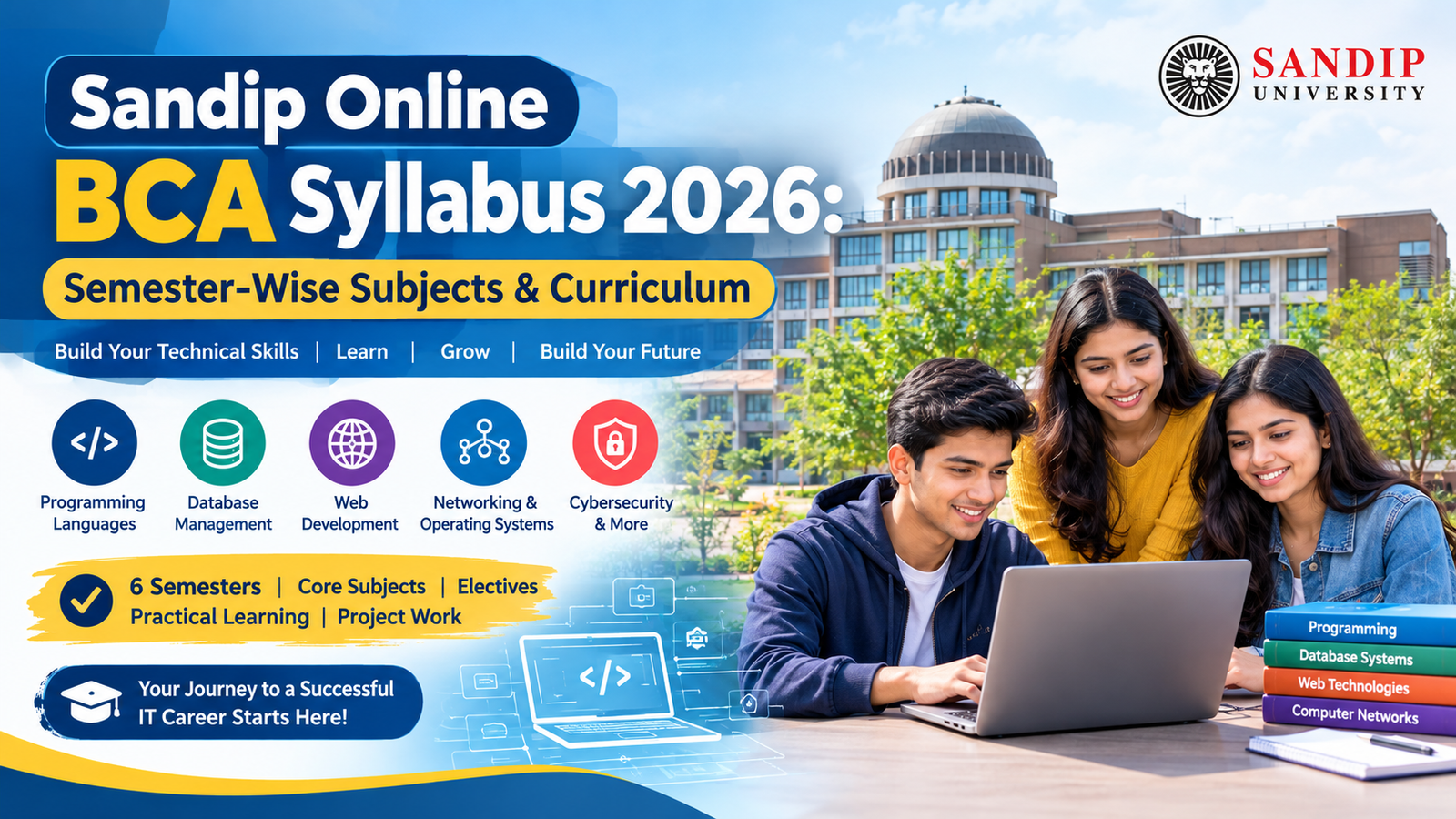
Sandip Online BCA Syllabus 2026: Semester-Wise Subjects & Curriculum

Introduction to Sandip Online BCA Syllabus 2026
The Sandip Online (BCA) Bachelor of Computer Applications is a popular undergraduate programme for students who want to build a career in information technology, software development, computer applications, web development, database management, and other technology-related fields. As businesses increasingly rely on digital platforms, software systems, and data-driven solutions, computer application skills have become valuable across many industries.
Students searching for the Sandip Online BCA Syllabus 2026 often want to understand the subjects covered in each semester, the programming languages they may learn, the structure of the curriculum, and the career opportunities available after completing the course.
A typical Sandip Online BCA curriculum combines computer science fundamentals with programming, mathematics, database management, operating systems, networking, web technologies, software engineering, and project work. These subjects help students develop logical thinking, problem-solving abilities, and practical computing knowledge.
This SEO guide explains the expected semester-wise Sandip Online BCA curriculum, important subjects, practical learning opportunities, eligibility requirements, course duration, assessment methods, and career options for students planning their education in 2026.
Important note: The semester-wise subjects described below represent an illustrative Sandip Online BCA curriculum, not a verified official Sandip University syllabus. The actual subjects, credits, electives, programming languages, duration, and semester structure may differ. Students should confirm the approved curriculum and whether the particular Sandip Online BCA programme is available in an online mode for the 2026 academic session before applying.
What Is the Sandip Online BCA Course?
The Bachelor of Computer Applications is an undergraduate degree focused on computer applications, software systems, programming, and information technology. It introduces students to the technical concepts and practical skills required to understand, develop, maintain, and improve computer-based applications.
A Sandip Online BCA programme may be suitable for students who enjoy computers, logical reasoning, technology, coding, and problem-solving. It can also provide a foundation for further studies in computer science, information technology, and related disciplines.
Students exploring Sandip Online BCA 2026 should first confirm the availability and delivery mode of the specific programme. They should also check its academic recognition, eligibility requirements, fee structure, learning platform, and examination arrangements.
Key Areas Covered in a BCA Programme
A typical Sandip Online BCA curriculum may include:
- Programming Fundamentals: Learning programming concepts, algorithms, and problem-solving techniques.
- Computer Fundamentals: Understanding computer hardware, software, and basic computer architecture.
- Database Management: Learning how data is stored, organized, retrieved, and managed.
- Web Development: Understanding website structure, design, development, and internet technologies.
- Operating Systems: Studying how operating systems manage memory, files, processes, and computer resources.
- Computer Networks: Learning about communication systems, network architecture, and data transmission.
- Software Engineering: Understanding software development methods, testing, documentation, and maintenance.
- Data Structures: Learning how to organize and process data efficiently.
- Cybersecurity Fundamentals: Exploring basic security principles, threats, and protective practices.
- Project Development: Applying technical knowledge to practical programming and application-development tasks.
The exact subjects depend on the university’s curriculum and the programme’s approved structure.
Sandip Online BCA Syllabus 2026: Semester-Wise Subjects
A conventional undergraduate BCA programme may be organized into six semesters over three years. The outline below provides an example of how subjects could progress from computer fundamentals to advanced technical concepts and projects.
The actual Sandip University BCA syllabus for 2026 may differ in subject names, order, credits, and electives.
Semester 1: Computer Fundamentals and Programming Basics
The first semester generally introduces students to computers, programming logic, mathematics, and foundational digital skills. It helps learners develop the technical understanding needed for more advanced subjects.
1. Computer Fundamentals
Computer fundamentals introduces the basic components and functions of computer systems. Students may learn about hardware, software, input and output devices, memory, storage, operating concepts, and different types of computers.
This subject helps learners understand how computer systems process information and support modern applications.
2. Programming in C or an Introductory Programming Language
Many traditional Sandip Online BCA curricula introduce programming through C or another foundational language. Students may study variables, data types, operators, conditional statements, loops, functions, arrays, and introductory problem-solving.
Learning programming fundamentals helps students develop the logical thinking required to write and debug code.
3. Mathematics for Computing
Mathematics for computing may cover algebra, sets, functions, matrices, logic, and other mathematical concepts relevant to computer science.
Depending on the programme, students may also encounter introductory discrete mathematics and numerical techniques.
4. Digital Computer Fundamentals
This subject introduces the digital principles behind computing systems. Potential topics include number systems, binary arithmetic, Boolean algebra, logic gates, and basic digital circuits.
5. Communication Skills
Communication skills helps students improve written and spoken communication, presentation techniques, professional writing, and the ability to explain technical ideas clearly.
6. Practical Programming Laboratory
Programming laboratory sessions allow students to practise writing, compiling, testing, and debugging programs. Students may complete exercises involving calculations, conditions, loops, and simple functions.
Learning outcomes: Students begin understanding computer systems, programming logic, basic mathematics, and technical communication.
Semester 2: Programming, Data Structures and Database Fundamentals
The second semester commonly develops students’ programming skills and introduces ways to organize, store, and process information.
1. Object-Oriented Programming
Object-oriented programming introduces concepts such as classes, objects, encapsulation, inheritance, abstraction, and polymorphism. The language used may depend on the approved curriculum.
These concepts are widely used in software development because they help programmers organize code into reusable components.
2. Data Structures
Data structures explain how information can be organized and processed efficiently. Students may learn arrays, linked lists, stacks, queues, trees, and searching and sorting methods.
Understanding data structures is important for developing efficient software and preparing for technical interviews.
3. Database Management Systems
Database management systems introduces the principles of data storage and retrieval. Topics may include database tables, keys, relationships, normalization, SQL queries, and transaction concepts.
Students may practise creating databases and writing queries to retrieve, insert, update, and manage records.
4. Discrete Mathematics
Where included, discrete mathematics covers logical reasoning, relations, functions, sets, graphs, and combinatorics. These concepts provide a mathematical foundation for algorithms and computing theory.
5. Web Technology Fundamentals
This subject may introduce HTML, CSS, internet concepts, web browsers, website structure, and introductory JavaScript.
Students can use these skills to create simple web pages and understand how websites are organized.
6. Programming and Database Laboratory
Practical work may involve writing programs, implementing basic data structures, designing tables, and executing SQL commands.
Learning outcomes: Students improve their programming ability, understand database concepts, and begin creating simple web applications.
Semester 3: Advanced Programming and Operating Systems
The third semester may introduce more advanced programming techniques and explain how computer systems manage software and hardware resources.
1. Data Structures and Algorithms
This subject may expand on fundamental data structures and introduce algorithm analysis, recursion, searching, sorting, and efficiency concepts.
Students learn to compare different approaches to solving computational problems.
2. Operating Systems
Operating systems explains how software manages computer resources. Topics may include processes, threads, memory management, file systems, scheduling, and synchronization.
Understanding operating systems helps students appreciate what happens behind the scenes when applications run.
3. Software Engineering
Software engineering introduces systematic approaches to designing, developing, testing, and maintaining software. Students may study software development life cycles, requirements analysis, design documentation, testing, and project planning.
4. Object-Oriented Programming Laboratory
Practical exercises may involve developing programs using classes, objects, inheritance, and other object-oriented concepts.
5. Database Applications
This subject may explore more advanced SQL queries, database relationships, data integrity, and database-backed applications.
6. Web Development Laboratory
Students may create web pages, implement forms, apply CSS styling, and use introductory scripting to improve website functionality.
Learning outcomes: Students strengthen their programming skills and gain a better understanding of software development and computer system management.
Semester 4: Computer Networks, Web Development and Software Design
The fourth semester generally expands technical knowledge by introducing networking, more advanced web development, and software application design.
1. Computer Networks
Computer networks introduces the principles used to connect computers and exchange information. Topics may include network types, communication protocols, network devices, IP addressing, and network architecture.
Students may also learn introductory concepts associated with the TCP/IP model and network security.
2. Java Programming or Advanced Programming
Depending on the curriculum, students may study Java or another programming language in greater depth. Potential topics include object-oriented programming, exception handling, collections, file operations, and application development.
3. Web Application Development
Web application development may cover dynamic websites, server-side programming, form processing, database connectivity, and introductory application architecture.
The technologies used depend on the university’s prescribed subjects and laboratory resources.
4. Computer Organization and Architecture
This subject examines the internal organization of computer systems. Students may learn about processors, memory units, instruction execution, registers, and input/output systems.
5. Probability, Statistics or Applied Mathematics
Some curricula include mathematical subjects that support data analysis, computing, and decision-making.
6. Software Development Laboratory
Students may work on small applications that combine programming, databases, and user-interface concepts.
Learning outcomes: Students gain a broader understanding of networking, software architecture, and web-based application development.
Semester 5: Advanced Computing and Specialization Subjects
The fifth semester may introduce advanced technical subjects and electives that allow students to explore particular areas of information technology.
1. Python Programming
Where included, Python programming introduces a widely used language for automation, scripting, data processing, and application development.
Students may learn functions, modules, file handling, exceptions, and libraries relevant to the programme.
2. Cloud Computing
Cloud computing introduces the delivery of computing resources over networks. Students may explore cloud infrastructure, storage, virtual machines, deployment concepts, and cloud service models.
The depth of coverage depends on the syllabus.
3. Cybersecurity Fundamentals
Cybersecurity introduces methods for protecting systems, networks, and data. Topics may include authentication, access control, common threats, safe computing practices, and security principles.
This subject provides a foundation rather than professional-level security expertise.
4. Data Analytics or Data Science Fundamentals
Where offered, data analytics introduces methods for examining datasets and presenting useful information. Students may learn data cleaning, descriptive statistics, visualization, and introductory analytical tools.
5. Mobile Application Development
Some BCA curricula offer mobile application development as a subject or elective. Students may explore application interfaces, mobile programming concepts, and the development process.
6. Elective Subjects
Potential elective areas may include:
- Cloud computing
- Mobile application development
- Artificial intelligence fundamentals
- Data analytics
- Cybersecurity
- Advanced web development
- Internet of Things fundamentals
These are examples of possible subject areas, not a confirmed list of Sandip University electives.
Learning outcomes: Students expand their technical knowledge and may begin exploring a preferred area of specialization.
Semester 6: Advanced Applications and Final Project
The final semester of a conventional six-semester BCA programme generally emphasizes practical application, integration of technical concepts, and preparation for employment or further study.
1. Advanced Web or Application Development
Students may study advanced application concepts based on their curriculum. This can include application architecture, database integration, user authentication, application testing, and deployment fundamentals.
2. Introduction to Artificial Intelligence
Where included, this subject may introduce artificial intelligence concepts, intelligent systems, machine learning fundamentals, and practical applications.
Students should not assume that artificial intelligence is a mandatory subject unless it appears in the official syllabus.
3. Information Security or Emerging Technologies
Some programmes introduce advanced or emerging computing topics in the final semester. The selected subjects depend on the approved curriculum.
4. Project Management
Project management introduces planning, scheduling, resource allocation, risk identification, documentation, and coordination of software projects.
5. Major Project or Capstone Project
Students may be required to design and develop an application that addresses a defined problem. Example project ideas include:
- Student attendance management system
- Online library management system
- Inventory management application
- College event registration website
- Appointment booking system
- Basic expense tracking application
- Student information portal
A well-planned project typically includes requirements, design, implementation, testing, documentation, and a demonstration.
6. Internship or Practical Training
Some programmes include an internship or practical training component. Students should verify whether it is mandatory, how it is assessed, and whether the university provides placement or internship assistance.
Learning outcomes: Students apply their technical knowledge to a practical project and prepare for entry-level roles or further education.
Important: This six-semester outline is illustrative. It should not be represented as the verified official Sandip Online BCA syllabus for 2026.
Important Programming Languages in the Sandip Online BCA Curriculum
Programming languages are an important part of Sandip Online BCA education because they help students develop applications and understand software development.
The exact languages taught depend on the curriculum, but students may encounter some of the following.
1. C Programming
C is commonly used to teach foundational programming concepts, memory-related principles, control structures, functions, and problem-solving.
2. C++ or Java
C++ and Java are used in many educational contexts to teach object-oriented programming. The choice of language varies by programme.
3. Python
Python is popular for scripting, automation, data analysis, and many application-development tasks. Its relatively readable syntax makes it useful for learning programming concepts.
4. JavaScript
JavaScript is widely used to create interactive website features and browser-based applications.
5. SQL
SQL is used to interact with relational databases. Students may use it to create tables, retrieve information, update records, and manage structured data.
Learning one language thoroughly is generally more valuable than memorizing syntax from many languages without practical experience. Students should practise regularly and build small applications alongside their coursework.
Practical Learning and Laboratory Work in Sandip Online BCA
Computer applications is a practical field. Students benefit from applying theoretical knowledge through programming exercises, database tasks, and software projects.
Depending on the programme, practical activities may include:
- Programming exercises: Writing and debugging code.
- Database assignments: Creating tables and writing SQL queries.
- Web development: Building responsive web pages and simple applications.
- Network exercises: Understanding network configuration and communication concepts.
- Software testing: Identifying errors and checking whether applications meet requirements.
- Project development: Designing and implementing a working application.
- Technical documentation: Explaining project objectives, architecture, testing, and results.
Students considering an Sandip Online BCA should confirm how laboratory activities are conducted, whether special software is required, and whether any in-person examinations or practical sessions are compulsory.
Sandip Online BCA Eligibility Criteria 2026
Eligibility requirements depend on the specific Sandip Online BCA programme and the applicable admission regulations.
Undergraduate Sandip Online BCA programmes commonly require candidates to have completed Class 12 or an equivalent recognized qualification. The minimum aggregate marks, accepted academic streams, mathematics requirements, and other conditions can differ between institutions.
Before applying, students should confirm the exact eligibility requirements for Sandip University Sandip Online BCA admission in 2026.
Is Mathematics Compulsory for BCA?
Mathematics requirements vary by university and programme. Some Sandip Online BCA programmes accept candidates from multiple academic streams, while others specify particular subjects or qualifications.
Students should not assume that mathematics is either compulsory or unnecessary without checking the applicable admission rules.
Documents Commonly Required for Admission
Applicants may be asked to provide:
- Class 10 marksheet or certificate
- Class 12 marksheet or certificate
- Valid identity document
- Recent photograph
- Signature image, if required
- Transfer or migration certificate, where applicable
- Additional documents specified by the institution
The final document list depends on the admission process.
Sandip Online BCA Course Duration
A conventional Sandip Online BCA programme commonly follows a three-year structure with six semesters. However, duration, credits, and academic requirements depend on the approved programme and applicable regulations.
Students should verify the following before enrolling:
- Total programme duration.
- Number of semesters and required credits.
- Rules for examinations and supplementary assessments.
- Project and practical requirements.
- Maximum permitted time to complete the degree.
- Whether the programme is available in the online mode.
An online delivery format, where offered, may provide flexibility in accessing course materials. Students must still meet academic deadlines, complete assessments, and satisfy all applicable programme requirements.
How Is the Sandip Online BCA Course Evaluated?
BCA programmes may use several assessment methods to evaluate theoretical knowledge and practical ability.
Internal Assessment
Internal assessment may include assignments, quizzes, laboratory exercises, presentations, and project submissions.
Semester Examinations
Semester examinations assess students’ understanding of the subjects covered during the academic term. The examination format may include objective questions, descriptive questions, programming problems, or practical assessments.
Laboratory Examinations
Where applicable, laboratory examinations may require students to write programs, execute SQL queries, solve computing problems, or demonstrate practical skills.
Project Evaluation
Project assessment may consider the quality of the solution, implementation, documentation, testing, presentation, and the student’s understanding of the work.
The exact evaluation pattern and weighting of each component depend on the approved academic regulations.
Skills Developed Through a Sandip Online BCA Degree
A Sandip Online BCA programme can help students develop technical and professional skills that are useful in technology-related careers.
1. Programming and Logical Thinking
Programming teaches students to break complex problems into smaller steps and create logical solutions.
2. Database Management
Database subjects help students understand how information is stored, queried, organized, and protected.
3. Web Development
Web development skills can help students build websites, interactive interfaces, and database-driven applications.
4. Analytical Thinking
Algorithms, mathematics, and data-related subjects encourage structured problem-solving and analytical reasoning.
5. Debugging and Testing
Students learn to identify errors, test solutions, and improve the reliability of applications.
6. Teamwork and Communication
Projects and presentations help learners explain technical concepts, coordinate tasks, and collaborate with other people.
7. Adaptability
Technology changes quickly. Students who develop strong fundamentals and continue learning can adapt more effectively to new tools, frameworks, and programming approaches.
Career Opportunities After BCA
Sandip Online BCA graduates may explore several entry-level roles in software development, IT support, web technologies, databases, and related fields. Job eligibility depends on employer requirements, technical skills, experience, and the role’s responsibilities.
1. Junior Software Developer
Junior software developers assist with writing, testing, debugging, and maintaining applications. Employers may require proficiency in one or more programming languages.
2. Web Developer
Web developers create and maintain websites and web applications. Depending on the position, skills in HTML, CSS, JavaScript, server-side programming, and databases may be useful.
3. Front-End Developer
Front-end developers build the parts of applications users interact with. They commonly work with HTML, CSS, JavaScript, and relevant frameworks.
4. Back-End Developer
Back-end developers work on server-side logic, databases, APIs, authentication, and application infrastructure. The specific tools vary between employers.
5. Database Support Executive
Database-related roles may involve managing records, writing queries, supporting data operations, and helping maintain database reliability.
6. IT Support Executive
IT support professionals help users resolve computer, software, network, and account-access issues. Troubleshooting and communication skills are valuable in this role.
7. Software Testing Trainee
Software testing trainees help verify application functionality, document defects, execute test cases, and support quality assurance activities.
8. Technical Support Engineer
Technical support roles involve investigating technical problems and helping customers or employees use software and systems effectively.
9. Junior Data Analyst
Students with relevant skills in spreadsheets, SQL, statistics, and data visualization may explore junior data analyst opportunities. Additional training or a strong project portfolio may be necessary.
10. Freelance Developer
Students with sufficient practical skills may undertake small projects such as website creation, basic business applications, or maintenance work. Freelancing requires technical competence, client communication, and project management.
A BCA degree does not guarantee a specific job or salary. Students should develop demonstrable skills through projects, internships, coding practice, and relevant certifications.
Higher Education Options After BCA
Students who want to continue studying after Sandip Online BCA may consider postgraduate programmes and professional learning pathways.
Master of Computer Applications (MCA)
An MCA provides advanced study in computer applications and software development. Admission depends on the institution’s eligibility rules and any applicable entrance examination.
MSc in Computer Science or Information Technology
Depending on the institution’s admission requirements, graduates may explore postgraduate study in computer science, information technology, or related subjects.
Certifications in Software Development
Certifications and structured courses in programming, web development, cloud computing, databases, or software testing can help students strengthen specific technical skills.
Data Analytics and Artificial Intelligence
Students interested in data-related careers may study statistics, Python, SQL, data visualization, and introductory machine learning. Entry requirements vary by programme.
Cybersecurity and Cloud Computing
Additional training in network security, cloud platforms, and infrastructure may help students explore these technical areas.
Before selecting a postgraduate programme, students should verify whether their undergraduate degree meets the relevant eligibility requirements.
Why Choose Sandip Online BCA in 2026?
Technology plays a significant role in education, healthcare, banking, retail, manufacturing, communication, and many other sectors. Organizations use software applications and digital systems to manage operations, communicate with customers, and process information.
A Sandip Online BCA programme can provide a foundation for understanding how these systems are built and maintained.
Potential advantages include:
- Exposure to programming and computer applications.
- Opportunities to develop logical and analytical thinking.
- Introduction to databases, networking, and software development.
- A foundation for entry-level technology roles.
- Preparation for further study in computer applications or related fields.
- Opportunities to develop a portfolio of practical projects.
The value of the programme depends on its academic quality, recognition, curriculum, learning support, and the student’s willingness to practise and develop technical skills.
How to Prepare for a BCA Course
Students can begin preparing for Sandip Online BCA by developing foundational computer skills and exploring introductory programming.
Learn Basic Computer Concepts
Understand computer hardware, operating systems, files, folders, software installation, and basic troubleshooting.
Practise Programming
Start with an introductory language and practise variables, conditions, loops, functions, and simple algorithms.
Explore HTML and CSS
Basic web technologies provide an accessible way to create small projects and understand website structure.
Develop Mathematical Reasoning
Practise basic algebra, logical reasoning, number systems, and problem-solving. These skills can be useful in programming and computing theory.
Build Small Projects
Create a calculator, personal webpage, student record system, or another manageable project. Small projects help turn theory into practical knowledge.
Learn to Use Version Control
Students interested in software development can gradually learn Git and use repositories to organize and document their projects.
Preparation is not necessarily an admission requirement, but it can make the transition to technical subjects easier.
How to Choose the Right BCA Programme
Before applying for Sandip Online BCA 2026, students should consider several factors beyond the subject list.
Verify Recognition and Delivery Mode
Confirm the status of the awarding institution and whether the specific BCA programme and online delivery mode meet applicable regulatory requirements. Recognition of an institution does not automatically establish approval for every programme or delivery method.
Review the Complete Syllabus
Ask for the current curriculum, including subject names, semester allocation, credits, electives, practical components, and project requirements.
Check Programming and Laboratory Facilities
Understand which programming languages and tools are taught, how practical work is conducted, and whether students receive suitable technical support.
Understand the Total Fees
Review tuition, registration, examination, technology, and other applicable charges. Request a complete fee breakdown before making a payment.
Evaluate Learning Support
For an online programme, confirm how students access course materials, contact faculty, submit assignments, receive feedback, and obtain technical assistance.
Check Examination Requirements
Confirm the examination format, practical assessment arrangements, attendance rules, and any mandatory in-person requirements.
Consider Your Career Goals
Students interested in web development may prioritize practical web projects, while those interested in databases, data analytics, or cybersecurity may look for relevant subjects and opportunities to build specialized skills.
Frequently Asked Questions About Sandip Online BCA Syllabus 2026
1. What is the Sandip Online BCA Syllabus 2026?
A Sandip Online BCA syllabus generally includes programming, computer fundamentals, mathematics, databases, data structures, operating systems, software engineering, networking, and web technologies. The exact official Sandip University syllabus for 2026 should be confirmed with the institution.
2. How many semesters are there in BCA?
A conventional three-year Sandip Online BCA programme commonly contains six semesters. The exact structure depends on the approved programme.
3. Which programming languages are taught in BCA?
Depending on the curriculum, students may study C, C++, Java, Python, JavaScript, or other languages. The actual languages vary by institution and semester.
4. Is mathematics compulsory for Sandip Online BCA admission?
Mathematics requirements differ between institutions and programmes. Students should check the applicable admission eligibility criteria.
5. Can arts or commerce students apply for Sandip Online BCA?
Some Sandip Online BCA programmes accept candidates from different academic streams, while others specify particular subject requirements. Applicants should confirm the eligibility rules for their chosen programme.
6. Does the BCA syllabus include practical projects?
Many Sandip Online BCA programmes include programming laboratories, assignments, and projects. The specific practical requirements depend on the approved curriculum.
7. Is Python taught in Sandip Online BCA?
Python may be included as a core subject, elective, or practical component, depending on the curriculum. Students should review the actual syllabus.
8. What career options are available after Sandip Online BCA?
Potential roles include junior software developer, web developer, IT support executive, software testing trainee, database support professional, and junior data analyst, subject to relevant skills and employer requirements.
9. Can students pursue MCA after BCA?
BCA graduates may apply for MCA programmes if they satisfy the relevant admission requirements. Eligibility rules and entrance examinations vary by institution.
10. Is online Sandip Online BCA suitable for students who need flexibility?
An online programme may be suitable for students who need flexible access to learning materials, provided the specific programme is available in that mode and meets their academic needs. Students should confirm recognition, examination requirements, and learning support before enrolling.
Conclusion
The Sandip Online BCA Syllabus 2026: Semester-Wise Subjects & Curriculum is an important topic for students planning to pursue undergraduate education in computer applications and information technology.
A typical Sandip Online BCA curriculum begins with computer fundamentals, programming, mathematics, and communication skills. It then progresses to data structures, database management, operating systems, software engineering, computer networks, web development, and advanced computing topics. Practical assignments and projects can help students apply their knowledge to real-world problems.
After completing a Sandip Online BCA, graduates may explore entry-level roles in software development, web technologies, IT support, database operations, software testing, and other technology-related areas. They may also consider postgraduate education or specialized technical certifications.
Before enrolling in Sandip University BCA for 2026, students should verify the programme’s actual availability and delivery mode, official semester-wise syllabus, eligibility criteria, fees, recognition, duration, examination pattern, and admission procedure.
Planning to study Sandip Online BCA in 2026? Compare the curriculum with your interests, strengthen your programming fundamentals, and confirm the official programme details before making an admission decision.