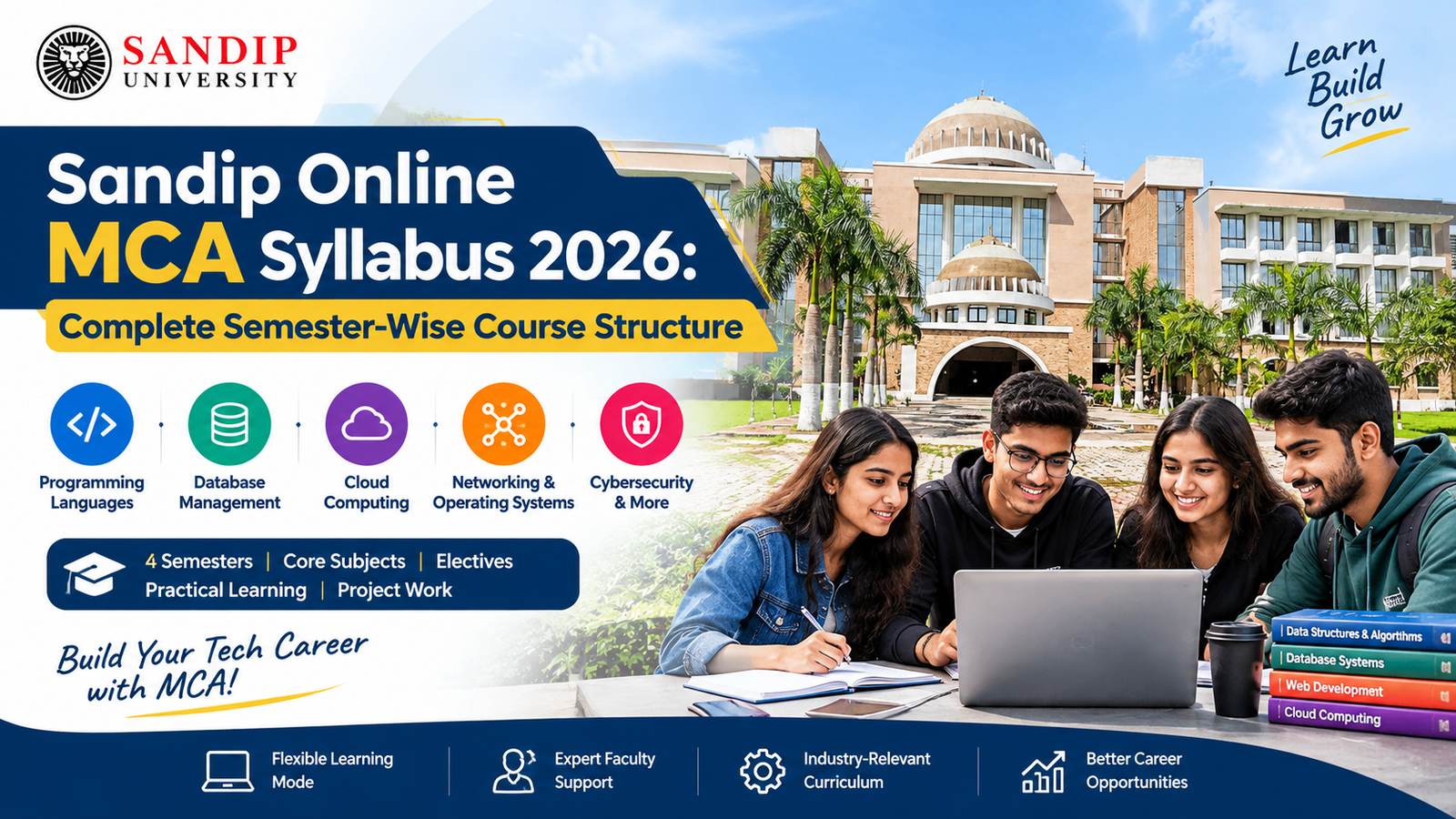
Sandip Online MCA Syllabus 2026: Complete Semester-Wise Course Structure

Introduction to Sandip Online MCA Syllabus 2026
The Master of Computer Applications (MCA) is a postgraduate programme designed for students who want to develop advanced knowledge of computer applications, software development, programming, databases, networking, and modern information technology. As organizations increasingly depend on digital systems, cloud platforms, cybersecurity, and data-driven applications, postgraduate computing education can help learners prepare for a range of technology-related careers.
Students searching for the Sandip Online MCA Syllabus 2026 often want to know which subjects are covered in each semester, which programming languages they may learn, whether the course includes practical projects, and what career opportunities may be available after completing the degree.
An Sandip Online MCA curriculum generally combines computer science fundamentals with advanced programming, data structures, database management, operating systems, software engineering, web technologies, computer networks, and specialized subjects. Depending on the programme, students may also study cloud computing, artificial intelligence, machine learning, cybersecurity, or data analytics.
This guide explains an illustrative semester-wise Sandip Online MCA curriculum, important subjects, practical learning opportunities, eligibility requirements, programme duration, assessment methods, and potential career pathways.
Important note: The semester-wise structure below is a general MCA curriculum guide, not a verified official Sandip University syllabus. The actual subjects, electives, credits, duration, and delivery format may differ. Students should confirm the official curriculum and the availability and recognition of the specific programme in online mode for the 2026 academic session before applying.
What Is the Sandip Online MCA Course?
The Master of Computer Applications is a postgraduate degree focused on computer applications, software systems, programming, and information technology. It is generally intended for graduates who want to deepen their technical knowledge and prepare for more advanced responsibilities in the IT sector.
An MCA programme may help students strengthen their understanding of software architecture, database systems, application development, operating systems, and modern computing technologies. It may also provide opportunities to work on technical projects that demonstrate practical problem-solving abilities.
Students considering Sandip Online MCA 2026 should check the specific programme’s availability, academic recognition, eligibility conditions, total fees, learning platform, examination method, and practical requirements.
Key Areas Covered in an MCA Programme
A typical Sandip Online MCA curriculum may cover:
- Advanced Programming: Developing software using structured and object-oriented programming concepts.
- Data Structures and Algorithms: Organizing information and designing efficient computational solutions.
- Database Management: Designing, querying, and managing structured data systems.
- Software Engineering: Applying systematic methods to software design, development, testing, and maintenance.
- Operating Systems: Understanding process management, memory allocation, files, and system resources.
- Computer Networks: Studying communication protocols, network architecture, and connectivity.
- Web and Application Development: Building websites, web applications, and software solutions.
- Cloud Computing: Understanding cloud infrastructure, deployment, and distributed services.
- Data Analytics and AI: Exploring data analysis and intelligent computing where included.
- Project Development: Applying technical knowledge to practical computing problems.
The exact subject list depends on the approved curriculum of the programme.
Sandip Online MCA Syllabus 2026: Semester-Wise Course Structure
MCA programmes may follow different academic structures depending on the university, applicable regulations, and admission cohort. Some programmes use a four-semester structure, while others may have different duration or credit requirements.
The following outline presents an example of a four-semester, two-year MCA curriculum. It is intended to help students understand the subjects commonly found in postgraduate computer application programmes. It should not be treated as the confirmed official Sandip University syllabus for 2026.
Semester 1: Advanced Computing Fundamentals
The first semester of a typical Sandip Online MCA programme builds on students’ existing knowledge of computing and introduces advanced programming and software development concepts.
1. Advanced Programming
Advanced programming develops students’ ability to design, write, test, and maintain software. Depending on the curriculum, students may study object-oriented programming, functions, exception handling, file processing, modular programming, and reusable code.
Programming languages may include Java, Python, C++, or another language prescribed by the university.
2. Data Structures and Algorithms
Data structures and algorithms is an important subject for software development and technical problem-solving. Students may study arrays, linked lists, stacks, queues, trees, graphs, searching, sorting, recursion, and algorithm analysis.
The subject helps learners understand how to select suitable approaches for different computational problems.
3. Database Management Systems
Database management systems examines how applications store, organize, retrieve, and update information. Topics may include relational database design, normalization, SQL, transaction processing, indexing, and database integrity.
Students may practise designing database schemas and writing queries for practical business applications.
4. Computer Organization and Architecture
This subject introduces the internal structure of computer systems. Students may study processors, registers, memory, instruction execution, input/output systems, and computer performance.
Understanding computer architecture can help learners appreciate how software interacts with hardware.
5. Mathematical Foundations of Computer Science
Mathematical foundations may include discrete mathematics, logic, sets, relations, functions, graphs, and combinatorics. These concepts support algorithm design, formal reasoning, and computer science theory.
6. Programming Laboratory
Practical programming work allows students to implement algorithms, create small applications, test code, and resolve programming errors.
Learning outcomes: Students strengthen programming logic, develop algorithmic thinking, and improve their understanding of databases and computing systems.
Semester 2: Software Engineering and System Development
The second semester may focus on software development methodologies, operating systems, networks, and advanced application development.
1. Software Engineering
Software engineering introduces systematic methods for planning, designing, building, testing, deploying, and maintaining software.
Topics may include requirements gathering, software development life cycles, system modelling, project documentation, quality assurance, and maintenance.
Students learn why software development requires planning, testing, teamwork, and structured documentation.
2. Operating Systems
Operating systems examines how computer systems manage resources and support application execution.
Potential topics include processes, threads, CPU scheduling, memory management, file systems, synchronization, and deadlocks.
These concepts are useful for understanding application performance and system-level behaviour.
3. Computer Networks
Computer networks introduces communication between computers and connected devices. Students may study network architecture, transmission methods, routing, addressing, communication protocols, and network troubleshooting.
Depending on the syllabus, the subject may also cover network security fundamentals.
4. Web Technologies
Web technologies may include HTML, CSS, JavaScript, server-side programming, APIs, and database integration.
Students may learn how web applications process requests, display information, and communicate with databases.
5. Object-Oriented Analysis and Design
This subject explores techniques for modelling software systems before implementation. Students may learn classes, objects, design principles, UML diagrams, and software architecture fundamentals.
6. Software Development Laboratory
Laboratory exercises may require students to build small applications, connect software to databases, test features, and document implementation decisions.
Learning outcomes: Students gain a better understanding of software development processes, operating systems, network communication, and application design.
Semester 3: Advanced Technologies and Specialization
The third semester of an illustrative MCA curriculum may introduce advanced computing topics and specialization-oriented subjects. The exact selection depends on the programme.
1. Cloud Computing
Cloud computing explores the delivery of computing services over networks. Topics may include cloud service models, virtual machines, storage, deployment, scalability, and cloud architecture.
Students may learn how organizations use cloud platforms to host applications and manage computing resources.
2. Data Analytics
Data analytics introduces techniques for examining information, identifying patterns, and communicating findings.
Topics may include data preparation, descriptive statistics, data visualization, analytical methods, and the use of programming tools for data processing.
3. Artificial Intelligence Fundamentals
Where included, artificial intelligence introduces concepts related to intelligent systems, search techniques, knowledge representation, and basic machine learning.
Students should confirm whether artificial intelligence is part of the actual Sandip MCA curriculum rather than assuming it is compulsory.
4. Cybersecurity Fundamentals
Cybersecurity covers the principles of protecting computer systems, networks, and data. Students may explore authentication, authorization, encryption concepts, common threats, secure coding, and risk management.
This subject can provide a foundation for further learning in information security.
5. Mobile or Advanced Application Development
Some curricula include mobile application development or advanced software development. Students may explore application interfaces, programming frameworks, APIs, and deployment concepts.
6. Elective Subject
Depending on the approved curriculum, students may choose an elective related to their interests. Possible subject areas in Sandip Online MCA programmes include:
- Cloud computing
- Data analytics
- Artificial intelligence
- Machine learning
- Cybersecurity
- Mobile application development
- Advanced database systems
- Web application development
These are examples of possible areas, not a confirmed list of electives offered by Sandip University in 2026.
Learning outcomes: Students broaden their technical knowledge and may begin focusing on a specific computing area.
Semester 4: Major Project and Professional Application
The final semester of a conventional four-semester Sandip Online MCA programme often emphasizes project work, advanced application development, and the integration of technical knowledge.
1. Advanced Software Development
This subject may cover advanced application architecture, integration, performance, maintainability, testing, and deployment.
The exact content depends on the approved curriculum and selected specialization.
2. Emerging Technologies
Some programmes introduce emerging technology topics such as distributed systems, Internet of Things, advanced cloud services, or intelligent applications.
Students should refer to the official syllabus for the specific subjects included.
3. IT Project Management
IT project management examines how software projects are planned, organized, monitored, and delivered.
Topics may include project scope, timelines, resource allocation, risk management, documentation, and teamwork.
4. Research Methods or Technical Seminar
Where included, research methods or technical seminars help students review technical literature, evaluate computing solutions, present findings, and communicate ideas professionally.
5. Major Project or Dissertation
A major project provides an opportunity to apply computing knowledge to a practical problem. Students may need to define requirements, design a solution, develop software, test the application, and prepare a report.
Possible Sandip Online MCA project ideas include:
- Online examination management system
- Hospital appointment and record management application
- E-commerce website with database integration
- Student learning management system
- Inventory and billing application
- Customer relationship management system
- Data visualization dashboard
- Cloud-based document management application
- Secure login and access management system
The best project is one that matches the student’s skills, has clearly defined requirements, and can be completed and demonstrated effectively.
6. Internship or Industry-Based Training
Some Sandip Online MCA programmes include an internship, practical training, or industry-based project. Students should verify whether this component is compulsory and how it is assessed.
Learning outcomes: Students integrate technical concepts, demonstrate project development skills, and prepare for professional or further academic opportunities.
Important: This four-semester outline is illustrative. The official Sandip University MCA programme may use a different structure, subject list, or duration.
Important Programming Languages in the MCA Curriculum
Programming is a central part of many Sandip Online MCA programmes. Students may work with one or more languages depending on their prior knowledge, specialization, and university syllabus.
1. Java
Java is widely used in enterprise software and application development. It can help students understand object-oriented programming, exception handling, collections, and application architecture.
2. Python
Python is used in scripting, automation, web development, data analytics, and machine learning. Its ecosystem includes many libraries for working with data and developing applications.
3. C and C++
C and C++ can help students understand programming fundamentals, memory concepts, data structures, and performance-sensitive applications.
4. JavaScript
JavaScript is widely used for interactive websites and web applications. It can be used alongside HTML, CSS, server-side technologies, and web frameworks.
5. SQL
SQL is used to interact with relational databases. Students may learn to design tables, retrieve data, create relationships, and manage database operations.
6. Other Technologies
Depending on the curriculum, students may encounter additional languages, frameworks, development tools, and database platforms.
Students should focus on understanding programming principles and building working applications rather than learning many languages superficially.
Practical Learning in an Sandip Online MCA Programme
An Sandip Online MCA programme can be more valuable when students combine theoretical knowledge with practical experience.
Depending on the course structure, practical activities may include:
- Programming assignments: Implementing algorithms and building applications.
- Database exercises: Designing schemas, writing queries, and testing data operations.
- Software engineering projects: Preparing requirements, diagrams, and test plans.
- Web application development: Creating websites and applications connected to databases.
- Cloud exercises: Exploring deployment and computing services where facilities are available.
- Security assignments: Learning basic security testing and secure programming practices.
- Research presentations: Reviewing technical topics and communicating findings.
- Major projects: Developing an application that addresses a defined problem.
Students considering an online MCA should verify how laboratory sessions, programming exercises, practical examinations, and project supervision are delivered.
Sandip Online MCA Eligibility Criteria 2026
Eligibility requirements vary according to the university, programme, and applicable admission regulations.
Sandip Online MCA programmes generally require an eligible bachelor’s degree. Some programmes specify that applicants must have studied mathematics at the Class 12 or undergraduate level, while others may have different requirements or approved pathways.
Students should verify the exact eligibility criteria for Sandip University MCA admission in 2026.
Common Eligibility Considerations
Applicants may need to confirm:
- Whether their bachelor’s degree is accepted.
- Whether a minimum aggregate percentage or CGPA is required.
- Whether mathematics or another specified subject is compulsory.
- Whether entrance examinations or other selection criteria apply.
- Whether their previous qualification satisfies the requirements for the chosen delivery mode.
Do not assume that every graduate automatically qualifies for every MCA programme.
Documents Commonly Required
Depending on the admission process, applicants may be asked to submit:
- Class 10 marksheet or certificate
- Class 12 marksheet or certificate
- Bachelor’s degree certificate or provisional certificate
- Undergraduate semester marksheets
- Government-approved identity document
- Recent photograph
- Signature image, if required
- Migration or transfer certificate, where applicable
- Additional documents specified by the institution
Applicants should follow the university’s current document checklist.
Sandip Online MCA Course Duration
Sandip OnlineMCA duration depends on the programme structure and applicable academic regulations. A common format is two years divided into four semesters, but students should confirm the exact duration of the programme they intend to join.
Before applying, verify:
- Total course duration.
- Number of semesters and required credits.
- Rules for completing pending subjects.
- Project and practical requirements.
- Examination schedules.
- Maximum permitted period for completing the degree.
- Whether the specific programme is available in online mode.
An online format, where available, may provide flexible access to learning resources. Students still need to complete assessments, meet deadlines, and satisfy all academic requirements.
How Is the MCA Course Evaluated?
Sandip Online MCA programmes may use a combination of assessment methods to evaluate theoretical knowledge and technical skills.
Internal Assessment
Internal assessment may include assignments, quizzes, practical exercises, presentations, case studies, and project submissions.
Semester Examinations
Semester examinations evaluate students’ understanding of subjects such as programming, databases, operating systems, and software engineering.
The format may include descriptive questions, objective questions, programming problems, or other approved assessment methods.
Practical Examinations
Where required, practical examinations may test programming ability, database queries, application development, or technical troubleshooting.
Project Assessment
Project evaluation may consider the problem statement, system design, implementation, testing, documentation, presentation, and the student’s understanding of the work.
The exact grading system and weighting of assessments depend on the official academic regulations.
Skills Developed Through an MCA Degree
An Sandip Online MCA programme may help students develop several technical and professional capabilities.
1. Advanced Programming
Students learn to design, implement, debug, and maintain software using structured programming techniques and appropriate development tools.
2. Algorithmic Problem-Solving
Data structures and algorithms help learners evaluate different solutions and improve computational efficiency.
3. Database Design
Database subjects develop skills in data modelling, query writing, database management, and data integrity.
4. Software Engineering
Software engineering helps students understand how to plan, develop, test, document, and maintain software systems.
5. System and Network Understanding
Operating systems and networking subjects explain how software interacts with computer resources and communicates across networks.
6. Analytical Thinking
Mathematics, algorithms, and data-related subjects support structured reasoning and technical decision-making.
7. Project Management and Teamwork
Project work can help students practise planning, collaboration, documentation, and professional communication.
8. Continuous Learning
Technology changes quickly. Sandip Online MCA students benefit from developing the ability to learn new programming languages, frameworks, platforms, and development methods throughout their careers.
Career Opportunities After Sandip Online MCA
Sandip Online MCA graduates may pursue technical and software-related roles depending on their skills, projects, experience, and employer requirements.
1. Software Developer
Software developers build, test, and maintain applications. Employers may require proficiency in programming languages, data structures, databases, and software development tools.
2. Full-Stack Developer
Full-stack developers work on both the front-end and back-end components of applications. Relevant skills may include JavaScript, web frameworks, server-side programming, APIs, and databases.
3. Application Developer
Application developers design and maintain software for business, education, finance, healthcare, and other use cases.
4. Database Developer
Database developers design database structures, write queries, improve performance, and support applications that rely on structured data.
5. Systems Analyst
Systems analysts examine business requirements and evaluate how technology can improve processes. The role requires analytical thinking and the ability to communicate with technical and nontechnical teams.
6. Software Test Engineer
Software test engineers evaluate applications, prepare test cases, identify defects, and help improve software quality.
7. Cloud Support or Cloud Engineering Associate
Students with relevant cloud skills may explore entry-level roles supporting cloud infrastructure, deployments, and application operations. Specific positions may require additional certifications or experience.
8. Data Analyst
Data analyst positions may be suitable for candidates with skills in SQL, spreadsheets, statistics, data visualization, and analytical tools.
9. Cybersecurity Analyst Trainee
Students with suitable security knowledge and practical experience may explore junior security-related roles. Some positions require specialist training or certifications.
10. Technical Consultant
Technical consultants help organizations evaluate, configure, implement, or support software systems. The required skills depend on the technology and industry.
A postgraduate degree alone does not guarantee a particular job title or salary. Practical experience, technical ability, project quality, communication, and interview preparation can significantly influence career opportunities.
Higher Education and Certifications After MCA
Students who complete an Sandip Online MCA may choose to strengthen their knowledge through specialized learning or research.
Certifications in Cloud Computing
Cloud certifications and practical training may help students understand cloud infrastructure, deployment, monitoring, and security.
Data Science and Machine Learning
Students interested in data-focused careers can develop skills in Python, statistics, data processing, and machine learning fundamentals.
Cybersecurity Certifications
Additional security training can help learners explore network security, secure software development, incident response, and related fields.
Software Development Certifications
Specialized training in frameworks, application development, databases, or software testing may help students develop job-specific skills.
Research and Doctoral Study
Students interested in academic research may explore eligible research programmes, subject to the admission rules of the institution.
The most appropriate option depends on the student’s career goals and existing technical skills.
Why Consider MCA in 2026?
Organizations continue to use software systems, cloud services, data platforms, and digital applications to support business operations. An Sandip Online MCA can provide advanced study in computer applications and create a foundation for exploring technical careers.
Potential benefits include:
- Deeper understanding of programming and software systems.
- Exposure to advanced databases and application development.
- Opportunities to develop practical technical projects.
- A foundation for software engineering and related roles.
- Scope to explore cloud computing, analytics, and security.
- Preparation for further specialized learning.
However, the value of a programme depends on its curriculum, recognition, delivery quality, practical opportunities, and the student’s ability to apply what they learn.
How to Prepare for Sandip Online MCA Studies
Students can improve their readiness for postgraduate computing by revisiting key computer science concepts and developing regular programming habits.
Strengthen Programming Fundamentals
Practise variables, conditions, loops, functions, object-oriented concepts, and debugging.
Review Data Structures and Algorithms
Understand arrays, linked lists, stacks, queues, trees, searching, sorting, and algorithm complexity.
Practise SQL
Create sample databases and practise queries, joins, filtering, grouping, and database design.
Build Small Applications
Create a web application, student record system, inventory tool, or other project that demonstrates programming and database skills.
Learn Version Control
Git and related tools can help organize source code, track changes, and collaborate on development projects.
Develop Technical Communication
Practise explaining your project design, technical decisions, testing process, and results clearly.
These activities can help students prepare for advanced study, although the specific admission requirements remain those stated by the institution.
How to Choose the Right Sandip Online MCA Programme
Before applying for Sandip Online Sandip Online MCA 2026, consider the following factors.
Verify Recognition and Online Availability
Confirm the institution’s status and whether the specific Sandip Online MCA programme and mode of delivery meet applicable regulatory requirements. Recognition of a university does not automatically establish approval for every programme or delivery mode.
Review the Official Syllabus
Request the current semester-wise syllabus, credit structure, electives, programming languages, practical requirements, and project guidelines.
Understand the Fee Structure
Check tuition, registration, examination, technology, and other applicable charges. Ask for a clear breakdown of the total cost.
Evaluate Learning Support
If the programme is online, confirm access to faculty, recorded learning materials, assignment feedback, technical assistance, and project supervision.
Check Examination and Practical Requirements
Understand how examinations are conducted and whether laboratory work, internships, or in-person activities are compulsory.
Match the Curriculum to Your Career Goals
Students interested in software engineering may prioritize programming and software architecture, while students interested in data analytics may look for relevant mathematics, statistics, databases, and analytical tools.
Frequently Asked Questions About Sandip Online MCA Syllabus 2026
1. What is the Sandip Online MCA Syllabus 2026?
Sandip Online MCA syllabus generally covers advanced programming, data structures, databases, software engineering, operating systems, networking, and application development. The exact official Sandip University curriculum for 2026 should be confirmed with the institution.
2. How many semesters are there in MCA?
A common two-year MCA structure contains four semesters. However, the duration and structure depend on the approved programme.
3. Which programming languages are taught in MCA?
Depending on the curriculum, students may study Java, Python, C++, JavaScript, SQL, or other technologies. The official subject list determines which languages are included.
4. Is mathematics compulsory for MCA admission?
Mathematics requirements vary by programme and institution. Applicants should check the applicable eligibility rules for the 2026 admission session.
5. Can BCA graduates apply for MCA?
BCA graduates may be eligible if they satisfy the specific programme’s admission conditions. Applicants with other undergraduate degrees should also verify whether their qualifications are accepted.
6. Does MCA include project work?
Many Sandip Online MCA programmes include projects, practical assignments, or other applied learning components. The exact requirements depend on the approved curriculum.
7. Does the Sandip Online MCA syllabus include artificial intelligence?
Artificial intelligence may appear as a core subject, elective, or specialization in some curricula. Students should confirm whether it is included in the specific programme they are considering.
8. What jobs can students pursue after MCA?
Potential career paths include software developer, application developer, full-stack developer, database developer, software tester, systems analyst, and other technology-related roles, depending on skills and experience.
9. Can MCA graduates work in cloud computing or cybersecurity?
Yes, graduates with relevant knowledge and practical skills may explore entry-level roles in these areas. Some positions require additional certifications or specialized experience.
10. Is an online MCA suitable for working professionals?
An online programme may suit learners who need flexible access to learning materials, provided the specific programme is offered in that mode and meets their academic needs. Students should verify recognition, assessment rules, and practical requirements before enrolling.
Conclusion
The Sandip Online MCA Syllabus 2026: Complete Semester-Wise Course Structure is a useful starting point for students planning postgraduate education in computer applications and information technology.
A typical Sandip Online MCA curriculum develops knowledge of advanced programming, data structures, databases, software engineering, operating systems, computer networks, and modern application development. Depending on the approved programme, students may also explore cloud computing, cybersecurity, artificial intelligence, data analytics, or other specialized topics.
Practical assignments and major projects can help students apply theoretical concepts and demonstrate their technical abilities. After completing an Sandip Online MCA, graduates may explore software development, application development, database management, software testing, analytics, and other IT-related careers.
Before enrolling in Sandip University Sandip Online MCA for 2026, students should confirm the official syllabus, programme availability and delivery mode, eligibility criteria, fees, recognition, duration, examination format, and admission procedure.
Planning to pursue Sandip Online MCA in 2026? Review the official curriculum, compare it with your technical interests, and develop practical programming skills to make an informed decision about your postgraduate education.