DIPLOMA
Showing 97–108 of 181 results
- Create and circularize an environment of learning and analysis.
- Multidimensional temperament development of the learners.
- Fulfill the requirements of country and also the community at massive.
- Adopt innovative ways of teaching.
- Support information coaching with co- information and further information activities.
- Provide learner-centric educational and private enrichment programmes.
- Integrative and comprehensive approach towards numerous disciplines.
- Nurturing talent and power, gaining information and skills.
- Inculcate analytical perspective and scientific temperament.
![1113-HMR Institute of Technology & Management - [HMRITM], New Delhi](https://collegekampus.com/wp-content/uploads/2021/10/HMR-LOGO-300x300.jpg)
KL Polytechnic, Roorkee
K.L. Polytechnic (KLP) was established, on 25th January 1956 by the endless efforts of Shri Rai Sahab Kanhaiya Lal Ji. At the time of establishment, its name was Kanhaiya Lal Technical Institute (KTI) and only one course, Diploma in Civil Engineering was started. In 1963, it was upgraded as Kanhaiya Lal Polytechnic and two other courses, Three Years Diploma in Mechanical (Production) Engineering & Diploma in Electrical Engineering were introduced. Later, Three Years Diploma in Electronics Engineering (1971), Two Years Post Graduate Diploma in Computer Applications (PGDCA) (1995) and Three Years Diploma in Mechanical (Automobile) Engineering (2008) courses were also added to the course list of institutes. K.L. Polytechnic (KLP) also known as Kanhaiya Lal Polytechnic is an engineering stream college based in Roorkee, Uttarakhand India. K.L college was established on 25th January 1956 and was founded by Shri Rai Sahib Kanhaiya Lal ji. The college is affiliated to AICTE and UTEB (Uttarakhand technical education board). The K.L. Polytechnic (KLP) college offers both UG and PG programs to its students. Under UG, it offers diploma in 5 different streams and under PG, it offers PG diploma in computer applications. The admission criteria are based on the qualifying exam JEEP which is conducted by UBTER.
College Of Engineering And Rural Technology , Meerut
The College Of Engineering And Rural Technology , Meerut was established in 1999 under the aegis of the Chitragupt Social Welfare & Educational Society, Society has been contributing tremendously to meet the indispensable and engineering in the present era of global industrialization. The College Of Engineering And Rural Technology , Meerut aims at grooming budding young professionals by equipping them with required knowledge and talent for their all round development. The College Of Engineering And Rural Technology , Meerut is accredited by AICTE. College Of Engineering And Rural Technology , Meerut offers 24 courses across 2 streams namely Engineering, Management. Popular degrees offered at College Of Engineering And Rural Technology , Meerut include B.Tech, MBA, M.Tech, MHRDM, Diploma. Besides a robust teaching pedagogy, College of Engineering & Rural Technology is also a leader in research and innovation. Focus is given to activities beyond academics at College of Engineering & Rural Technology, which is evident from its infrastructure, extracurricular activities and national & international collaborations. The placement at College Of Engineering And Rural Technology , Meerut is varied, with recruitment options both in corporates and public sector as well as entrepreneurship.
Founded in 2009 as KL College of Engineering, the Koneru Lakshmaiah Education Foundation University Guntur, is Andhra Pradesh’s first private engineering educational institute. Originally established as Koneru Lakshmaiah Charities trust, the college became Deemed to be university in 2012 as per University Grants Commission (UGC) recommendations. KLEF University, Guntur is known for delivering industry-focused academic programmes that meet the global requirements. The institute offers undergraduate, postgraduate, doctoral, and postdoctoral courses following the outcome-based international education models.
KL University, Guntur houses colleges, schools, departments, and centres in the varied fields of science and humanities, architecture, engineering, law, fine arts, pharmacy, commerce, business, computer application, and hotel management. The institute places a special focus on innovation and application catering to the evolving needs of the society. Koneru Lakshmaiah Education Foundation University Guntur provides both full-time residential and online-distance courses. Apart from offering an excellent scholarly environment, the institute takes pride in being a steady source of socially responsible, skilled, and globally competitive learners to India and worldwide.
KLEF University Guntur conducts regular visits, tours, training, extension lectures, counselling sessions, interactions, and coaching programmes in partnership with various industry verticals. As per the recent NIRF 2021 rankings, KL University Guntur was ranked 50th in the engineering category, 38th in the management category, 69th in the overall category and 35th in the university category. In National Institutional Ranking Framework (NIRF) rankings 2020, the institute holds the 70th position overall, 70th in management, 58th in engineering, and 41st amid universities. Koneru Lakshmaiah Education Foundation University, Guntur continuously promotes inter-disciplinary and trans-disciplinary research through conferences, workshops, and seminars in collaboration with premier bodies globally. Introducing the choice-based credit system, new specialisations, financial assistance schemes, ICT-enabled education, and more, the institute aims to provide equal access to education for socially deprived communities, meritorious students, and differently-abled candidates.



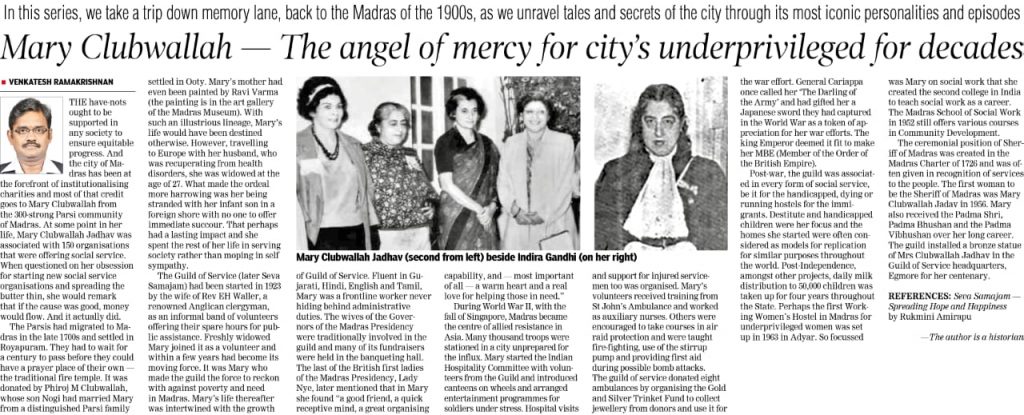
Born in 1908 into a rich Parsi family, Mary Clubwala Jadhav was raised strictly in the traditional way by her mother who taught her the values of caring and sharing. In 1926, she was married to Mr. Nogi Clubwala who encouraged her to involve in social activities. In 1937, Mrs. Mary Clubwala was made as the honorary secretary of the Guild of Service. In 1942, with World War II raging Mrs. Clubwala founded the Indian Hospitality Committee and persuaded women from all communities and walks of life to join in the effort to organise mobile canteens, hospital visits, diversional therapy and entertainment programmes for the army men.The victorious 14th Army presented her a Japanese sword in appreciation of her tremendous efforts. Mrs. Mary Clubwala was called “the Darling of the Army” by General Cariappa! After the War, her focus was once again on the Guild of Service which put down roots for various projects like health centres, bakery units, an adoption centre, family assistance schemes, Meals on Wheels, rural development projects, a school for the deaf, to name just a few.
Mrs. Clubwala’s concern for destitute children was responsible for starting the Seva Samajam Boys’ Home and the Seva Samajam Girls’ Home in Adyar in 1950. In 1954, she helped get started, through the joint efforts of the Guild and the Madras Rotary Club, the Bala Vihar in Kilpauk, a school for mentally challenged children. Perhaps Mrs. Clubwala’s most significant contribution was establishing the Madras School of Social Work in 1952 as the fourth social work institution in India and the first institution in South India. She had been honoured by the International Council of Social Welfare with the “Outstanding Service Award” at Hague in 1972. She has also been awarded the “Padma Shri” by Government of India. On 6 th February 1975, she breathed her last in Bombay after a surgery to fight cancer. Condoling her death, Mrs. Indira Gandhi mentioned that India lost an eminent social worker.